
-->

Wednesday, 4 January 2023

ZF and Beep to launch ‘several thousand’ autonomous shuttles in the US

ZF and Beep to launch ‘several thousand’ autonomous shuttles in the US

Automotive supplier ZF is partnering with autonomous shuttle operator Beep to deliver “several thousand shuttles” to customers over the coming years, ZF said at CES in Las Vegas.

Beep, which describes itself as an autonomous mobility-as-a-service company, will implement ZF’s next-generation, Level 4 autonomous shuttle, which the company also launched at CES today. Level 4 autonomy means the vehicle can drive itself without requiring the human to take over in most situations, as long as it’s within the vehicle’s operational design domain. ZF’s new shuttle, which will be built in partnership with AV software company Oxbotica, is designed for urban environments and mixed traffic, ZF said.

ZF’s previous shuttle model only drives in designated lanes. Those shuttles are currently deployed via ZF’s subsidiary 2getthere in Rottderdam and Masdar City, and ZF says it has clocked a total of 62 million autonomously driven kilometers in real traffic with more than 14 million passengers.

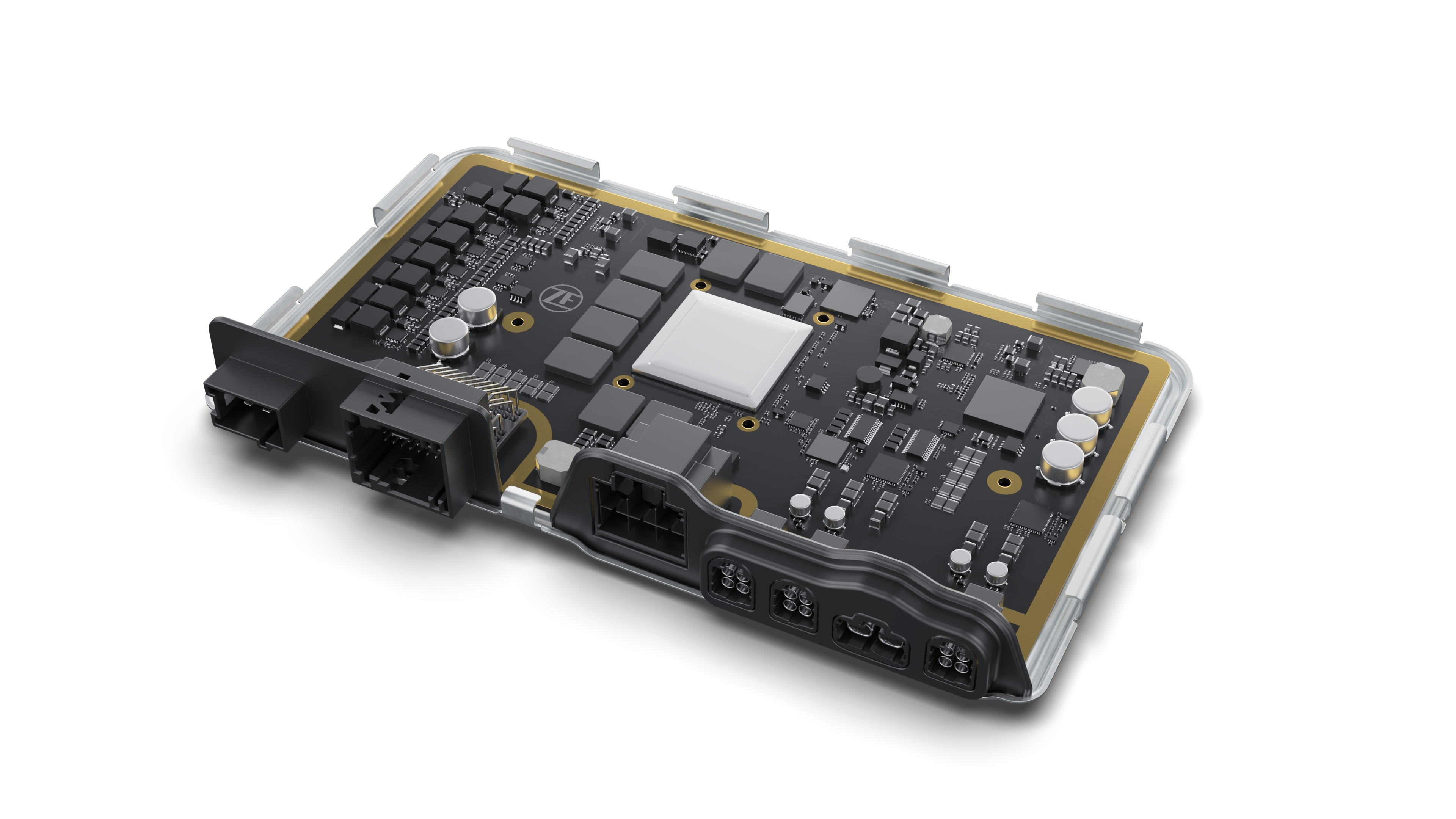
The new shuttle will implement other new technology that ZF unveiled in Las Vegas, including its ZF ProConnect connectivity platform, which enables communications with surrounding infrastructure and the cloud, and the ZF ProAI supercomputer, a device that can support advanced driver assistance systems (ADAS), infotainment and chassis functions. Those two platforms work together to enable ZF’s virtual driver, the company’s proprietary autonomous driving software stack.

The rise of electric vehicles has resulted in increased communication within the vehicle; everything from opening and closing windows to automated driving features to infotainment to passenger comfort is controlled via computers. Instead of piling electronic control units (ECU) — which historically have handled one function at a time — on top of each other, suppliers are converging them into so-called supercomputers. ZF’s Pro AI supercomputer combines multiple systems-on-a-chip (SoC) from different suppliers into one hardware unit that’s more efficient, takes up less space (the new ProAI is 12x6x6 inches) and eases supply constraints.

ZF’s ProAI supercomputer Image Credits: ZF

Nvidia, which is quickly garnering a reputation for handling all things compute in the software-defined vehicle, is seeing the need for a new piece of hardware, as well. The tech giant announced at CES it would work with Foxconn to build ECUs with Nvidia’s Drive platform, including its Orin SoC, effectively creating a supercomputer that can replace what would otherwise be a number of ECUs in a vehicle dedicated to different tasks, such as digital instrument cluster, in-vehicle parking and autonomous driving.

To handle so many complex tasks, ZF’s latest version of ProAI’s overall computing power can achieve up to 1,500 TOPS, which is a 50% increase from the company’s previous version. ZF said it has more than 13 million units already ordered and expects further growth in the future, with volume supply scheduled to start in 2024.

Bringing autonomy to public transportation

Rendering of interior of ZF's autonomous shuttle

Rendering of interior of ZF’s autonomous shuttle Image Credit: ZF

ZF’s shuttle will be able to carry 22 passengers, with 15 seated, according to ZF. The vehicle is Americans with Disabilities Act-compliant and includes an automatic ramp and wheelchair restraints. The shuttle will initially hit a max speed of 25 miles per hour, and in further development go up to 50 miles per hour, according to ZF. Customers can choose a battery capacity between 50 and 100 kWh, which will be able to cover up to 80 miles in pure electric mode.

The agreement between Beep and ZF aims to deliver several thousand shuttles over the next few years, with a market entry for ZF’s next-gen shuttle starting in 2025, and a ramp up of production in mid-2026, according to Torsten Gollewski, executive vice president of autonomous mobility systems at ZF.

Neither Beep nor ZF said where they would start deploying ZF’s shuttles, but Beep said It’s evaluating a number of possible sites.

“Beep has already been commissioned with concrete routes. We are currently working out the operational scenario. We will comment on this in more detail in due course,” Gollewski told TechCrunch. “Generally, we consider both scenarios for each potential customer depending on the route, as one of the advantages of our shuttle solutions is the ability to operate in mixed traffic as well as in dedicated lanes – depending on the kind of solution needed and the most efficient way of achieving that we can deliver the best option for a community and also link a rural community with surrounding larger cities.”

Most of Beep’s current deployments are along specific routes within closed campuses. For example, Beep provides a shuttle service in Lake Nona, Fla., within a 17-square-mile development that connects residential, commercial, retail, recreational and medical services. The company also recently partnered with Peachtree Corners, Ga., a 500-acre technology park, to test shuttles on a dedicated path along a main road connecting the hub.

“ZF’s full suite of shuttle services, its U.S. partner network and its automotive-grade vehicle complement our turnkey mobility networks and autonomous services technology platform,” said Joe Moye, Beep’s CEO, in a statement. “This shuttle will allow us to continue to pursue our vision of extending mobility equity and reducing carbon emissions, expanding our use cases while meeting industrial requirements for vehicle service life, performance and safety.”

Because ZF is an automotive supplier, the company said it offers Beep and any other future partners servicing and maintenance through its global network of 20,000 workshop partners. In North America, ZF has 3,000 workshop partners.

“As a technology leader, ZF sees itself not only as a shuttle supplier, but also as a partner for the entire lifecycle of its shuttles,” said Gollewski. “We offer not just the shuttle, but also services with its autonomous transport system, including fleet management, maintenance, repair and trainingTherefore, the partnership also includes a comprehensive service concept to ensure smooth operation and thus maximum uptime of the shuttles.”

Read more about CES 2023 on TechCrunch

ZF and Beep to launch ‘several thousand’ autonomous shuttles in the US by Rebecca Bellan originally published on TechCrunch


Samsung’s new washer captures microplastics from your dirty laundry

Samsung’s new washer captures microplastics from your dirty laundry

Unless you live in a natural fibers-only household, your laundry is likely exacerbating an environmental crisis with each wash.

The terrible microplastics mess we’re making — thanks in great part to the rise of synthetic clothing — apparently inspired Samsung to develop some new washing machine tech, which it called a “breakthrough in the fight against microplastics” today at CES 2023.

Specifically, Samsung is rolling out two new washing machine features — a plastic-catching filter that works with any washer and a specialized wash cycle that halved microplastic pollution in a Samsung-funded study. The tech giant says it worked with Patagonia for more than a year on the features, and claimed in a press release that they might “have a real impact on the health of aquatic ecosystems.”

Samsung’s “Less Microfiber” wash cycle

Here’s the rub: When your washing machine knocks your shirts and hoodies around, the friction causes synthetic materials like polyester to shed tiny threads, or microplastics. These teeny bits flow into the ocean through waste-water systems, and spread basically everywhere — in the air, sea turtle guts, our bodies, you name it. Though we don’t know exactly how harmful microplastics are to people, a recent analysis of 17 lab studies showed that microplastics can damage human cells and trigger allergic reactions, in addition to harming wildlife.

One company certainly won’t solve plastic pollution, but luckily other folks are working on this problem, too. Third-party filters and washing bags are two ways to reduce the environmental cost of washing synthetic materials, yet they’re no substitute for buying less or even ditching plastic clothes altogether.

Samsung’s new washer captures microplastics from your dirty laundry by Harri Weber originally published on TechCrunch


What Luminar’s acquisition of startup Civil Maps means for its lidar future

What Luminar’s acquisition of startup Civil Maps means for its lidar future

As lidar company Luminar pushed ahead to meet its goals for 2022 — milestones that included locking in new commercial contracts with unnamed automakers and shipping production-ready sensors to SAIC — it also snapped up a small HD mapping startup called Civil Maps.

The acquisition, which was disclosed Wednesday during Luminar founder and CEO Austin Russell’s presentation at CES 2023, is more than just a large publicly traded company taking advantage of a consolidating industry. Although the timing couldn’t have been better due to the current economic environment, according to Russell.

For Russell, the acquisition is part of Luminar’s longer term vision to be more than just a lidar supplier. Mapping, specifically the mapping tech that Civil Maps created, is foundational to that goal, Russell said.

Why maps? Russell believes that the company’s lidar sensor coupled with its perception software and HD maps will be essential to improving safety and capability of advanced driver assistance systems and automated driving features in vehicles.

“We have a vision to be able to create the first accurate, comprehensive, up-to-date map of the world in 3D,” Russell said Wednesday at CES 2023. “Civil Maps has leveraged lidar data to be able to collectively put together a very specific kind of compressed map that’s able to leverage crowdsource capabilities from multiple vehicles and put it together into a singular map solution. This is something that we believe will be hugely accretive to the foundation of what we built on the lidar.”

Integrating Civil Maps’ tech into Luminar’s lidar sensor, which also includes perception software, could be hugely valuable if deployed at scale, Russell contends. Luminar has announced a number of commercial wins in the past year. Its lidar sensor is going into production models made by SAIC and Volvo. It has also landed contracts with Nissan, Mercedes and Polestar. Based on its internal estimates, the company expects that by the second half of the decade (so after 2025) there will be more than 1 million Luminar-equipped vehicles out on the road.

“This is something, that for the first time, we’re going to get a truly comprehensive view of everything going on, an up-to-date map from around the world with vehicles contributing towards this holistic map,” Russell said on stage.

The acquisition, along with Luminar’s other 2022 purchase of laser chip company Freedom Photonics, is part of Luminar’s strategy to continue to “move up the stack,” according to Russell. In other words, Luminar wants to provide it all — or at least a lot — of what automakers need to sell vehicles equipped with next-generation automated driving features.

And based on today’s economics, Russell expects more acquisitions in 2023.

“In some cases, we’re talking about deals that are at 1/10 or the 1/20 of the price that people were hoping for in the prior year,” he said. Still, Russell cautioned that Luminar isn’t going to buy just any lidar or related tech company.

“It’s all about relative value, right?” he added.  “Obviously, we have to be very smart about this in this kind of market and be very conservative about what we do. So that’s why I really have that strict adherence to the 10x rule. If we think we’re only going to get a 2x value added something, we don’t do it.”

Read more about CES 2023 on TechCrunch

What Luminar’s acquisition of startup Civil Maps means for its lidar future by Kirsten Korosec originally published on TechCrunch


Daily Crunch: Salesforce CEO admits ‘we hired too many people’ as company lays off +7,000 employees

Daily Crunch: Salesforce CEO admits ‘we hired too many people’ as company lays off +7,000 employees

To get a roundup of TechCrunch’s biggest and most important stories delivered to your inbox every day at 3 p.m. PDT, subscribe here.

Hello, and welcome to the middle of the week. CES is starting tomorrow, so bookmark TechCrunch’s dedicated CES page to catch up on all the happenings. Now, onto the news!  — Christine

The TechCrunch Top 3

  • Another round of layoffs: Paul has the latest on what’s happening over at Salesforce. The company said it had to cut its workforce by 10% — approximately 7,000 people — and will close offices in several markets. He checked out Salesforce’s SEC filing related to the matter and reported that CEO Marc Benioff stated the layoffs were a result of hiring “too many people leading into this economic downturn we’re now facing.”
  • Not so happy new year: More privacy fines and corrective measures greeted Meta as the calendar flipped to a new year. The company was hit with over $410 million in new fines from the European Union due to the number of “General Data Protection Regulation (GDPR) complaints over the legal basis [Meta] claims [it has] to run behavioral ads,” Natasha L writes.
  • Get food, mail your packages: Now you can have your food and your packages too. DoorDash is launching a new service that will pick up prepaid packages and drop them off at a UPS, FedEx or USPS location, Aisha reports.

Startups and VC

It’s Autodesk’s turn for a competitor, and Snaptrude wants to be it. The startup took in some fresh venture capital to take on the design giant in the building design space, Jagmeet writes. Snaptrude wants to infuse better interoperability and cloud-based collaboration where others, like Autodesk, have lagged.

And we have four more for you:

  • App-solutely too slow: If your mobile app can’t keep up, customers may keep away. Product Science, which develops mobile app performance monitoring tools, landed $18 million to find flaws in execution to minimize app freezes and errors, Kyle writes.
  • It’s all so surreal: Also by Kyle, SurrealDB joins a crowded managed database service industry, raising $6 million for its database-as-a-service approach.
  • IP oh no: The market uncertainty that has plagued the online grocery delivery industry has caught up with South Korean grocery startup Kurly, which scrapped its IPO, Kate reports.
  • “There’s a great future in plastics”: Singapore-based AlterPacks took in $1 million in pre-seed funding to turn food waste into food containers, Catherine writes.

5 failure points between $5M and $100M in ARR

Tennis ball hitting the net on red court.

Image Credits: Javier Zayas Photography (opens in a new window) / Getty Images

Before Tracy Young was co-founder and CEO of TigerEye, she held identical roles at construction productivity software startup PlanGrid.

Even though she led the company to $100 million in ARR before its acquisition by Autodesk, “I’ve had years to dissect the mistakes I made with my first startup,” she writes in TC+.

Young looks back at “five key failure points” that are common potholes on every founder’s path and shares tactical advice for addressing internal conflict, losing product-market fit, and other stumbles.

“If these reflections help even one founder make one less mistake, I would consider this effort worthwhile.”

Two more from the TC+ team:

TechCrunch+ is our membership program that helps founders and startup teams get ahead of the pack. You can sign up here. Use code “DC” for a 15% discount on an annual subscription!

Big Tech Inc.

Roku is expanding its product line to include a range of 11 smart televisions that the company says it designed and built with its own services in mind, Sarah writes. And you won’t have to wait very long to get them — they will be available beginning in the spring.

Meanwhile, the TechCrunch team at the Consumer Electronics Show (CES) in Las Vegas filed 16 stories since yesterday evening. You can find all of them here, but I wanted to point out a few I’ve enjoyed reading so far:

And we have five more for you:

Daily Crunch: Salesforce CEO admits ‘we hired too many people’ as company lays off +7,000 employees by Christine Hall originally published on TechCrunch


Bankruptcy judge rules Celsius Network owns users’ interest-bearing crypto accounts

Bankruptcy judge rules Celsius Network owns users’ interest-bearing crypto accounts

A federal bankruptcy judge ruled cryptocurrencies deposited into interest-bearing accounts at Celsius Network, a now-bankrupt cryptocurrency lending platform, actually belong to the firm – thanks to the fine print.

The verdict gives Celsius ownership of the $4.2 billion in cryptocurrency that users deposited into its high-interest Earn program, according to a 45-page filing from the U.S. Bankruptcy Court Southern District of New York on Wednesday.

With the Earn program, Celsius allowed users to deposit cryptocurrencies like bitcoin, ether and tether and receive weekly interest payments. Depending on the time horizon and token, the platform offered as much as 18% interest annually.

Celsius had approximately 600,000 accounts in its Earn program, and the accounts held a collective value of approximately $4.2 billion as of July 10, 2022, the filing noted. About $23 million of that value consisted of stablecoins. But all of that is now property of the estate, aka Celsius, the judge ruled.

Thanks to Celsius’ “unambiguous” terms and conditions, any cryptocurrency assets – including stablecoins – that were deposited into Earn Accounts, became Celsius’s property, the filing stated.

Celsius, which was once one of the world’s largest crypto lenders, filed for bankruptcy protection in mid-July 2022. At the time, Celsius said it had anywhere between $1 billion and $10 billion in assets and liabilities and more than 100,000 creditors.

Prior to filing for bankruptcy, Celsius froze withdrawals for customers in June citing “extreme market conditions.” That freeze was never lifted. Now, the crypto assets held in those accounts are property of Celsius, the judge ruled.

This decision is a stark contrast from the argument thousands of Celsius customers have had in claiming that their deposited funds were, in fact, theirs. Last month, Celsius fought with customers in court over ownership of deposited funds as it wanted to sell about $18 million worth of stablecoins from Earn accounts to fund its organization. Now, Celsius can sell those assets.

And for those looking to fight the court ruling and get their funds back, it seems unlikely because “there simply will not be enough value available to repay all Account Holders in full,” the filing stated.

With bankruptcy proceedings, priority to receiving frozen funds is often given to secured creditors. But the filing deems account holders with the Earn program as unsecured creditors of Celsius, which means their recovery depends on the distributions to unsecured creditors under a Chapter 11 bankruptcy plan.

“If only some Account Holders prevail with their arguments that they own the cryptocurrency assets in their accounts, they hope to recover 100% of their claims, while most of the Account Holders are left as unsecured creditors and may recover only a small percentage of their claims.”

Going forward, this verdict can set a precedent for investors across the crypto industry and what one’s terms of use really means for people who deposit onto platforms. This could also point to what may happen with other Chapter 11 bankruptcy proceedings transpiring in the crypto space like FTX, Voyager and BlockFi, to name a few.

Bankruptcy judge rules Celsius Network owns users’ interest-bearing crypto accounts by Jacquelyn Melinek originally published on TechCrunch


Tuesday, 3 January 2023

Amazon secures $8B loan, anticipating market headwinds

Amazon secures $8B loan, anticipating market headwinds

Amazon has secured an $8 billion loan in anticipation of market headwinds.

Provided by DBS Bank, Mizuho Bank and others, the loan — which will mature in 364 days (January 3, 2024), with an option to extend for another 364 days — will be used for “general corporate purposes,” Amazon said in a filing with the U.S. Securities and Exchange Commission. In a statement, an Amazon spokesperson told TechCrunch that the loan adds to the range of financing options the company has tapped in recent months to hedge against the “uncertain macroeconomic environment.”

“Like all companies we regularly evaluate our operating plan and make financing decisions — like entering into term loan agreements or issuing bonds — accordingly,” the spokesperson said via email. “Given the uncertain macroeconomic environment, over the last few months we have used different financing options to support capital expenditures, debt repayments, acquisitions and working capital needs.”

Amazon’s income dipped toward the end of 2022 as the economy took its toll. The tech giant spent billions doubling the size of its fulfillment network during the pandemic, a play that served it well initially but which proved to be short sighted.

Amazon was forced to shut down or delay plans for over a dozen facilities as e-commerce sales last year grew slower than expected. Another headwind — soaring energy prices — impacted Amazon’s business in a major way, with the company’s spending on shipping climbing 10% to $19.9 billion in Q3 2022.

To cut costs, Amazon plans to reduce its workforce in early 2023, reportedly by as much as 10,000 employees. The layoffs, which would be the largest in the company’s history, are said to be concentrated in Amazon’s human resources, Alexa and retail divisions.

In other penny-saving measures, Amazon has frozen hiring for corporate roles in its retail business, shut down its Amazon Care telehealth service, closed all but one of its U.S. call centers, and scaled back Amazon Scout, its long-running delivery robot project. Those moves haven’t been enough to prevent the company’s market cap from falling below $1 trillion for the first time since April 2020.

Amazon had about $35 billion in cash and cash equivalents and long-term debt of about $59 billion at the end of the third quarter ended September 30, Reuters reports. For the first nine months of 2022, Amazon paid $932 million in cash paid of interest on debt, up from $731 million for the same period a year earlier; the interest rate spread on the new $8 billion will start at 0.75% before increasing to 1.05% if Amazon decides to extend the loan’s maturity.

Amazon secures $8B loan, anticipating market headwinds by Kyle Wiggers originally published on TechCrunch


New York’s right-to-repair bill has major carve-outs for manufacturers

New York’s right-to-repair bill has major carve-outs for manufacturers

During the lull between last Christmas and New Year’s, New York State became one of the first in the country to enact a “right to repair” law — albeit with amended language that some advocates say make the law toothless. Called the Digital Fair Repair Act and set to go into effect on July 1, New York’s regulation requires manufacturers to provide owners and independent repair shops the manuals, parts, diagnostics and diagrams necessary to repair consumer devices.

Which devices does the Digital Fair Repair Act cover, exactly? Well, a lot — any that constitute as “digital electronic equipment,” basically. But there are some carve-outs, including cars, home appliances, medical devices, off-road equipment and enterprise devices used by data centers, schools and hospitals.

The legislation only applies to gadgets manufactured after July 1, moreover, and it doesn’t require manufacturers to volunteer any security unlocking codes needed to repair a device. It also lets those same manufacturers decline to deliver specific components if they think “the risk of improper installation heightens the risk of injury.”

The bulk of those exceptions were added at the eleventh hour with the approval of Governor Kathy Hochul, who said in a statement that they’re intended to lessen the risk of security issues and physical harm while making repairs. Advocates like Louis Rossman, however, who runs a MacBook repair shop, expressed immediate skepticism, arguing that manufacturers will exploit the amendments to their own ends.

Representatives for Microsoft and Apple pressed Hochul’s office for changes, Ars Technica reported last year. So did industry association TechNet, which represents tech companies including Amazon, Google and TechCrunch parent Yahoo! The previous version of the bill received wide bipartisan support, passing the New York state assembly 147-2 and the senate 59-4, but sat on the governor’s desk for months.

“Such changes could limit the benefits for school computers and most products currently in use,” Public Interest Research Groups, a collective of consumer rights organizations, told Engadget in a statement last week. “Even more troubling, the bill now excludes certain smartphone circuit boards from parts the manufacturers are required to sell, and requires repair shops to post unwieldy warranty language.”

Rossman points out that under the Digital Fair Repair Act, companies like Apple will still be allowed to serialize components after a repair, preventing independent repairers from repairing devices with spare parts — even genuine parts removed from the same product. “[The] manufacturer will tell you that when you have a bad $28 chip on your motherboard that what you need to do is replace the $745 Motherboard,” he said in a video response to the law’s passage.

The Digital Fair Repair Act is among a raft of bills recently introduced in more than 40 states that aim to expand repair options for consumer devices. Supporters of the legislation say that a lack of documentation, poor spare parts access and software restrictions are limiting consumer choice. Manufacturers counter that authorized repairs are necessary to ensure quality and protect their intellectual property.

Last year, President Joe Biden signed an executive order that called on the U.S. Federal Trade Commission to ban “anticompetitive restrictions on using independent repair shops or doing DIY repairs of your own devices and equipment.” Anticipating new regulations, companies including Google, Apple, Samsung and Valve started providing repair manuals and selling parts for some of their products.

New York’s right-to-repair bill has major carve-outs for manufacturers by Kyle Wiggers originally published on TechCrunch


Daily Crunch: Reddit users discover Apple is raising its battery replacement service fees

Daily Crunch: Reddit users discover Apple is raising its battery replacement service fees

To get a roundup of TechCrunch’s biggest and most important stories delivered to your inbox every day at 3 p.m. PDT, subscribe here.

And we’re back! Well, just me for now anyway. Haje is covering CES, so if you are there, seek him out and say “Hi!” Thanks so much to Henry for conducting the Daily Crunch train last week. It was a joy to read it and hope you enjoyed it, too. It looks like we are back at it with a long list of news, so let’s get started. — Christine

The TechCrunch Top 3

  • It’s hard to pull the wool over Reddit users’ eyes: If you have an out-of-warranty Apple iPhone, iPad or MacBook, you might want to join Reddit. Users spotted, and quickly circulated, a change in the repair pages for those devices that stated battery replacement service charges would increase by up to $50 for these devices, Ivan reports.
  • Sit, Bonk, sit…good dog: Newly launched dog coin Bonk is being credited as having contributed to a spike in Solana’s price. The cryptocurrency’s prices had been volatile lately, Jacquelyn writes, following the whole FTX debacle.
  • TikTok forms its own “Adults Only” room: An ability to restrict TikTok livestreams to adult viewers is now something the social media giant is making available to creators for short-form videos, Aisha reports.

Startups and VC

Can co-CEOs work? If you’re a company with two founders looking for that advice, Becca and Darrell have a good Found podcast for you. This time they were joined by Brex co-founder and co-CEO Henrique Dubugras, who talked about not only the company’s corporate credit card and expense management startup, but also about what made him and his co-founder, Pedro Franceschi, decide to be co-CEOs.

And we have three more for you:

  • If 2022 were a headline…: Natasha M, Mary Ann and Alex solicited answers to that question and compiled a list of how you described the tech industry’s 2022.
  • Sharing economy, but for hospital rooms: HD is a Southeast Asia startup betting that matching demand with supply can also apply to vacant hospital rooms. Rita has more on how the company is doing this.
  • BharatPe CEO is out: Manish reports that BharatPe CEO Suhail Sameer plans to leave the India-based fintech at the end of the week. Though CFO Nalin Negi will jump into the role as interim CEO, the company is already on shaky ground: BharatPe sent its founder packing last year after it was discovered he was allegedly misusing company funds.

How to make the most of your startup’s big fundraising moment

Shot Of Loud Speaker On Wall

Image Credits: Anatolij Fominyh / EyeEm (opens in a new window) / Getty Images

No matter the size, early-stage investments are a sign of validation for any startup.

However, “when you see other companies raising hundreds of millions of dollars, it can be easy to think no one will be interested in hearing about your startup’s much smaller round,” writes Hum Capital CMO Scott Brown.

In this marketing playbook for early-stage startups, Brown explains how founders can use fundraising announcements to maximize media interest, comply with SEC guidelines and align more closely with investors to “get the most bang for their buck.”

One more from the TC+ team:

  • Greener pastures: Could climate be a safe investment right now? It seems so. Tim spoke to Union Square Ventures about its new $200 million fund and shares what USV plans to do in 2023.

TechCrunch+ is our membership program that helps founders and startup teams get ahead of the pack. You can sign up here. Use code “DC” for a 15% discount on an annual subscription!

Big Tech Inc.

If you were hoping for some Nvidia news today, boy, have we got you covered. Romain, Rebecca and Brian listened in on a CES virtual press conference so you didn’t have to. Some highlights include a lot of Nvidia’s tools going into cars: Mercedes will use Nvidia’s digital twin tech to modernize its factories, Foxconn’s EVs will be built with Nvidia’s self-driving toolkit, and Hyundai, BYD and Polestar are among carmakers that will use the company for its in-car gaming features. Meanwhile, Nvidia’s robot simulator adds human coworkers and Nvidia upgrades GeForce Now with RTX 4080 performance for premium users.

And we have five more for you:

Daily Crunch: Reddit users discover Apple is raising its battery replacement service fees by Christine Hall originally published on TechCrunch


Nvidia helps Hyundai, BYD, Polestar join the in-car gaming revolution

Nvidia helps Hyundai, BYD, Polestar join the in-car gaming revolution

Nvidia’s on demand cloud gaming service, known as GeForce Now, is headed to select Hyundai, BYD and Polestar electric vehicles, the company said Tuesday ahead of CES 2023 in Las Vegas. The announcement, while lacking details on timelines or vehicle models, is notable because it marks the first time Nvidia is expanding its GeForce Now service beyond phones, smart TVs and computers and into cars.

Nvidia’s in-car games offering comes as automakers sink more resources into so-called “software-defined vehicles,” in hopes of finding new sources of revenue beyond building, selling and financing cars, trucks and SUVs. While Tesla was the first to pioneer in-car gaming and recently added Steam games to its vehicles, other automakers have picked up the pace. A number of automakers, including Stellantis, announced at CES last year plans to add Amazon Fire TV streaming into upcoming vehicles. In October, BMW partnered with AirConsole to bring games to its BMW 7 series EVs this year.

One can see the appeal of integrating such entertainment with newer vehicles, particularly for electric vehicles. Have to wait 30 minutes to charge your car? Put your feet up and stream some Wheel of Time. Got hyper kids in the back of a long car ride? Distract them with Cyberpunk 2077 or The Witcher 3: Wild Hunt. Automakers and suppliers may also be looking towards to a future when driving tasks become more automated.

Danny Shapiro, Nvidia’s VP of automotive, told TechCrunch customers could stream games into stationary vehicles that are connected to WiFi or even cars in motion if there’s a high bandwidth connection. To make this happen, Nvidia leverages its large network of servers and partner networks around the world to enable game-playing in the cloud. Games are essentially being played on a server in one of Nvidia’s data centers and then streamed to someone’s device.

“It’s like Netflix but interactive,” Shapiro said in a recent interview. “It’s not just buffering content and sending it down. Somebody would have a gaming controller, and those button clicks are transmitted to the server. The game is played, rendered and then streamed back to the device. So there’s a lot of technology we’ve developed to basically reduce the latency and enable somebody to play a game in the cloud with the exact same experience as they would expect on their PC or running on their local TV.”

Hyundai, BYD and Polestar all rely on Nvidia’s Drive platform for infotainment and autonomous vehicle development, but GeForce Now is hardware agnostic, said Shapiro.

GeForce Now features more than 1,000 titles from leading PC game stores like Steam, the Electronic Arts app, Ubisoft, Epic Games Store and GOG.com, as well as free-to-play games like Fortnite, Lost Ark and Destiny 2, according to Nvidia.

Read more about CES 2023 on TechCrunch

Nvidia helps Hyundai, BYD, Polestar join the in-car gaming revolution by Rebecca Bellan originally published on TechCrunch


Solana price spikes as newly launched dog coin BONK gains community hype

Solana price spikes as newly launched dog coin BONK gains community hype

Last week, Solana (SOL) fell to its lowest level since February 2021. But its price has risen over 12% in the past 24 hours on Tuesday after almost nine days of consecutive losses that brought its price to around $8 on Friday.

Amid Solana’s movement, the two largest cryptocurrencies by market cap, bitcoin and ether, both shifted less than 1% in the past 24 hours, showing some stability.

Solana has been volatile for a number of reasons in recent weeks, including one of its most prominent backers being the now-disgraced former FTX CEO Sam Bankman-Fried and top NFT projects planning to leave its blockchain.

But some are crediting the recent spike to interest from Solana community members in Bonk (BONK), a new meme token that airdropped about 50% of its 56 trillion token supply to users last week. Airdropping is when a cryptocurrency sends a free supply of its token to a number of crypto wallets in a way to gain users or reward loyal community members. In this case, Bonk was airdropped to

“We’re here to reward everyone that made #Solana what it is today,” the Solana-focused dog coin tweeted about a month ago before gaining traction.

About 20% of Bonk’s total airdrop supply went to Solana NFT collections, which consisted of almost 300,000 individual NFTs. The shiba inu dog-themed cryptocurrency has risen about 96% in the past 24-hours, according to CoinGecko data.

Even some major Solana projects have considered (or did) adopt the newly launched token from large decentralized exchanges like Orca to NFT markets like Magic Eden.

While Bonk gains steam, it’s highly likely that it will have a similar fate to other meme or dog-focused crypto tokens that often see a pump, followed by a steep dump and little to no recovery. In the meantime, however, it has helped the Solana ecosystem gain momentum in a time when many crypto players saw it as a goner.

As there has been some slight recovery for Solana, its future remains uncertain even amid its dog coin-related hype. As of today, Solana has dropped from being the fifth-largest token in early November to 15th-largest and is the number one trending cryptocurrency on CoinMarketCap.

Solana price spikes as newly launched dog coin BONK gains community hype by Jacquelyn Melinek originally published on TechCrunch


Apple is increasing battery replacement service charges for out-of-warranty devices

Apple is increasing battery replacement service charges for out-of-warranty devices

Apple is increasing service charges for battery replacement of out-of-warranty iPhones, iPads, and MacBooks starting March 2023. The price rise ranges from $20 to $50 for different kinds of devices.

The change was spotted by Reddit users, who pointed out that Apple had silently mentioned this change on the repair pages for these devices.

The current out-of-warranty battery service fee will apply until the end of February 2023. Effective March 1, 2023, the out-of-warranty battery service fee will be increased by $20 for all iPhone models prior to iPhone 14,” the company mentions on the iPhone battery replacement and repair page

Here is a quick breakdown of the extra amount you will need to pay for battery replacement for a device that’s not covered by warranty starting in March:

  • iPhone 13 and prior: $20 (total price: $89)
  • iPad Pro 12.9” (5th generation and prior), iPad Pro 11” (3rd generation and prior), iPad Pro 10.5”, iPad Pro 9.7”, iPad mini (6th generation and prior), and iPad Air (5th generation and prior): $20 (total price: $99 to $119)
  • All MacBook Air models: $30 (total price: $159)
  • All MacBook Pro models: $50 (total price: $249)

For reference, iPhone 14’s battery’s battery replacement price is $99, which is higher compared to older models.

This change is global and local price rises may vary. For instance, the UK will charge GBP 20 for an iPhone battery change, while France will charge EUR 24.

The service charge increase won’t affect AppleCare or AppleCare+ subscribers or folks who rely on third-party repair services.

Notably, Apple opened up its self-service program for US-based iPhone users last April, which allows people to get and replace parts without any external help.

While the price increase in service charge for battery replacement is not ideal, it will still lease a new life to your device so you don’t have to spend money on a new gadget.

Apple is increasing battery replacement service charges for out-of-warranty devices by Ivan Mehta originally published on TechCrunch


Monday, 2 January 2023

What to expect from the creator economy in 2023

What to expect from the creator economy in 2023

Social media platforms and creator-focused startups haven’t looked too hot this year, as companies like Snapchat, Patreon, Cameo and Meta all waged layoffs along with the rest of the tech industry. YouTube ad revenue is declining, and creator funds for platforms like Pinterest have dried up.

It might seem like things are bad on the surface, but the creator economy is more than just a buzzword that’s losing interest among venture capitalists. Despite challenges on a platform level, creators are continuing to make a living outside of the bounds of traditional media and will only continue to grow in 2023.

Social media platforms will need to commit to creators (seriously, this time)

In my opinion, the biggest creator news in 2022 was YouTube’s announcement that it would include Shorts creators in the YouTube Partner Program, allowing shortform creators to earn ad revenue for the first time ever. Starting in early 2023, creators will be able to apply to the YouTube Partner Program if they meet a new Shorts-specific threshold of 1,000 subscribers and 10 million Shorts views over 90 days. As members of the Partner Program, these creators will earn 45% of ad revenue from their videos.

This is huge, because it’s an open secret that shortform video is hard to monetize. For example, TikTok pays creators through its Creator Fund, a pool of $200 million unveiled in summer 2020. At the time, TikTok said it planned to expand that pool to $1 billion in the U.S. over the next three years, and double that internationally. That might sound like a lot of money, but by comparison, YouTube paid creators over $30 billion in ad revenue over the last three years. As the pool of eligible creators becomes more saturated, creator funds are pretty useless — if you’re in TikTok’s creator program and have a video get 1 million views, you might be able to cash out for a small latte. So while these multi-million (or billion) dollar creator funds might seem like a beacon for creators, they don’t help too much. Most popular TikTokers make their money from sponsorships and off-platform opportunities, rather than from their videos.

TikTok has long been the dominant platform in short form video, while Snapchat, Instagram and YouTube largely copied the newcomer to keep up. But creators will finally be incentivized to flock to YouTube Shorts once they can actually earn ad money there. The best part? There has never been more pressure on TikTok to follow suit.

‘Creator Economy’ isn’t a buzzword

What’s a buzzword? You know it when you see it. It’s when Facebook rebrands to Meta and you suddenly get hundreds of emails about “the metaverse,” or when a crypto startup declares its commitment to fostering “community” just because it has a semi-active Discord server. You could also classify “creator economy” as a buzzword — I personally find myself cringe whenever I say it out loud, but I stand by the fact that it’s a much easier shorthand than saying “the industry in which talented people on the internet are leveraging social media audiences to develop careers as independent creatives.”

But all of these buzzwords actually represent real things. Yes, even the metaverse is a thing, though I’d argue we’re talking more about Club Penguin than whatever Mark Zuckerberg is into. The problem with buzzwords, though, is that they dilute real phenomena into fads that get further muddled by disconnected venture capitalists doubling down on the trend with over-enthusiastic investments.

On TechCrunch’s own Equity podcast last week, everyone’s favorite tweeter and brand new dad (!!) Alex Wilhelm reflected on a prediction he made last year.

“The passion economy isn’t sustainable,” he read, quoting his prediction from last year. “Nailed it! Who talks about creators these day? Nobody!”

I can forgive Alex because I do hate “passion economy” with the fire of an exploding supernova for each and every follower Khaby Lame has on TikTok. The term glorifies the relentless, soul-crushing hustle that people face while trying to “make it” in a field they love, while ignoring that industries that people pursue out of passion (art, non-profit work, politics) are often the most exploitative of all.

I think what Alex is getting at here, though, is that in 2021, venture capitalists poured money into the creator economy in the same way they pursued “trendy” tech like AI and web3. According to data retrieved from Crunchbase earlier this year, here’s the breakdown of creator economy funding for the first three quarters of 2022.

  • Q1: 58 rounds worth $343.2 million.
  • Q2: 42 rounds worth $336.0 million.
  • Q3: 19 rounds worth $110.2 million.

I don’t think this means that the creator economy is failing, though. It could just mean that the industry is correcting for over-investing in a bunch of creator-focused companies that creators didn’t actually want or need. Also, you know, the economy.

I’ve been saying for the entire past year that creator economy startups can only succeed if their foremost goal is truly to help creators. In 2021, a year when venture capital flowed like champagne at a Gatsby party, we joked that there were more creator economy startups than creators. But that’s a problem for investors, not creators, many of whom operate completely oblivious to the whims of a16z. It’s indicative of an environment that incentivizes tech moguls with no hands-on experience to try to solve problems of an industry that they don’t quite understand, and as a result, the space became deeply oversaturated. I cannot keep track of the number of companies I’ve encountered that attempt to automate the process of securing brand deals or help creators make white label products.

I’d go as far as to say that it’s bad for creators when there are too many startups angling for their partnership. We know that most startups are doomed to fail — what happens if you rely on a company to offer your business some sort of service, and then they fail within a few years? This is why I’ve made it a personal policy of mine to always ask creator-focused startup founders how they would plan to protect their creators from harm if their company fails.

No matter where the VC funds may fall in 2023, the playbook for creators’ success remains the same. Diversify your income streams, build trust with your audience, and make sure you don’t burn yourself out.

Venture capital will continue to intersect with creators, but not in the way you think

Investments into creator economy companies might be down, but creators are continuing to interface with VC money in a way that their audiences don’t often see. Charli D’Amelio and her family have become investors themselves. MrBeast is seeking funding at a unicorn-sized valuation, which isn’t surprising given that other especially successful creators have accomplished the same.

In less extreme cases, many creators are growing their businesses through startups like Creative Juice, Spotter and Jellysmack, which offer up-front cash in exchange for temporary ownership over a creator’s YouTube back catalog, which means the company gets all of the ad revenue from those videos. These companies operate similarly to venture capital firms. They invest in creators that they believe will turn that cash infusion into even more money, giving both parties a return.

Despite securing massive funding rounds and mammoth valuations, the model that these companies operate is still relatively new, and creators should exercise caution, as they should with any business deal.

What to expect from the creator economy in 2023 by Amanda Silberling originally published on TechCrunch


Yet another Zomato co-founder leaves the firm

Yet another Zomato co-founder leaves the firm

Zomato said on Monday its co-founder and chief technology officer Gunjan Patidar has left the firm, the latest in a series of departures at the Indian food delivery firm whose shares have lost over 57% of its value in the past year.

Patidar is the fourth co-founder to leave the firm. His departure also follows exits by Mohit Gupta, another co-founder, and two other senior executives last month.

“Patidar was one of the first few employees of Zomato and built the core tech systems for the Company. Over the last ten plus years, he also nurtured a stellar tech leadership team that is capable of taking on the mantle of leading the tech function going forward. His contribution to building Zomato has been invaluable,” the Indian food delivery firm disclosed in a stock exchange filing.

The exits come at a time when Zomato chief executive Deepinder Goyal, also a co-founder, is attempting to share and delegate top responsibilities with other executives. The company appointed four chief executives in August last year and rebranded its internal, broader organization as “Eternal.”

Yet another Zomato co-founder leaves the firm by Manish Singh originally published on TechCrunch


We need to destigmatize down rounds in 2023

We need to destigmatize down rounds in 2023

A new year is upon us, and with it comes uncertain, and uncomfortable, market conditions. Accompanying those conditions are equally uncomfortable decisions. For startup founders, determining which path is right for their business may require fundamentally rethinking the way they measure success.

The business climate in 2023 will be unfamiliar to many who founded a company in the past decade. Until now, a seemingly endless stream of relatively cheap capital has been at the disposal of any startup deemed by the VC world to have high growth potential. Everyone wanted a piece of “the next Facebook.” With interest rates near zero, the risks were relatively low and the prospective rewards were astronomical.

Burning money to chase growth became the norm; you’d just raise more money when you ran out. Debt? Who needs it! Existing investors were happy to play along, even if their share in the company was somewhat diluted — growing valuations kept everyone sated.

Over the years, this pattern of rapidly rising valuations and a pie growing fast enough to compensate for any dilution — fueled by “free money” that made almost any investment justifiable — crystallized into a mythology at the core of startup culture. It was a culture that nearly everyone, from founders and investors to the media, fed into.

Climbing valuations made for great headlines, which sent a signal, both to potential employees and the markets, that a company had momentum. High valuations quickly became one of the first things new investors looked to when it was time to raise additional capital, whether that was through a private round of funding or an IPO.

The funding route you take has enormous consequences for the future of your company; it shouldn’t be clouded by ego or driven by media appetites.

But tough economic conditions tend to dispel complacency with hard realities, and we’ll see reality checking in when it comes to funding this year. Amid rising interest rates and a generally negative macroeconomic outlook, the tap will run slowly –– or not at all. Equity financing is no longer cheap and plentiful, and as drought strikes, a sense of anxiety will grip founders. They can no longer burn cash without seriously contemplating where they’ll get more when it’s gone.

When that time comes, founders will be faced with a choice that could make or break their business. Do they turn to alternatives like convertible notes, or do they approach new investors for more equity funding? Tech stocks have been pummeled in the past year, which could mean their company’s value has taken a hit since the last time they raised capital, leaving them with the prospect of the dreaded “down round.”

It’s easy to see why down rounds seem out of the question for many startup founders. For starters, they’d face the flip side of the positive media mania, which risks eroding employee morale and investor confidence. In a culture where growing valuations are worn like a badge of honor, founders may fear that taking a down round would render them Silicon Valley pariahs.

Down rounds don’t spell the end of your business

The truth is, there’s no one-size-fits-all solution. The funding route you take has enormous consequences for the future of your company, and so it shouldn’t be clouded by ego or driven by media appetites.

We need to destigmatize down rounds in 2023 by Ram Iyer originally published on TechCrunch


Hear from Ecobee CEO and Founder at a special, in-person TechCrunch Live at CES

Hear from Ecobee CEO and Founder at a special, in-person TechCrunch Live at CES

Ecobee started in 2007 when connected thermostats were an entirely different product and nothing like what’s available today. Ecobee released its Smart thermostat in 2008, bringing modern connectivity and usability to the device. I’m excited to host a special irl TechCrunch Live event at CES 2023. We’re filming in the LVCC Grand Concourse on the first day of CES, and hope you can stop by to watch.

Stuart Lombard is sitting down with me to talk about the growth and development of his startup, ecobee. He started the company in 2007 with fellow Canadians to improve household energy use. He raised $159 million to fund the effort and sold the company for $750 million.

At TechCrunch Live, we host conversations with successful founders who took an interesting path, and Lombard journey is filled with twists and turns. The company raised its $2.23 million Series A in 2007, released its first product in 2008, and then in 2011, had to fight for attention after the sleek Nest Learning Thermostat release. Ecobee kept at it. In 2021, Generac Power Systems bought ecobee for $750 million.

This TechCrunch Live will be filmed at CES 2023, and it’s free to attend. Watch the broadcast at booth #60488, located in the LVCC Grand Concourse, at 11:00 on Thursday, January 5. The event will also be streamed live on TechCrunch.com, YouTube, Facebook, and Twitter.

TechCrunch Live returns to its normal, weekly schedule starting on February with Benchmark’s Sarah Tavel and Cambly CEO and co-founder Sameer Shariff.

Read more about CES 2023 on TechCrunch

Hear from Ecobee CEO and Founder at a special, in-person TechCrunch Live at CES by Matt Burns originally published on TechCrunch


How to make the most of your startup’s big fundraising moment

How to make the most of your startup’s big fundraising moment

Late-stage startups are facing major fundraising headwinds, but early-stage investing is still a bright spot for startups until they hit Series B rounds.

Traditional venture capital dollars are harder to come by these days, but institutional investors are still looking for smart investments, and industry watchers are hungry for the good news a new round of financing suggests. While the market is uncertain, founders need to be ready to use their capital infusions as an asset that extends beyond the cash it represents.

In any market environment, a fundraising event can act as a vote of confidence or validation from investors, supporting your company’s growth via talent acquisition and brand awareness. No matter the size of the round, securing external investment is a key milestone in many companies’ journeys, and it often takes a tremendous amount of effort. However, after putting all that work in, many founders make the mistake of letting a funding moment pass by without extracting all the value they could have.

Over the course of my 20+ years as a marketing leader at startups, venture capital firms and large tech companies, I’ve helped dozens of companies announce funding news, ranging from $1 million pre-seed rounds to $50 million raises.

Here’s my playbook for founders looking to make their “big money” moments go farther:

Rethink assumptions about fundraising news

Publicizing funding news lets you create incremental value beyond the capital investment by highlighting your momentum and driving brand awareness.

Founders may overlook the value of announcing funding news for several reasons, but the biggest one is assuming the round isn’t “big enough” to warrant attention. When you see other companies raising hundreds of millions of dollars, it can be easy to think no one will be interested in hearing about your startup’s much smaller round.

Fortunately, that isn’t true. While big numbers may draw splashy headlines, smaller rounds can still drive interest if the announcement is executed well and you can connect the news with some larger industry/technology/societal trend.

Another reason founders hesitate is if all or part of the new capital is through a debt investment. Though it’s becoming more common, especially as VC investors pump the breaks, there is still some stigma around debt funding, and founders may worry they’ll be penalized for adding debt to their balance sheets.

However, securing a debt investment often requires even more rigor than an equity investment, so highlighting a debt raise can actually indicate your business’ fundamentals and revenue numbers are strong enough to support repayment.

Founders may also worry about giving competitors too much information about their business and prefer to make progress while flying under the radar. There are benefits to keeping certain information under wraps, but it’s important not to get so focused on building behind closed doors that you miss the opportunity to get more visibility with the prospects and partners that will drive revenue.

Finally, funding announcements are sometimes just not at the top of a founder’s long to-do list, largely because they are either unsure of how to run an announcement or lack the marketing expertise to execute it effectively. This next section should help on that front.

Three steps to maximize the marketing value of your fundraise

The future is unknown, so when you have a funding round locked up and cash in the bank, you have the opportunity to make the biggest impact you can with the news you have in hand.

To leverage this moment and be successful you need to:

Step 1: Plan ahead

Preparing for a fundraising announcement takes time and strategic thinking. As soon as you’ve reached the point in your investor conversations where term sheets are a likely next step, you should assemble your marketing team to start working on a plan. This includes aligning with your investors early about their ability to participate in a news announcement.

Some key questions your marketing lead should consider include:

  • Who can offer public quotes or commentary on the investment?
  • What are the key messages you would like to communicate about this round and what messages would you like your investors to amplify?
  • When is the investor available to review announcement materials and participate in potential media interviews?

    How to make the most of your startup’s big fundraising moment by Ram Iyer originally published on TechCrunch


Sunday, 1 January 2023

India set an ‘incredibly important precedent’ by banning TikTok, FCC Commissioner says

India set an ‘incredibly important precedent’ by banning TikTok, FCC Commissioner says

India set an “incredibly important precedent” by banning TikTok two and a half years ago, FCC Commissioner said, as he projected a similar fate for the Chinese giant Bytedance app in the U.S.

Brendan Carr, Commissioner of the FCC, warned that TikTok “operates as a sophisticated surveillance tool,” and told the Indian daily Economic Times that banning the social app is a “natural next step in our efforts to secure communication network.”

The senior Republican on the Federal Communications Commission said he is worried that China could use sensitive and non-public data gleaned from TikTok to “blackmail, espionage, foreign influence campaigns and surveillance.”

“We need to follow India’s lead more broadly to weed out other nefarious apps as well,” he said.

Carr’s remarks further illustrates a growing push among U.S. states and lawmakers that are increasingly growing cautious of TikTok, which has amassed over 100 million users in the nation.

India has banned hundreds of apps, including TikTok, PUBG Mobile, Battlegrounds Mobile India and UC Browser, with affiliation to China in the past two years amid skirmishes at the border of the two neighboring nations.

New Delhi said it had banned the apps because they posed threats to the “national security and defence of India, which ultimately impinges upon the sovereignty and integrity of India.”

TikTok had over 200 million monthly active users in India and counted the South Asian nation as its largest international market by users prior to the ban.

“India’s strong leadership has been informative and helpful as we have debated banning TikTok in the US,” Carr told the Indian paper (paywalled). “For those who argue that there is no way to ban an app, India is an example of a country that has done it and done it successfully.”

The U.S. House banned TikTok on all House-managed devices last week, citing a “high risk due to a number of security issues.” The move followed nearly two dozen states at least partially blocking the app from state-managed devices over concern that China could use it to track Americans and censor content.

“If you look at the history of TikTok’s malign data flows and its misleading representations, I don’t see a path forward for anything other than a blanket ban working,” he told the newspaper.

India set an ‘incredibly important precedent’ by banning TikTok, FCC Commissioner says by Manish Singh originally published on TechCrunch