Showing posts with label NEWS. Show all posts

Thursday, 16 March 2023

5 strategies for biotech startups to outlast a market downturn

5 strategies for biotech startups to outlast a market downturn

Founders in the biotech industry are no strangers to challenges. Success is impossible to come by without substantial investment, time, and technical expertise. Although life science startups managed to come out relatively unscathed last year, the enduring economic climate is turning fundraising into a never-ending marathon. Inflationary market dynamics and ongoing fiscal tightening continue to pose significant risks to capital commitments. A successful raise in 2021 feels like ancient history.

As a venture capitalist specializing in early-stage life science companies, I work with startups that have the potential to revolutionize the world against biothreats, pandemics and more. Every day I see new biotechnology that inspires my team and our investors to put capital to work. Many of these startups were well-capitalized last year but are now facing difficulties as they look to raise.

To ensure survival, it’s essential to explore alternative funding methods rather than relying solely on classic fundraising. This is especially true for biotech startups, where investment needs are higher and success timelines can be much longer.

If you’re an entrepreneur in the biotech industry, it could be time to make practical pivots to ensure your company can thrive. Here are five strategies that could help your biotech startup navigate a cooling fundraising environment:

To ensure survival, it’s essential to explore alternative funding methods rather than relying solely on classic fundraising.

1. Set lower fundraising goals

During an economic downturn, trying to raise a large sum might not be feasible, and the time and resources you invest in fundraising could be better used on key business initiatives. By raising less, you can prioritize your survival, conserve your most valuable resource (time), and keep your focus on meeting near-term inflection points. With a smaller pool of investors, you can also maintain a stronger influence over your company’s strategy.

2. Target experienced investors

When raising, it’s crucial to focus on building relationships with investors who share your vision and can offer more than just capital. Investors who have experience in your industry can provide valuable guidance and connections that can help you navigate challenges and take advantage of opportunities — this type of investor is valuable in a downturn since they can advise you on technology-specific strategies.

5 strategies for biotech startups to outlast a market downturn by Jenna Routenberg originally published on TechCrunch


SVB collapse forces African startups to rethink their banking options

SVB collapse forces African startups to rethink their banking options

The collapse of Silicon Valley Bank (SVB) last week sent ripples in startup ecosystems around the world, and it is emerging that millions of dollars held by African startups and venture capital funds at the bank were at stake, until the U.S. Federal Reserve acted to save the day.

In the wake of the bank’s collapse, founders in Africa have been forced to review their banking options to cushion their startups from such eventualities. Nala, a U.K.-based and Africa-focused mobile money transfer startup that managed to pull its funds out of SVB before it collapsed, told TechCrunch it’s exploring partnerships with new large corporate banks, while the Pan-African fund Future Africa, which suffered “minimal exposure” also hinted that it was keen on opening an account with a global banking institution.

“We’ve gotten inbound outreach by several banks…but you know banks always like to know a lot of information about companies, their revenue, the amount of cash the company would hold with them, and so on to bring them on board,” said Nala CEO, Benjamin Fernandez.

The impact of the collapse has been far-reaching that even unaffected entities are exploring more safeguards. Jumba, a Kenyan construction tech startup, is looking to diversify its deposit holdings, with co-founder Kagure Wamunyu telling TechCrunch the startup is opening an additional account with a “bigger bank” in the U.S. This comes as more startups increasingly prefer holding their funds in multiple bank accounts in big financial institutions, which are generally perceived to be safer.

African startups impacted by SVB collapse

It is not yet clear how many African startups and VCs were affected by SVB’s collapse. A widely circulated report from the due diligence company Castle Hall showed that several funding vehicles for African startups, including 4DX Ventures, banked with SVB before it went bust; it’s unclear if they were affected.

Meanwhile African fintech unicorn Chipper Cash was also among several startups that could not access a portion of their funds. TechCrunch also learned of a Dutch wealth manager offering Egyptian startups investment banking and corporate services, including opening an SVB account; according to this report, about 50 tech firms were affected.

A significant amount of venture capital that African startups raise comes from US-based investors, who mandate that these startups domicile the funds in U.S. bank accounts. They have until now recommended SVB because of its history with tech businesses and the incentives and benefits the bank provides to startups that are hard to find in other financial institutions.

Fernandez said the bank provided cash management features alongside better interests on deposits and cheaper wire transfer fees than its counterparts – services that would be costlier for an African startup to access in bigger institutions.

The lender also provided loans, which many startups are unable to get in conventional banking institutions owing to their high-risk profile.

Just last year, SVB was a strategic partner of the International Finance Corporation (IFC) and US-based fund manager Partners for Growth (PFG), entities that provide debt capital to early- to mid-stage companies in emerging markets.

Such incentives for high-risk businesses are among the reasons startups domiciled in other parts of the world held accounts at SVB, according to Deepak Dave, an analyst at Toronto-based Riverside Advisory.

“We don’t have (in Africa) a financial system that is remotely mature enough to deal with startup financing. The reason that SVB can do loans in the U.S. is that the range of assets that has value in those countries is very different from ours, assets like half-created IP can even have a valuation to it. That is simply out of the question over here. First of all, almost certainly, the IP won’t even be licensed to the startup; it will have been licensed to an offshore vehicle controlled by the VC investors,” said Dave.

“Not only do we not have banks that are mature enough to do it, but we also don’t have a regulator who will understand what this type of lending is. They won’t have as deep a financial relationship with institutions here. But they can have a transactional relationship in institutions based here,” said Dave.

However, according to founders who spoke to TechCrunch, including those who even got accepted into accelerators like Techstars and Y Combinator, setting up an SVB bank account for their startups wasn’t a walk in the park. They cited reasons ranging from not meeting specific criteria such as SSN and proof of address in the U.S. to citizenship status and lack of SVB operations in Africa. As such, they turned to platforms such as Brex and Mercury, which recently expanded its FDIC insurance to $3 million, to carry out banking transactions.

“If you want US-based banking, which does instill credibility (still) with investors, those are your options,” said Stephen Deng, co-founder and managing partner at Africa-focused early-stage VC firm DFS Lab. “I think what changes is that founders must know how they manage counterparty risk. Sweep networks, and treasury management, are all top of mind.”

For an African startup, banking with such platforms is dicey as they can be unpredictable. Last year, Mercury restricted accounts linked to African tech startups, including those backed by Y Combinator. An event like this comes down to regulatory grey zones where banking-as-a-service platforms are beholden to KYC/KYB requirements of their partner banks and transactions from emerging markets are viewed as “high-risk.”

Founders say this event – which frequently occurred last year – and the SVB fiasco have reinforced the need to build homegrown solutions (Float is an example.) But that itself comes with its challenges, said Deng. “The further you move away from the service provider, the harder it becomes to have nuance around risk related to ‘Africa.’ The deposit base resulting from African tech is likely not large enough for those bank providers to make modifications to their KYC/KYB controls.” 

Read more about SVB's 2023 collapse on TechCrunch

SVB collapse forces African startups to rethink their banking options by Annie Njanja originally published on TechCrunch


Bing said to remove waitlist for its GPT-4 powered chat

Bing said to remove waitlist for its GPT-4 powered chat

Microsoft’s Bing is enjoying the spotlight for the first time in a decade after it released a GPT-powered interface last month. But the tech giant has so far been cautious about the pace at which it is making the new Bing offering — powered by  OpenAI’s GPT-4 tech — available to users. But it appears, Bing is bringing those walls down.

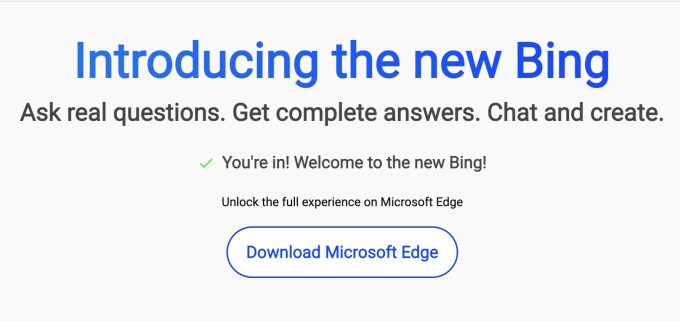
Microsoft, a major investor in OpenAI, appears to have lifted the waitlist from the new Bing, ostensibly allowing anyone to gain instant access to the new experience. Windows Central, which first spotted this change, said users don’t have to wait to try out the new Bing anymore. TechCrunch tested this with a few email IDs (both new and old) and got access instantly. However, not all email IDs we tested got access instantly.

Image Credits: Screenshot by TechCrunch

While the new Bing’s landing page still shows the typical “Join the Waitlist” button, you can sign in and get access instantly. We have asked Microsoft for a comment and will update the story if we hear back.

Microsoft is holding an event called “reinvent productivity with AI” later Thursday at 11 am ET. While today’s agenda is limited to introducing AI-powered tools for Microsoft 356 (Office) and Dynamic 365 — the company’s Salesforce competitor — it won’t be surprising if there is an announcement related to Bing as well.

The Seattle-based company is racing to integrate the AI-powered chatbot into many of its services. Last month, Microsoft introduced the GPT-4 powered bot to Windows 11’s taskbar. Earlier this week, Edge browser’s stable version got the Bing AI chatbot feature.

The OpenAI’s tech is proving to be a hit for Bing, which recently reported reaching 100 million daily active users. This is expected given the hype around AI-powered chatbots and how it has attracted tens of millions of users who wish to give it a whirl. After people were able to “jailbreak” the chatbot into saying problematic things, Microsoft started testing various restrictions on the conversations. Earlier this week it raised the limit to 15 turns in a conversation and 150 messages per day.

Bing said to remove waitlist for its GPT-4 powered chat by Ivan Mehta originally published on TechCrunch



Wednesday, 15 March 2023

IT-as-a-Service startup Deeploi raises €3M

IT-as-a-Service startup Deeploi raises €3M

Deeploi, a Germany-based startup that is building an IT-as-a-Service platform, today announced that it has raised a €3 million seed funding round led by Berlin’s Cherry Ventures, with participation from a group of angels that includes the founders of Taktile, Moss, Vay and sennder.

The company was founded by Julian Luebke and Philipp Hoffmann. Luebke got his start at Rocket Internet and then later joined real estate startup McMakler as its first employee, focusing on operations. Hoffmann, meanwhile, founded an IT company ten years ago, which started out as a traditional IT service provider and then moved toward becoming a managed service provider with a focus on Apple’s platforms. For that, Hoffmann also created the company’s own mobile device management system (MDM).

“I thought it might be a very cool thing to connect everything — to have everything in one platform and automate everything,” Hoffmann explained. “Then I met Julian and I realized that this could work very, very well. I had the idea. I had the expertise — and we have Julian for scaling the business.”

The founders describe Deeploi as an all-in-one IT platform that combines standard IT functions and the company’s premium support with IT agents to answer support calls. The team will cover everything from onboarding, support, endpoint management, network management and offboarding. For its security offering, Deeploi will partner with a cybersecurity company.

“The main difference to a lot of the existing business models is that we offer the companies IT as a service,” explained Luebke. “The companies don’t have to build up an IT department by themselves. We can take these functions over completely — or we can boost existing setups if they actually have already set up an IT department. They can use our platform and they can also use our premium support, for example, and we can take over easy, repetitive, redundant tasks for them.”

Because Deeploi can pull in data from existing systems (say HR) and then integrate this into its platform, it can also help businesses automate a lot of functions. When a new employee gets onboarded in an HR system, for example, the company can then automatically send out a new Macbook to them and set up access to certain SaaS tools.

Luebke noted that modern, cloud-native companies with modern tech stacks are Deeploi’s ideal customers, including brand agencies, marketing firms and D2C companies. For the time being, the company plans to focus on the Western European market, where it is now starting to test its service with a select number of users. The plan is to launch the platform to a wider audience in June.

“Once we have established market dominance in Western Europe and have really built out our product then we don’t really see any limiting factors of going to the US,” said Luebke.

IT-as-a-Service startup Deeploi raises €3M by Frederic Lardinois originally published on TechCrunch


The FTC finalizes Epic’s $245 million settlement over sketchy Fortnite purchases

The FTC finalizes Epic’s $245 million settlement over sketchy Fortnite purchases

The Federal Trade Commission slammed Epic Games with $245 million in fines this week, ordering the Fortnite developer to compensate consumers who made unwitting purchases in its digital store. The settlement, first announced back in December, is now finalized.

“Fortnite’s counterintuitive, inconsistent, and confusing button configuration led players to incur unwanted charges based on the press of a single button,” the FTC wrote in the announcement. The complaint also criticized Epic for allowing underage players to make frictionless, unauthorized purchases without sign off from their parents.

The $245 million settlement — a huge number but one that doesn’t top the regulator’s $5 billion fine against Facebook in 2019 — will go toward refunding customers. The FTC order will also require Epic to discontinue its use of “digital design tricks” like dark pattern design, obtain affirmative consent for digital purchases and it will block the company from locking the accounts of customers who dispute charges for digital goods and services.

The latest settlement, now finalized, follows another massive $275 million in fines that the agency proposed in December over the company’s handling of accounts for Fortnite players under the age of 13. The FTC alleged that Epic ran afoul of the Children’s Online Privacy Protection Act (COPPA) by collecting full names and contact information from children without parental consent. That settlement also cited Epic’s decision to launch Fortnite without parental controls and special protections for the young users who comprise a large swath of its player base.

“The Justice Department takes very seriously its mission to protect consumers’ data privacy rights,” Associate Attorney General Vanita Gupta previously said of the dual settlements. “This proposed order sends a message to all online providers that collecting children’s personal information without parental consent will not be tolerated.”

In early December, just prior to the FTC announcement, Epic announced that it would introduce a new account type designed to protect younger players. That feature, called “cabined accounts,” was added into Fortnite, Rocket League and Fall Guys — three popular online multiplayer titles from the game maker.

“All players globally will be asked to provide their date of birth at log in,” Epic wrote in a blog post at the time. “If someone indicates they are under 13 or their country’s age of digital consent, whichever is higher, their account will be a Cabined Account and they will be asked to provide a parent or guardian’s email address to begin the parental consent process.” Until they obtain parental consent, chat, digital purchases and some other features are disabled for cabined accounts.

Protections relying on users self-reporting their own age are an imperfect solution at best. But gaming and social media companies alike have yet to craft systems that concerns over kids’ safety (and the ensuing regulatory risks) while still allowing young users access to the online virtual spaces where they will inevitably wind up spending time.

Epic games like Fortnite are already well established among young users, but the company is apparently doubling down on the youngest subset of those players. Last year, Epic announced a partnership with LEGO to build “an immersive, creatively inspiring and engaging digital experience for kids of all ages to enjoy together” — a metaverse collaboration that could give rival Roblox a run for its money.

The FTC finalizes Epic’s $245 million settlement over sketchy Fortnite purchases by Taylor Hatmaker originally published on TechCrunch


Dear Sophie: How can I return to the United States as a founder?

Dear Sophie: How can I return to the United States as a founder?

Here’s another edition of “Dear Sophie,” the advice column that answers immigration-related questions about working at technology companies.

“Your questions are vital to the spread of knowledge that allows people all over the world to rise above borders and pursue their dreams,” says Sophie Alcorn, a Silicon Valley immigration attorney. “Whether you’re in people ops, a founder or seeking a job in Silicon Valley, I would love to answer your questions in my next column.”

TechCrunch+ members receive access to weekly “Dear Sophie” columns; use promo code ALCORN to purchase a one- or two-year subscription for 50% off.


Dear Sophie,

I lived and worked in the United States on an L-1B for a year, and then changed to an H-1B for 2.5 years before I moved back to India (where I’m a citizen) and founded a startup.

Now I want to return to the U.S. to raise funds for my startup. What are my options for returning to the U.S. as a founder?

— Fast-Moving Founder

Dear Fast-Moving,

Congratulations on launching your own venture and making the move to jump back to the States to expand your startup and secure investors! I recommend working with an immigration attorney to determine the best options based on your long-term goals, as well as a corporate attorney to discuss the best structure for your startup’s U.S. entity to make it attractive to investors. Most U.S. investors prefer to invest in a parent company based in the U.S. that’s a Delaware C corporation.

Depending on which non-immigrant visa you pursue, you may be able to avoid having to go through an in-person consular interview through the end of this year since you went through the interview process for your L-1B intracompany transferee specialized knowledge worker visa. The U.S. Department of State extended the visa interview waiver program until the end of this year. Consular officers have the discretion to waive the visa interview requirement for certain work visas like the O-1A and H-1B if the beneficiary was previously issued a visa and has never been refused one. Unfortunately, the interview cannot be waived for the L-1 visa.

You have a few visa options to return to the U.S. as a founder, so let’s dive in!

A composite image of immigration law attorney Sophie Alcorn in front of a background with a TechCrunch logo.

Image Credits: Joanna Buniak / Sophie Alcorn (opens in a new window)

B-1 visa

If you want to set up your startup’s U.S. entity, find office space, or meet with prospective investors, you can do that on a B-1 visitor visa for business. The B-1 will enable you to enter the U.S. and stay for up to six months. However, you cannot do any work while on a B-1. Your immigration attorney can tell you what activities are allowed.

When you arrive in the U.S., be prepared that the U.S. Customs and Border Protection officer at the airport may ask you what business activities you intend to do during your stay.

While you’re in the U.S. on a B-1 you can change your status to one of the visas below without leaving the U.S.

Dear Sophie: How can I return to the United States as a founder? by Walter Thompson originally published on TechCrunch


Tuesday, 14 March 2023

Krafton backs Indian influencer marketing platform One Impression in $10M funding

Krafton backs Indian influencer marketing platform One Impression in $10M funding

One Impression, an Indian influencer marketing platform that does business in markets including Indonesia, Dubai, Europe and the U.S., has raised $10 million in a funding round led by the South Korean gaming company Krafton.

The Gurugram-based startup is building an Amazon-like platform to help brands quickly find relevant influencers for their marketing campaigns. It touts having more than 7 million content creators on the platform that brands ranging from FMCG to e-commerce can access. These creators include the micro-ones developing content from villages and tier-2 and tier-3 towns, as well as large celebrities and even Bollywood actors that generate more than 100,000 content pieces for more than 500 brands in over 10 languages. The platform is also not limited to influencers from a particular genre and has creators in comedy, beauty, fashion and DIY, among other fields.

“We ensure the right pricing for every influencer, and as a platform, we ensure that as a brand, you get the best match and the best price for every creator that you work with,” said Apaksh Gupta, co-founder and CEO, One Impression, in an interview with TechCrunch.

Founded in 2018 by Gupta and his brother Jivesh Gupta, One Impression works directly with content creators, agencies and agents to offer brands a range of influencers to fit their requirements. This is unlike a traditional influencer marketing agency or a creator discovery tool, where you typically find just a single source to pick. Also, the startup offers full-stack solutions ranging from discovery, pricing and payments to compliance, government contracts, delivery and performance tracking.

“We’re bridging the gap between brands and creators. We’re trying to make the partnerships between brands and creators the most seamless, fastest, repeatable and scalable,” the executive said.

One Impression co-founders

One Impression co-founders Jivesh Gupta (left) and Apaksh Gupta (right) Image Credits: One Impression

In addition to helping brands reach the right influencer, One Impression is building tools for creators to help them monetize their content and unlock opportunities to collaborate with other creators and make finance easier using automation. The startup is also working on tools to let creators easily access studios across India and even get PR opportunities, said Gupta.

Currently, One Impression has enabled its platform for Instagram and YouTube. It also plans to unlock it for LinkedIn and Moj in India and TikTok for global markets over time.

“As different platforms continue to become important for any market, we’ll continue to integrate those new platforms into our platform,” Gupta said.

One Impression takes a fee from brands for connecting them with influencers and charges commissions to content creators that grow once the creators become more relevant for large-scale campaigns. This makes it a two-sided marketplace for both brands and creators. It is also working on launching premium tools to offer brands a subscription-based model for regular earnings.

The Krafton-led, all-equity Series A funding round also saw participation from Peer Capital. It valued the startup at $70 million post-money.

On whether the investment coming from Krafton was strategic, Gupta told TechCrunch that the gaming giant has come as a financial investor.

“The creator ecosystem is at the cusp of a revolution. It holds massive untapped potential, and we believe that One Impression is rightly positioned to be a global leader of the influencer industry. One Impression has an ambitious vision for the space, and we are delighted to support them in their journey,” said Sean Hyunil Sohn, CEO of Krafton India, in a prepared statement.

Since 2021, Krafton has invested over $100 million in various Indian startups to become more than a gaming company. However, the company has faced the banning of its widely popular gaming title Battlegrounds Mobile India (BGMI) in the country — just months after it struggled to bring its original PUBG Mobile title back that also got banned by the Indian government in 2020 over national security concerns.

“At Krafton, we are committed to the Indian market and see tremendous potential here. We have invested around $100 million in various Indian startups since 2021. And our investment in One Impression is a step towards augmenting this ecosystem and creating opportunities of growth,” Sohn said.

One Impression, which claims to have created a profitable business without marketing, plans to utilize the fresh funds to build a marketing team and scale its sales team to expand its presence in global markets, starting with Southeast Asia and the UAE. It also looks to make acquisitions in Dubai to boost its market presence. The planned expansion is projected to help the startup grow its average revenue rate to $40 million.

In 2022, One Impression raised $1 million from angels, including Peeyush Bansal of Lenskart, Anupam Mittal of People Group and celebrities such as Olympian Neeraj Chopra and comedian Zakir Khan, among others.

Krafton backs Indian influencer marketing platform One Impression in $10M funding by Jagmeet Singh originally published on TechCrunch