Remember, you can send me tips, suggestions and feedback to kate.clark@techcrunch.com or on Twitter @KateClarkTweets. If you don’t subscribe to Startups Weekly yet, you can do that here.
Uber Head of Payments Peter Hazlehurst addresses the audience during an Uber products launch event in San Francisco, California, on September 26, 2019. (Photo by Philip Pacheco / AFP) (Photo credit should read PHILIP PACHECO/AFP/Getty Images)
The sheer number of startup players moving into banking services is staggering,” writes my Crunchbase News friends in a piece titled “Why Is Every Startup A Bank These Days.”
I’ve been asking myself the same question this year, as financial services business like Brex, Chime, Robinhood, Wealthfront, Betterment and more raise big rounds to build upstart digital banks. North of $13 billion venture capital dollars have been invested in U.S. fintech companies so far in 2019, up from $12 billion invested in 2018.
This week, one of the largest companies to ever emerge from the Silicon Valley tech ecosystem, Uber, introduced its team focused on developing new financial products and technologies. In a vacuum, a multibillion-dollar public company with more than 22,000 employees launching one new team is not big news. Considering investment and innovation in fintech this year, Uber’s now well-documented struggles to reach profitability and the company’s hiring efforts in New York, a hotbed for financial aficionados, the “Uber Money” team could indicate much larger fintech ambitions for the ride-hailing giant.
As it stands, the Uber Money team will be focused on developing real-time earnings for drivers accessed through the Uber debit account and debit card, which will itself see new features, like 3% or more cash back on gas. Uber Wallet, a digital wallet where drivers can more easily track their earnings, will launch in the coming weeks too, writes Peter Hazlehurst, the head of Uber Money.
This is hardly Uber’s first major foray into financial services. The company’s greatest feature has always been its frictionless payments capabilities that encourage riders and eaters to make purchases without thinking. Uber’s even launched its own consumer credit card to get riders cash back on rides. It’s no secret the company has larger goals in the fintech sphere, and with 100 million “monthly active platform consumers” via Uber, Uber Eats and more, a dedicated path toward new and better financial products may not only lead to happier, more loyal drivers but a company that’s actually, one day, able to post a profit.
The TechCrunch team is heading to Berlin again this year for our annual event, TechCrunch Disrupt Berlin, which brings together entrepreneurs and investors from across the globe. We announced the agenda this week, with leading founders including Away’s Jen Rubio and UiPath’s Daniel Dines. Take a look at the full agenda.
This week on Equity, I was in studio while Alex was remote. We talked about a number of companies and deals, including a new startup taking on Slack, Wag’s woes and a small upstart disrupting the $8 billion nail services industry. Listen to the episode here.
Equity drops every Friday at 6:00 am PT, so subscribe to us on iTunes, Overcast and all the casts.
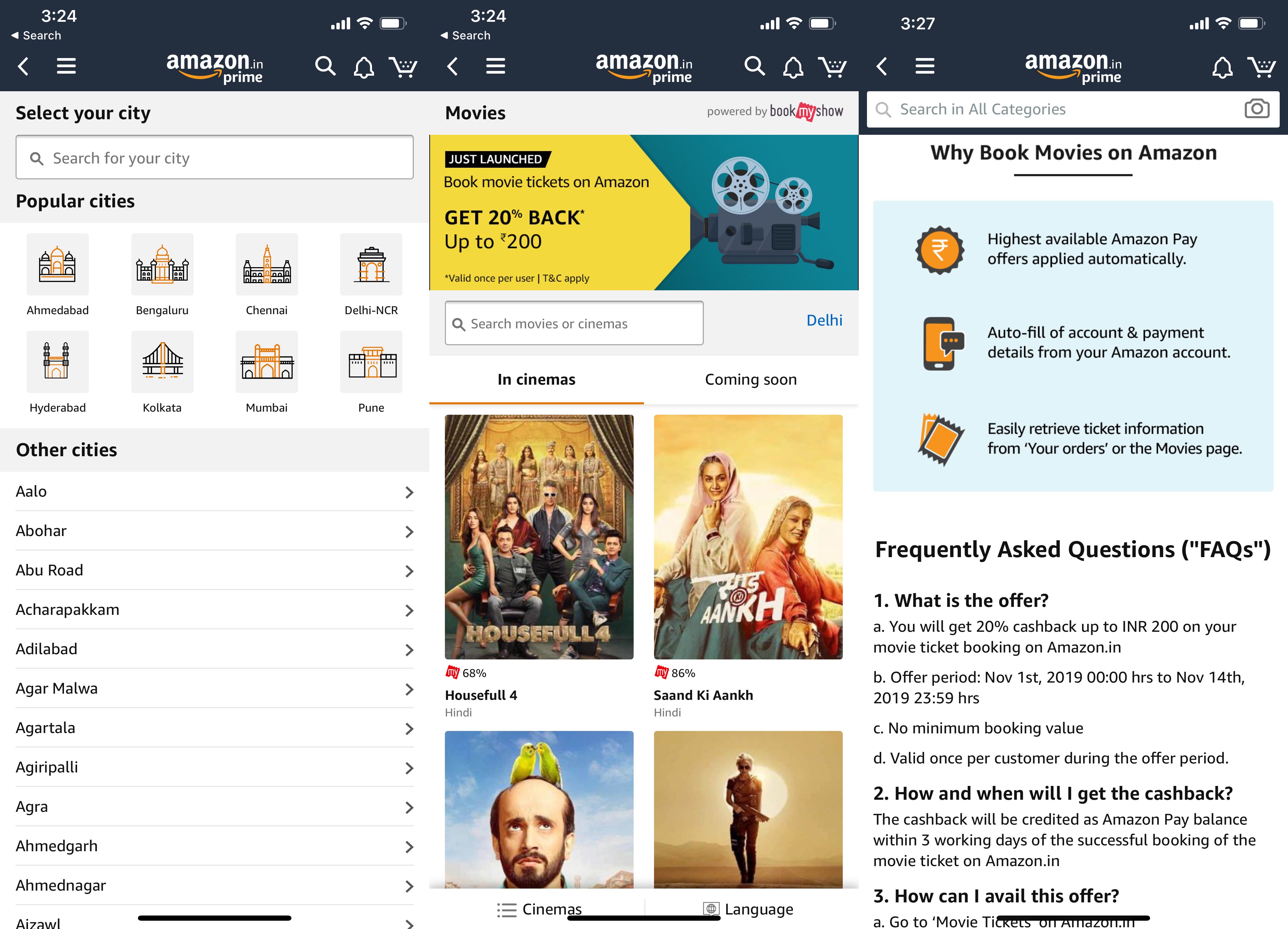
Amazon has set its eye on the next business it wants to disrupt in India: online movie tickets. The e-commerce giant said Saturday it has partnered with online movie ticketing giant BookMyShow to offer booking option on its shopping site and app.
Starting today, Amazon users in India can book their movie tickets from the “movie tickets” category under “shop by category” or the Amazon Pay tab, the e-commerce firm said. BookMyShow, which leads the online movie ticketing market, is the exclusive partner for this new offering, the two said.
Neither of the parties disclosed the financial arrangements of the deal, but BookMyShow is likely paying Amazon a fee for tapping “millions” of customers the e-commerce giant has amassed in the country.
Amazon said its credit card users in India will get a 2% cashback on each movie ticket purchase. On its app, the company adds until November 14. it will also offer cashback of up to Rs 200 on each ticket purchase.
For its flight ticketing service, Amazon India partnered with Cleartrip. Balu Ramachandran, SVP at Cleartrip, told TechCrunch in an interview earlier that the company was paying a promotional fee to Amazon, but declined to offer specifics.
An Amazon India spokesperson declined to comment on the financial arrangements.
BookMyShow, which employs 1,400 employees, sells about 15 million tickets each month. The service, which has a presence in over 650 towns and cities, today counts heavily-backed Paytm as one of its biggest rivals. Paytm, which entered the movie ticketing business three years ago, has been able to eat some of BookMyShow’s market share by offering cashback on each ticket purchase.
The media and entertainment business in India is worth $23.9 billion, a report from EY-FICCI said in March this year, which noted that consumer spendings on the web is increasingly growing. More than 50% of all tickets sold by the top four multiplex chains in the country have occurred on the web.
Ashish Hemrajani, founder and CEO of BookMyShow, said through the partnership the company will be able to access Amazon India’s “deep penetration across tier 2 and tier 3 cities.”
Mahendra Nerurkar, Director of Amazon Pay, said today’s partnership shows Amazon’s commitment to “simplify the lives of our customers in every possible way — as they shop, pay bills, or seek other services.”
Last month, Amazon introduced a new feature that allows Amazon Pay users to pay their mobile, internet, and utility bills. This is the first time Amazon is offering these functionalities in any market (it plans to bring this to the U.S. in coming months).
Amazon has been quietly expanding its payments offering, built on top of UPI payments infrastructure, in the country. Unlike its global rivals Google and Walmart that offer standalone apps for their payment services and also focus on transactions among customers, Amazon has kept Pay integrated with its e-commerce offering and focused on consumer-to-business transactions.
The company maintains tie-ups with several popular Indian online services and frequently offers cashback to incentivize users to pick Amazon Pay over other solutions. Earlier this week, Amazon pumped about $634 million into its India business.
Google has been working on autonomous vehicles — one of the biggest challenges in AI — for more than a decade, but it’s learning that the hardest part might just be getting people to enjoy the ride.
“This is an experience that you can’t really learn from someone else,” Waymo’s Director of Product Saswat Panigrahi told TechCrunch, while explaining the work he oversees on user experience (UX) development. “This is truly new.”
The sheer novelty of designing a UX for driverless mobility has drawn Waymo away from hard science-based technologies where tech giants often feel most comfortable. In the place of data, sensor and neural net development, Waymo finds its driverless development gated by painstaking research into human factors and behavioral psychology. Despite making critical decisions to avoid delving into the mysteries of human behavior and interactions, Waymo is finding that such research is an unavoidable challenge on the road to driverless mobility.
“User research has always been a big part of the development process,” said Ryan Powell, the company’s head of UX Research and Design.
In 2012, when the Google Self-Driving Car program was “dogfooding” a highway-only driver assistance system called “AutoPilot,” its in-car cameras found that employees were over-relying on the limited automation in dangerous ways. As a result of videos showing Googlers putting on makeup, using multiple devices and even falling asleep while using the system that they’d been told required constant observation, the decision was made to cancel AutoPilot product plans and focus on fully autonomous driving. “That was a big moment for the user research team because we had a big impact on the work that we were doing at Waymo in terms of making that commitment to Level 4 autonomy,” Powell recalls.
According to people with knowledge of the company’s plans, the new funding could range from $50 million to as much as $100 million.
The money would be used to scale up the company’s collagen manufacturing capacity as it preps for the longterm Gelita contract.
Geltor is one of a slew of companies developing technologies to culture proteins at scale as a way to supplement and ultimately replace animal-based proteins in manufacturing.
While other companies pursue meat replacements using cultured products, Geltor is focused on another aspect of the supply chain. The collagen and gelatin additives that are typically made from the waste materials left over from the meat industry.
Traditionally, gelatin is made by boiling skin, cartilage, and bones from animals. The material finds its way into any number of cosmetics and foodstuffs thanks to its ability to act as a thickening agent.
The markets for collagen and gelatin are worth a combined $9 billion dollars, which is a pretty sizable market for Geltor to tackle.
Just as importantly, should the meat replacement industry take off, then replacements will need to be found for the secondary markets that had been supplied by the waste streams for traditional meat processing.
Geltor already sells an animal-free collagen under the “Collume” brand as a marine collagen and “HumaColl21”, which is a human collagen. Both products are used in the skincare market.
The agreement with Gelita marks the company’s first move into food and beverage additives.
“Gelita’s decision to invest in biodesign technologies is a prime example of our commitment to innovation and satisfying market needs,” said Hans-Ulrich Frech, Gelita’s Global Vice President of Business Unit Collagen Peptides in a statement last month. “This addition to GELITA’s collagen portfolio will complement the already robust portfolio of scientifically substantiated Bioactive Collagen Peptides®, which are key ingredients in foods and nutritional supplements for their protein content and physiological benefits.”
Meanwhile, for Geltor, the deal further proves out the company’s thesis that protein manufacturing can be a big business outside of the meat market that attracted players like Memphis Meats, Future Meat Technologies, and other companies developing cell culture replacements for traditional animal husbandry.
“This pact further solidifies our view that we have entered a new era in how proteins are being utilized to improve products that consumers around the world use every day,” said Alexander Lorestani, the chief executive of Geltor in a statement. “Today, the market is ready and eager for premium offerings of protein ingredients, and this is the need that Geltor is serving.”
In January 2014, Google announced plans to acquire Nest for $3.2 billion; the acquisition was completed the following day, but since then, Nest’s integration has been a controlled burn.Initially, the company existed as a subsidiary of the newly-formed Alphabet Inc., but in early 2018, Google tightened its grip and integrated it directly into its hardware division.
Over the next year and a half, Nest became the face and name of Google’s smart home offering, a division that’s grown quickly as Google Home/Google Nest has become one of the top two players in the U.S. smart home category, rivaled only by Amazon’s Alexa/Echo offerings.
All the while, wearables have been an also-ran: Google has clearly had an interest in the category, launching Android Wear in 2014. The company partnered with some of consumer hardware’s biggest names, including Motorola, Asus, Sony, Huawei and LG, but to little fanfare. A year ahead the release of Android Wear (now Wear OS), Apple brought its own smartwatch to market, effectively leaving the competition in the dust.
The Apple Watch would soon eclipse the rest of the wearable industry; numbers from Canalys in August 2019 show Apple at 37.9 percent of the total North American wearable band market. Fossil, the only Wear OS partner to crack the top five, is in a distant fifth, with 4.1%.
Samsung and Garmin have found success with their own offerings, but both are far behind Fitbit at second place. Founded in 2007, Fitbit would eventually become synonymous with fitness trackers. A humble startup when it showcased its first product (an eponymous 3D pedometer) on stage at our TC50 event in 2008, Fitbit’s rise has been an unqualified success.
Fitbit predicted and eventually came to define the wearable zeitgeist, finding itself at the forefront of the next big wave in consumer electronics after the smartphone. As the mobile category has plateaued, wearables continue to grow at an impressive pace.Let’s take a moment to appreciate what has been an impressive run.
The last few years, however, have been far rockier as Fitbit stumbled and sputtered. By CEO James Park’s own admission, the company failed to embrace smartwatches quickly and fully enough, and as it has so many times in the past, Apple entered and dominated the space, leaving Fitbit reeling with an uncertain future.
Google has reached into parent company Alphabet’s $121 billion cash reserves to spend $2.1 billion on Fitbit, a move into the key consumer health market that places them in more direct competition with rival Apple.
For more than a year, Ftibit and Google have partnered on healthcare applications; last April, Fitbit announced that it would work with Google’s application programming interface to connect data with electronic medical records via Google’s Cloud Healthcare API. That move followed Fitbit’s February 2018 acquisition of Twine Health, which gave the wearables company a consumer health platform which complied with existing federal regulations.
“Working with Google gives us an opportunity to transform how we scale our business, allowing us to reach more people around the world faster, while also enhancing the experience we offer to our users and the healthcare system,” said Fitbit CEO and co-founder James Park at the time of the 2018 Google partnership.
Companies throughout the healthcare industry are pushing to get closer to patients, and wearables have opened a new window into their health. Additionally, the technology can potentially encourage patients to pursue preventive healthcare measures, rather than seeking care after they’re ill.
“All of us… we’re pursuing the same thing,” said a prominent healthcare executive at a multinational medical device manufacturer. “We see a healthcare system that’s highly inefficient with a lot of waste that is very much episode-related, where we all know health is dynamic and continuous.” Gaining “better insight into health and disease drivers and interventions at the right place and the right time is the holy grail.”
Privacy concerns abound
The biggest challenge for Alphabet and Google with this acquisition is privacy; the company has already faced massive criticism for its push into healthcare in the U.K. regarding concerns about how it would handle sensitive health information. The technology industry’s habit of releasing minimum viable products doesn’t work in an industry where complications can literally become a matter of life and death.
Sensing inevitable concern around Google’s upcoming access to a bevy of health data, Rick Osterloh, Google’s SVP for devices and services, offered that the company will not use user information for advertising. “We will never sell personal information to anyone,” he wrote. “Fitbit health and wellness data will not be used for Google ads. And we will give Fitbit users the choice to review, move, or delete their data.”
Competition with Apple
Those privacy concerns stand in direct contrast to the obvious competitor driving this acquisition forward — Apple. The Cupertino-based king of consumer hardware has set itself apart from other consumer tech companies through its professed emphasis on privacy, a position that Apple will likely leverage further as it continues to make deeper forays into health.
The mobile version of Nintendo’s iconic racing franchise, Mario Kart Tour, will soon support multiplayer races, bringing the game closer to its competitive roots. A limited multiplayer beta test is planned for December, just in time for holiday laziness, but only for paying subscribers — the rest of us will have to wait.
Mario Kart has had a focus on multiplayer since its first (and best, in my opinion) appearance on the SNES, with multiple modes available pitting players together in real time. So despite Mario Kart Tour’s general excellence as far as gameplay and variety, players have been disappointed by the lack of that core aspect of the game.
Sure, you can post high scores and best times, but that’s nothing compared with the feeling of coming from behind in a hard-fought race and beating out half a dozen tough competitors.
Well, players will soon have that opportunity — if they happen to be Gold Pass subscribers. That’s the subscription tier that gives access to extra content in the “free to start” game, and will be a requirement to join the beta
Naturally this will provoke ire among players who feel they are owed not just a free game, but a free game that gives them everything they want for free. And in fact they may eventually get that, but it’s probably smart for Nintendo to limit this experience at first to paying customers so they can stress-test, balance gameplay, and so on. A subpar multiplayer experience is a good way to turn off otherwise interested players.
Still, this feeds into a larger dissatisfaction among gamers with Nintendo’s online and multiplayer strategy. The subscription service required for many popular games on the Switch comes with a selection of Nintendo and Super Nintendo Games, but beyond that the benefits are minimal and features standard on other platforms for years — voice chat, for instance — are absent or long in coming.
At only $20 a year it’s hardly a big investment, but subscription fatigue is growing among tech-savvy consumers and they are cutting things out where they can. Hopefully Nintendo’s offering will solidify and survive.
The Daily Crunch is TechCrunch’s roundup of our biggest and most important stories. If you’d like to get this delivered to your inbox every day at around 9am Pacific, you can subscribe here.
Google will pay $7.35 per share for the wearables company — an all-cash deal that values Fitbit at $2.1 billion.
While Google has invested plenty in its own in-house development, buying Fitbit represents a step-change, and the opportunity to take advantage of years of effort focused specifically on the wearables category.
At launch, you’ll find “The Morning Show,” “See,” “For All Mankind,” “Dickinson,” “Snoopy in Space,” “Ghostwriter” and “Helpsters,” as well as the documentary feature “The Elephant Queen” and the talk show “Oprah’s Book Club.” Some of these offer the first three episodes at launch, while others include the full season.
Sidewalk Labs and Waterfront Toronto (the regulatory body overseeing the project) have come to an agreement that will limit the scope of the Sidewalk development — intended as a proving ground for the latest thinking in sustainable design — and make the company work more closely with oversight agencies on the construction of the 12-acre parcel.
The company, which has been flying demonstration flights with passengers on board for a while now, is gearing up to launch its first commercial service in Guangzhou after getting approval from local and national regulators to deploy its drones in the area.
This is the largest investment to date in the Japanese financial tech industry, according to data cited by Paidy, and brings the total investment the company has raised so far to $163 million.
Climate risk including extreme events and the related pressures our environment are fundamentally affecting the way business and governments operate – both tactically and strategically. Increasing climate volatility is causing food supply disruptions, and increasing pressure on Enterprises (including financial institutions, insurers, producers) to disclose what’s going on.
The trouble is, while there is a lot of data about all this, its complexity, incompleteness and sheer volume is too vast for humans to process with the tools available today. So just as the climate changes, we are faced with ‘data chaos’. Equally, other parts of the world suffer from data scarcity, making it much harder to provide useful and timely analysis.
So the challenge is to address these issues simultaneously. So a new startup, Cervest, has created an AI-driven platform designed to inform the decision-making capabilities of businesses, governments and growers in the face of increasing climate volatility.
Cervest, has now closed a £3.7m investment round to fund the launch of its real-time, climate forecasting platform.
The round was led by deep-tech investor Future Positive Capital, with co-investor Astanor Ventures. The seed-stage funding round brings the company’s total funding to more than £4.5m.
Built on three years of research and development by a team of scientists, mathematicians, developers and engineers, Cervest says its Earth Science AI platform can analyze billions of data points to forecast how changes in the climate will impact the future of entire countries right down to individual landscapes.
It does this by combining research and modeling techniques taken from proven Earth sciences – including atmospheric science, meteorology, hydrology and agronomy – with artificial intelligence, imaging, machine learning and Bayesian statistics.
Using large collections of satellite imagery and probability theory, the platform can identify signals, or early-warning signs, of extreme events such as floods, fires, and strong winds. It can also spot changes in soil health, and identify water risk.
Cervest says the platform could do such things as reveal to a multinational the optimum location to build a new factory; warn a wheat grower that their crop yield isn’t expected to meet its targets; or used by insurers to help them set premiums for the next 12 months.
The team comes from a network of more than 30 universities, including Imperial College, The Alan Turing Institute, Cambridge, UCL, Harvard and Oxford, and has published more than 60 peer-reviewed scientific papers.
A beta version of the platform is due to launch in Q1 2020.
Iggy Bassi, Founder & CEO, Cervest said: “Our goal is to empower everyone to make informed decisions that improve the long-term resilience of our planet. Today decision-makers are struggling with climate uncertainty and extreme events and how they are affecting their business operations, assets, investments, or policy choices.”
Sofia Hmich, Founder, Future Positive Capital said: “With reports suggesting we have fewer than 60 years of farming left unless drastic action is taken, the need for science-backed decisions could not be greater. Businesses and policymakers hold the key to change and with access to Cervest’s proprietary AI technology they can start to make that change a reality at low cost – before it’s too late.”
Bassi previously ran the impact-led agribusiness, GADCO, which was supported by Acumen Fund, Soros, Gates Foundation, World Bank, and Syngenta. Its impact featured in UNDP, World Economic Forum, FT, Guardian and Huff Post. He previously built a software company focused on data analytics.
Cervest was inspired by Bassi’s experience building a farm-to-market agribusiness whilst confronting first-hand the impacts of climate and natural resource volatilities.
The Cervest team includes 8 scientists and 4 PhDs. Between them, they have published more than 60 peer-reviewed scientific papers with more than 3000 citations in high-profile titles including Nature, Proceedings of the National Academy of Sciences and The Royal Statistical Society.
MIT’s Computer Science and Artificial Intelligence Laboratory has come up with a clever way for its small cube-like robots, which can move on their own, to communicate and coordinate with one another for self-assembly. The behavior is described by MIT researchers as somewhat ‘hive-like,’ and in the video above you can see what they mean by that.
These cube bots can roll across the ground, navigate up and across each other, and even jump short distances. And thanks to recent improvements made by the team working on the project, they can also communicate in a basic way using unique barcode identifiers on the faces of the blocks to allow them to identify one another. These 16 blocks can now use their communication system and their ability to move themselves around to perform tasks including producing various shapes, or even following arrows or light signals.
Their current abilities are pretty limited, but the researchers envision a time when a larger and more advanced version of this system could be use to deploy efficiently self-assembling bots that can create structures like bridges, ramps or even staircases for use in disaster response or rescue scenarios. Of course, they also theorize these things might be pretty attractive for more mundane applications like gaming, too.
Perhaps best known for a career-making seed investment in Snapchat, Lightspeed partner Jeremy Liew is a leading investor across media and entertainment, making bets on startups like Cheddar, Giphy, HQ, SpecialGuest, Mic, Beme, Playdom, Duta and Flixster.
I spoke to him earlier this week about how he assesses the market for media startups, which led into a discussion about “always-on” forms of entertainment that add stimulation to a person’s environment, instead of commanding their full focus.
Here’s the transcript of our conversation, edited for length and clarity:
Eric Peckham: Do you have a consistent framework for evaluating potential investments?
Jeremy Liew:Our perspective is that consumer technology is now more about the consumer side than the technology side. It’s really more about pop culture than new innovations in technology.
When we are assessing a consumer investment we ask ourselves, “does this have the potential to become part of pop culture?” One way to think about it is whether people who don’t use the product will still become familiar with what it is. Like how you can understand a reference to “Game of Thrones”even if you don’t watch it.
Another key question is, whether there is a scalable, repeatable way for the product to reach its audience. That can be advertising, it can be word of mouth, it could be through social channels.
We also asked ourselves, “is this product going to build a new habit?” and we assess whether the entrepreneur has a unique insight into both why this is happening and why it’s happeningnow.
Your colleague Alex Taussig told me you have an overarching “future of TV” thesis that’s guided a number of your investments. Tell me about that thesis and how it filters opportunities in the media & entertainment space for you.
I think you can split what used to be called TV into two core use cases: “TV as entertainment” and “TV as company.”
“TV as entertainment” is most of what Netflix, Amazon, Apple, HBO, and similar companies have been focused on. It is high-production quality entertainment you have to pay attention to. Think shows like “Game of Thrones,” “Succession,” “Orange is the New Black.”
Then there’s another classic category of TV — “TV as company,” which is stuff that’s on while you’re doing something else. You’ve got the morning show on while you’re getting the kids ready for school or you’re getting ready to go to work. That’s how you get the five hours of TV viewing per day that Americans average.
TV as entertainmenthas to be so good that you choose to watch it over doing anything else;TV as companyyou just have to not choose to turn it off.
The vast amount of attention to the move to video — with subscription video on-demand (SVOD) and so forth — has been onTV asentertainment.There are hit shows that will attract people to Netflix, or to HBO Go, to Disney+. But what causes them to stay as a subscriber after they binge-watched all the way through the stuff that brought them in the first place?
That tends to be theTV as companycontent. If you actually look at hours watched in television, no one is tuning in to catch the latest episode of “Shark Week” — it is just what’s on. Think about the TV Guide grid: every genre, every channel will likely have a mobile native equivalent.
Some of these already exist. ESPN — it’s a channel where men watch the best competitors in the world play the sports they used to play when they were in high school and then they talk about it with their friends. Twitch is a place where men, mostly, watch the best competitors in the world play the games they used to play when they were younger and talk about it with their friends.
We’ve known for a while now that Google was bringing the “Incognito mode” concept to Maps, allowing you to run searches and find routes without them automatically being tied to your account history.
If you’ve been digging around trying to find the option without any luck, you weren’t just missing it. Though first mentioned back in May at Google I/O, the company says the rollout is just now officially underway.
It’s a staged rollout, so don’t be surprised if you don’t see the new feature immediately even if you’re on the latest version of maps. It’s rolling out in batches, beginning with Android users. Google says it should be available to all Android users in “the next few days.”
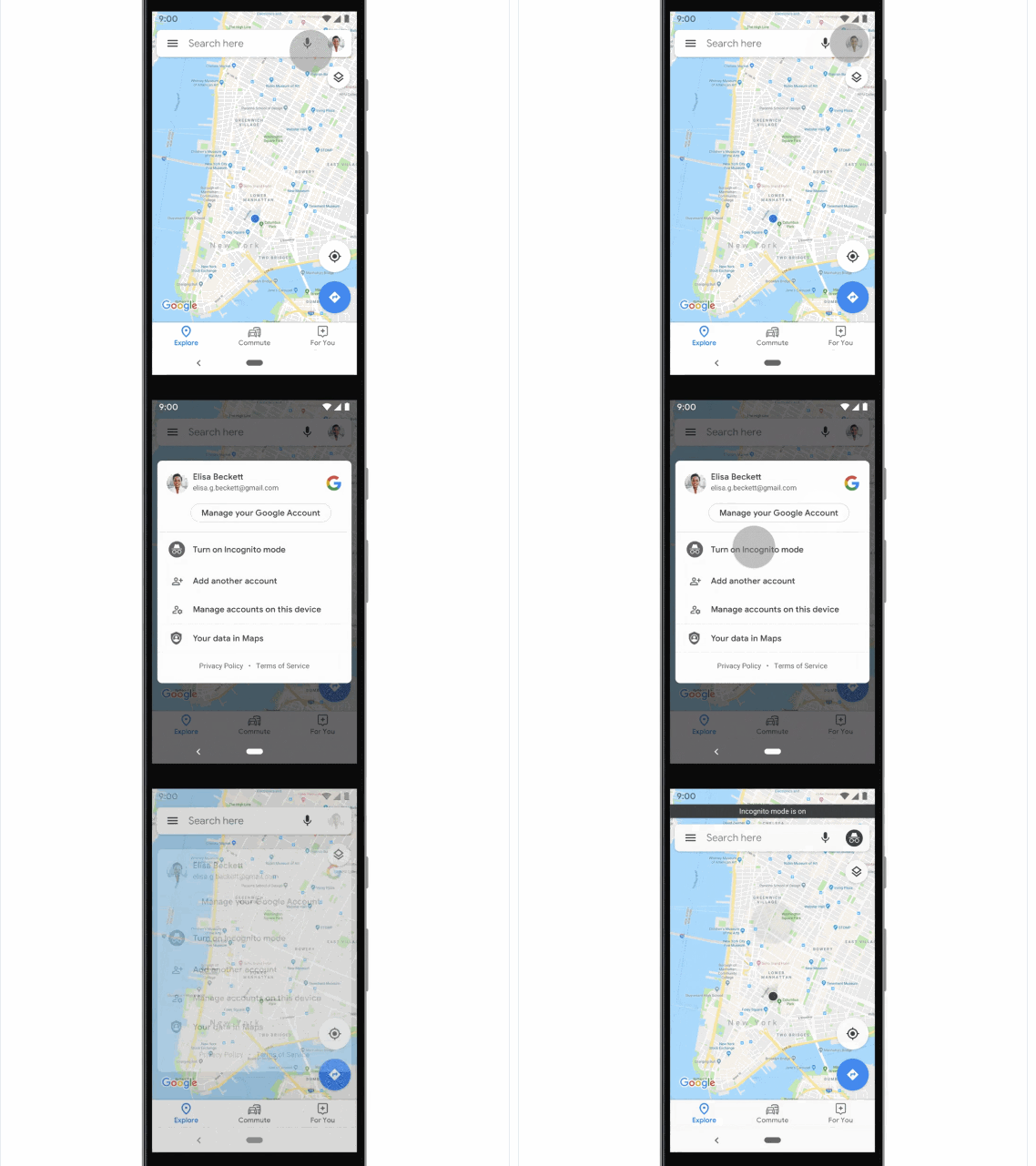
Once it’s enabled on your account, you can toggle incognito mode on/off by tapping your profile picture then flipping the switch. Here’s what that looks like:
So why incognito mode? As we wrote back in May: whether its the holiday season and you’re trying to keep your gift hunting locations under wraps, or you’re visiting a doctor and would just prefer it not pop up the next time a friend grabs your phone for some quick directions, there are all sorts of reasons you might want to leave fewer breadcrumbs. Remember, though, that while it’s less visibly tied to you, it’s still all stored in ways behind the scenes on Google’s end; the company told Wired earlier this month that while Incognito sessions aren’t tied to an account, they are logged with a unique session identifier that gets reset between sessions.
Ed Niedermeyer is an author, columnist and co-host of The Autonocast. His book, Ludicrous: The Unvarnished Story of Tesla Motors, was released in August 2019.
“Congrats! This car is all yours, with no one up front,” the pop-up notification from the Waymo One app reads. “This ride will be different. With no one else in the car, Waymo will do all the driving. Enjoy this free ride on us!”
Moments later, an empty Chrysler Pacifica minivan appears and navigates its way to my location near a park in Chandler, the Phoenix suburb where Waymo has been testing its autonomous vehicles since 2016.
Waymo, the Google self-driving-project-turned-Alphabet unit, has given demos of its autonomous vehicles before. More than a dozen journalists experienced driverless rides in 2017 on a closed course at Waymo’s testing facility in Castle; and Steve Mahan, who is legally blind, took a driverless ride in the company’s Firefly prototype on Austin’s city streets way back in 2015.
But this driverless ride is different — and not just because it involved an unprotected left-hand turn, busy city streets or that the Waymo One app was used to hail the ride. It marks the beginning of a driverless ride-hailing service that is now being used by members of its early rider program and eventually the public.
It’s a milestone that has been promised — and has remained just out of reach — for years.
Nearly two years after Krafcik’s comments, vehicles driven by humans — not computers — still clog the roads in Phoenix. The majority of Waymo’s fleet of self-driving Chrysler Pacifica minivans in Arizona have human safety drivers behind the wheel; and the few driverless ones have been limited to testing only.
Despite some progress, Waymo’s promise of a driverless future has seemed destined to be forever overshadowed by stagnation. Until now.
Waymo wouldn’t share specific numbers on just how many driverless rides it would be giving, only saying that it continues to ramp up its operations. Here’s what we do know. There are hundreds of customers in its early rider program, all of whom will have access to this offering. These early riders can’t request a fully driverless ride. Instead, they are matched with a driverless car if it’s nearby.
There are, of course, caveats to this milestone. Waymo is conducting these “completely driverless” rides in a controlled geofenced environment. Early rider program members are people who are selected based on what ZIP code they live in and are required to sign NDAs. And the rides are free, at least for now.
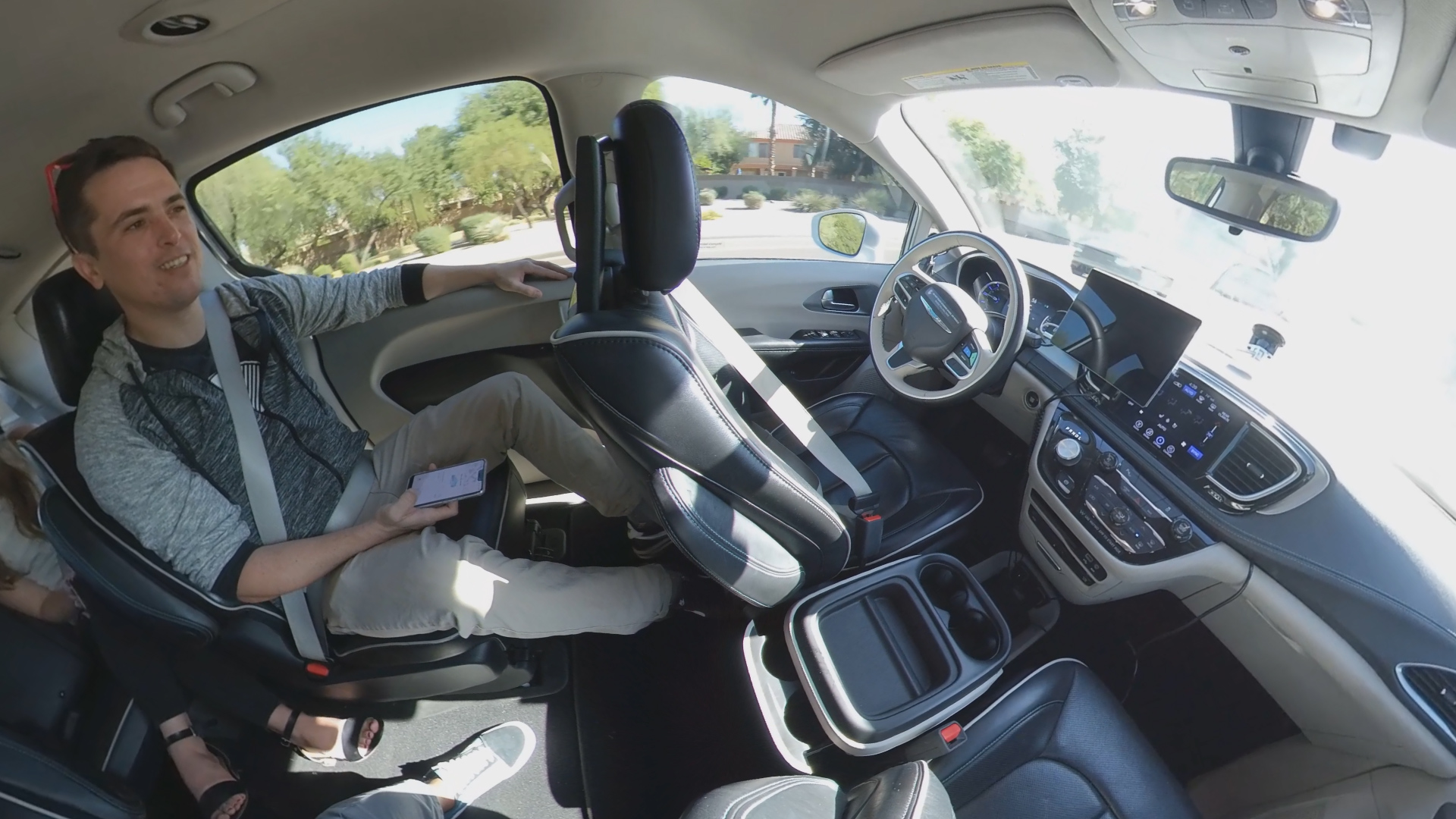
Still, as I buckle my seatbelt and take stock of the empty driver’s seat, it’s hard not to be struck, at least for a fleeting moment, by the achievement.
It would be a mistake to think that the job is done. This moment marks the start of another, potentially lengthy, chapter in the development of driverless mobility rather than a sign that ubiquitous autonomy is finally at hand.
Futuristic joyride
A driverless ride sounds like a futuristic joyride, but it’s obvious from the outset that the absence of a human touch presents a wealth of practical and psychological challenges.
As soon as I’m seated, belted and underway, the car automatically calls Waymo’s rider assistance team to address any questions or concerns about the driverless ride — bringing a brief human touch to the experience.
I’ve been riding in autonomous vehicles on public roads since late 2016. All of those rides had human safety drivers behind the wheel. Seeing an empty driver’s seat at 45 miles per hour, or a steering wheel spinning in empty space as it navigates suburban traffic, feels inescapably surreal. The sensation is akin to one of those dreams where everything is the picture of normalcy except for that one detail — the clock with a human face or the cat dressed in boots and walking with a cane.
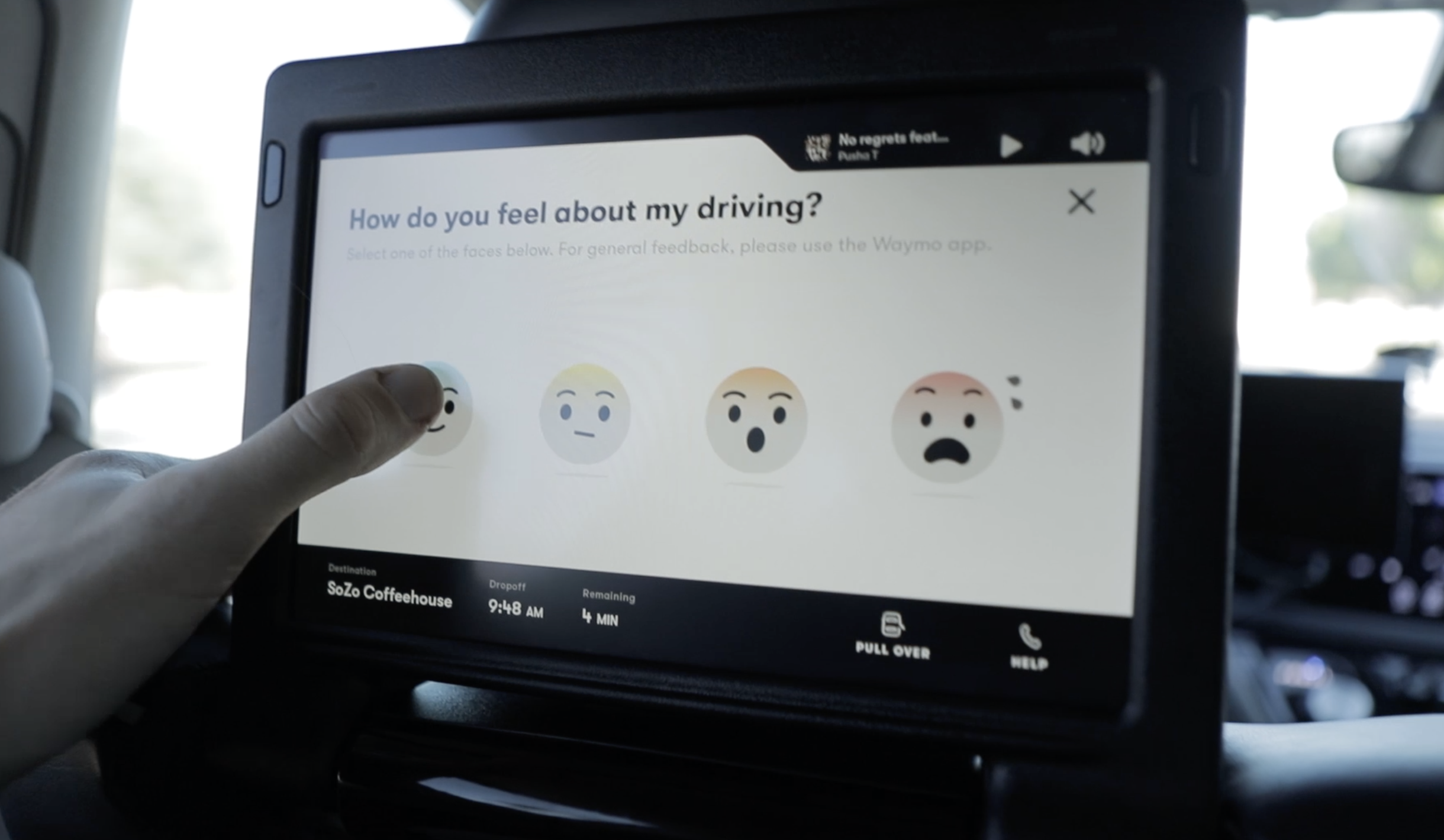
Other than that niggling feeling that I might wake up at any moment, my 10-minute ride from a park to a coffee shop was very much like any other ride in a “self-driving” car. There were moments where the self-driving system’s driving impressed, like the way it caught an unprotected left turn just as the traffic signal turned yellow or how its acceleration matched surrounding traffic. The vehicle seemed to even have mastered the more human-like driving skill of crawling forward at a stop sign to signal its intent.
Only a few typical quirks, like moments of overly cautious traffic spacing and overactive path planning, betrayed the fact that a computer was in control. A more typical rider, specifically one who doesn’t regularly practice their version of the driving Turing Test, might not have even noticed them.
How safe is ‘safe enough’?
Waymo’s decision to put me in a fully driverless car on public roads anywhere speaks to the confidence it puts in its “driver,” but the company was cagey about the specific source of that confidence.
Waymo’s Director of Product Saswat Panigrahi declined to share how many driverless miles Waymo had accumulated in Chandler, or what specific benchmarks proved that its driver was “safe enough” to handle the risk of a fully driverless ride. Citing the firm’s 10 million real-world miles and 10 billion simulation miles, Panigrahi argued that Waymo’s confidence comes from “a holistic picture.”
“Autonomous driving is complex enough not to rely on a singular metric,” Panigrahi said.
It’s a sensible, albeit frustrating, argument, given that the most significant open question hanging over the autonomous drive space is “how safe is safe enough?” Absent more details, it’s hard to say if my driverless ride reflects a significant benchmark in Waymo’s broader technical maturity or simply its confidence in a relatively unchallenging route.
The company’s driverless rides are currently free and only taking place in a geofenced area that includes parts of Chandler, Mesa and Tempe. This driverless territory is smaller than Waymo’s standard domain in the Phoenix suburbs, implying that confidence levels are still highly situational. Even Waymo vehicles with safety drivers don’t yet take riders to one of the most popular ride-hailing destinations: the airport.
The complexities of driverless
Panigrahi deflected questions about the proliferation of driverless rides, saying only that the number has been increasing and will continue to do so. Waymo has about 600 autonomous vehicles in its fleet across all geographies, including Mountain View, Calif. The majority of those vehicles are in Phoenix, according to the company.
However, Panigrahi did reveal that the primary limiting factor is applying what it learned from research into early rider experiences.
“This is an experience that you can’t really learn from someone else,” Panigrahi said. “This is truly new.”
Some of the most difficult challenges of driverless mobility only emerge once riders are combined with the absence of a human behind the wheel. For example, developing the technologies and protocols that allow a driverless Waymo to detect and pull over for emergency response vehicles and even allow emergency services to take over control was a complex task that required extensive testing and collaboration with local authorities.
“This was an entire area that, before doing full driverless, we didn’t have to worry as much about,” Panigrahi said.
The user experience is another crux of driverless ride-hailing. It’s an area to which Waymo has dedicated considerable time and resources — and for good reason. User experience turns out to hold some surprisingly thorny challenges once humans are removed from the equation.
The everyday interactions between a passenger and an Uber or Lyft driver, such as conversations about pick-up and drop-offs as well as sudden changes in plans, become more complex when the driver is a computer. It’s an area that Waymo’s user experience research (UXR) team admits it is still figuring out.
Computers and sensors may already be better than humans at specific driving capabilities, like staying in lanes or avoiding obstacles (especially over long periods of time), but they lack the human flexibility and adaptability needed to be a good mobility provider.
Learning how to either handle or avoid the complexities that humans accomplish with little effort requires a mix of extensive experience and targeted research into areas like behavioral psychology that tech companies can seem allergic to.
Not just a tech problem
Waymo’s early driverless rides mark the beginning of a new phase of development filled with fresh challenges that can’t be solved with technology alone. Research into human behavior, building up expertise in the stochastic interactions of the modern urban curbside, and developing relationships and protocols with local authorities are all deeply time-consuming efforts. These are not challenges that Waymo can simply throw technology at, but require painstaking work by humans who understand other humans.
Some of these challenges are relatively straightforward. For example, it didn’t take long for Waymo to realize that dropping off riders as close to the entrance of a Walmart was actually less convenient due to the high volume of foot traffic. But understanding that pick-up and drop-off isn’t ruled by a single principle (e.g. closer to the entrance is always better) hints at a hidden wealth of complexity that Waymo’s vehicles need to master.
As frustrating as the slow pace of self-driving proliferation is, the fact that Waymo is embracing these challenges and taking the time to address it is encouraging.
The first chapter of autonomous drive technology development was focused on the purely technical challenge of making computers drive. Weaving Waymo’s computer “driver” into the fabric of society requires an understanding of something even more mysterious and complex: people and how they interact with each other and the environment around them.
Given how fundamentally autonomous mobility could impact our society and cities, it’s reassuring to know that one of the technology’s leading developers is taking the time to understand and adapt to them.
As we move from a world dominated by virtual machines to one of serverless, it changes the nature of monitoring, and vendors like New Relic certainly recognize that. This morning the company announced it was acquiring IOpipe, an early-stage Seattle serverless monitoring startup to help beef up its serverless monitoring chops. Terms of the deal weren’t disclosed.
New Relic gets what it calls “key members of the team,” which at least includes co-founders Erica Windisch and Adam Johnson, along with the IOpipe technology. The new employees will be moving from Seattle to New Relic’s Portland offices.
“This deal allows us to make immediate investments in onboarding that will make it faster and simpler for customers to integrate their [serverless] functions with New Relic and get the most out of our instrumentation and UIs that allow fast troubleshooting of complex issues across the entire application stack,” the company wrote in a blog post announcing the acquisition.
It adds that initially the IOpipe team will concentrate on moving AWS Lambda features like Lambda Layers into the New Relic platform. Over time, the team will work on increasing support for Serverless function monitoring. New Relic is hoping by combining the IOpipe team and solution with its own, it can speed up its serverless monitoring chops .
As TechCrunch’s Frederic Lardinois pointed out in his article about the company’s $2.5 million seed round in 2017, Windisch and Johnson bring impressive credentials.
“IOpipe co-founders Adam Johnson (CEO) and Erica Windisch (CTO), too, are highly experienced in this space, having previously worked at companies like Docker and Midokura (Adam was the first hire at Midokura and Erica founded Docker’s security team). They recently graduated from the Techstars NY program,” Lardinois wrote at the time.
The startup has been helping monitor serverless operations for companies running AWS Lambda. It’s important to understand that serverless doesn’t mean that there are no servers, but the cloud vendor — in this case AWS — provides the exact resources to complete an operation and nothing more.
Photo: New Relic
Once the operation ends, the resources can simply get redeployed elsewhere. That makes building monitoring tools for such ephemeral resources a huge challenge. New Relic has also been working on the problem and released New Relic Serverless for AWS Lambda offering earlier this year.
IOpipe was founded in 2015, which was just around the time that Amazon was announcing Lambda. At the time of the seed round the company had eight employees. According to Pitchbook data, it currently has between 1 and 10 employees, and has raised $7.07 million since its inception.
New Relic was founded in 2008 and raised over $214 million, according to Crunchbase, before going public in 2014. Its stock price was $65.42 at the time of publication up $1.40.
It’s almost certain that an angel will play a role in your startup’s journey, but like everything else in a startup’s life, you need to watch out for potential problems. If you don’t manage them properly, these early backers could get in the way of your startup’s success. The advice from investors and founders below will help you navigate the process of raising a successful angel round while avoiding some of the long-term hassles.
James Currier laughs at how little he knew as a first-time founder looking for angel investors in 1999. The more investors the better, he figured — until he had to handle the fallout of an angel round with sixteen backers.
“They want you to talk to their lawyer and their tax accountant and, before you know it, my 16 angels turned into 64 different relationships,” says Currier, a four-time serial entrepreneur and now a managing partner at early-stage venture firm NFX. “It quite quickly became almost a full-time job checking in with them and taking time to hear all their ideas.”
His advice to founders? Keep your circle of investors as small as possible so you can concentrate on what matters. “This is a time to be as focused as you can on product and customers and revenue,” he says. Raising an angel round is a triumphant moment for any fledgling startup. Yet as with every step of a founder’s journey, there are potential landmines along the way. Failing to manage your angels, Currier and others warn, can distract a company and hurt, rather than help, its chances of success. “They can really gum up the works sometimes,” Currier says.
Be selective
The first thing to keep in mind when thinking about raising an angel round is to choose carefully. “I advise clients to be really thoughtful about who they bring into the seed round,” says Ivan Gaviria, a lawyer at Gunderson Dettmer who has been counseling Silicon Valley startups for more than twenty years. “Clients will say to me, ‘Oh, I need this person because they’re connected in this industry and they’re going to get me leads or whatever,’” he says. “But guess what? Everybody’s well-intentioned, but everybody’s also busy.”
In the vast majority of cases, once angels write a check and get their shares, Gaviria says, “they are not going to spend a ton of time adding value to the company.” Yet Gaviria still sees entrepreneurs pursue what he and others call a “party round,” especially when founders have a well-developed network. “I’ve seen 20, 25, 30 parties, all wanting to drop $25,000 or $50,000 in an entrepreneur’s new endeavor,” he says. “They’re trying to do right by their friends and acquaintances and others who want in on the angel round, but they’re also creating headaches for themselves and their lead investors.”
Gaviria gives the example of “pro-rata rights” — the routine guarantee that angel investors can choose to buy a proportionate number of shares in a future round. “Now 20 or 25 or 30 people have to be notified and the paperwork done for each,” he says.
Set expectations and boundaries for communication
An even bigger challenge is time management and navigating relationships with 20 or 30 people to whom you’ll now feel obliged. “There’s a difference with angels between information versus advice and engagement,” Currier says. “As a CEO, you have to explain to angels the difference. Because some angels want to be entertained.” Those investors hope for a financial return, of course, but they also relish the idea of having a front-row seat to your entrepreneurial journey. To make sure that desire doesn’t turn into a burdensome series of check-ins and inopportune “how is it going” calls, NFX gives founders a template for communications with investors. A monthly report helps to set both expectations and boundaries, Currier says.
Slowly but surely, smart speakers are taking over. As Amazon builds Alexa into everything from tiny clocks to microwaves and Google wraps Assistant into just about anything it can, it feels like it’ll be no time before the rooms that don’t have some sort of voice-powered device are the exception.
But most people and businesses probably have no idea how to get their content prepped and ready to play friendly with these speakers. That’s the driving force behind Soundcheck, a company opening up its doors this morning.
Soundcheck helps to take your content and package it up in a format these smart speakers and voice assistant devices more readily understand.
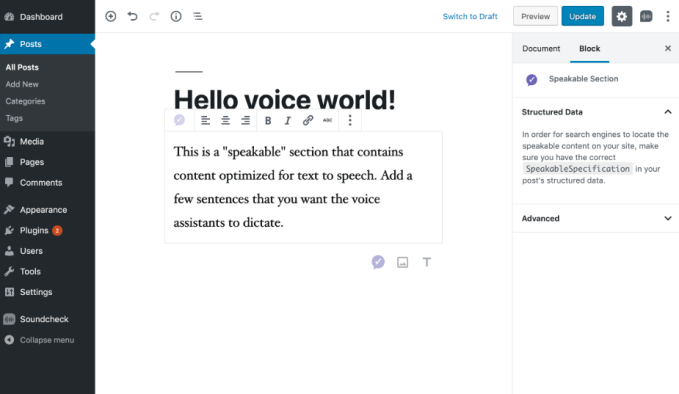
Soundcheck’s primary focus initially is on WordPress-powered sites — not a small target, considering that estimates suggest WordPress powers over 30% of the Internet. They’ve built a plugin that lets you take information on your WordPress site and, in a tap-or-two, wrap up the most important pieces in Google’s “speakable” data format — effectively acting as a highlighter, saying “Hey voice speakers and the search algorithms that power them! This bit of information is meant for you, and answers that question about Topic X”.
Getting data into this format usually means writing custom markup for each page in question, which is something that not everyone (like, say, a small business owner using WordPress mostly for the whole simplified WYSIWYG aspect) is prepped to do. Soundcheck boils the process down to a button press, handles the data validation, and provides a preview of how that content might sound when read aloud by a voice assistant.
Soundcheck will be free for users who just want the basic plugin, with support for their 50 latest WordPress posts. If you need support for more posts, or you want to do fancier things like custom API integrations and tying into dedicated Amazon Alexa/Google Assistant apps, they’ll charge somewhere between $20-$79 a month. The company tells me it’s also building out an analytics tool to help publishers better understand where and when its data is being accessed by voice. They also say that support for other content platforms beyond WordPress is on the roadmap.
Soundcheck is founded by Daniel Tyreus and Narendra Rocherolle — the latter of which also co-founded Webshots, the ultra early photo sharing site that sold to Excite@Home for $82.5M in 1999. They originally set out to build Peck, a service founded in 2016 that aimed to figure out the best way to pull in information on a subject and pack it down into its most concise form. They found that one of the toughest parts of that equation was getting data packaged up and ready for smart speakers like Alexa and Google Home — so they pivoted to focus on that.
The team has raised $1.5M to date, backed by True Ventures, Resolute Ventures, Twitter co-founder Biz Stone, and Flickr co-founder Caterina Fake — along with Automattic, the very team behind WordPress.
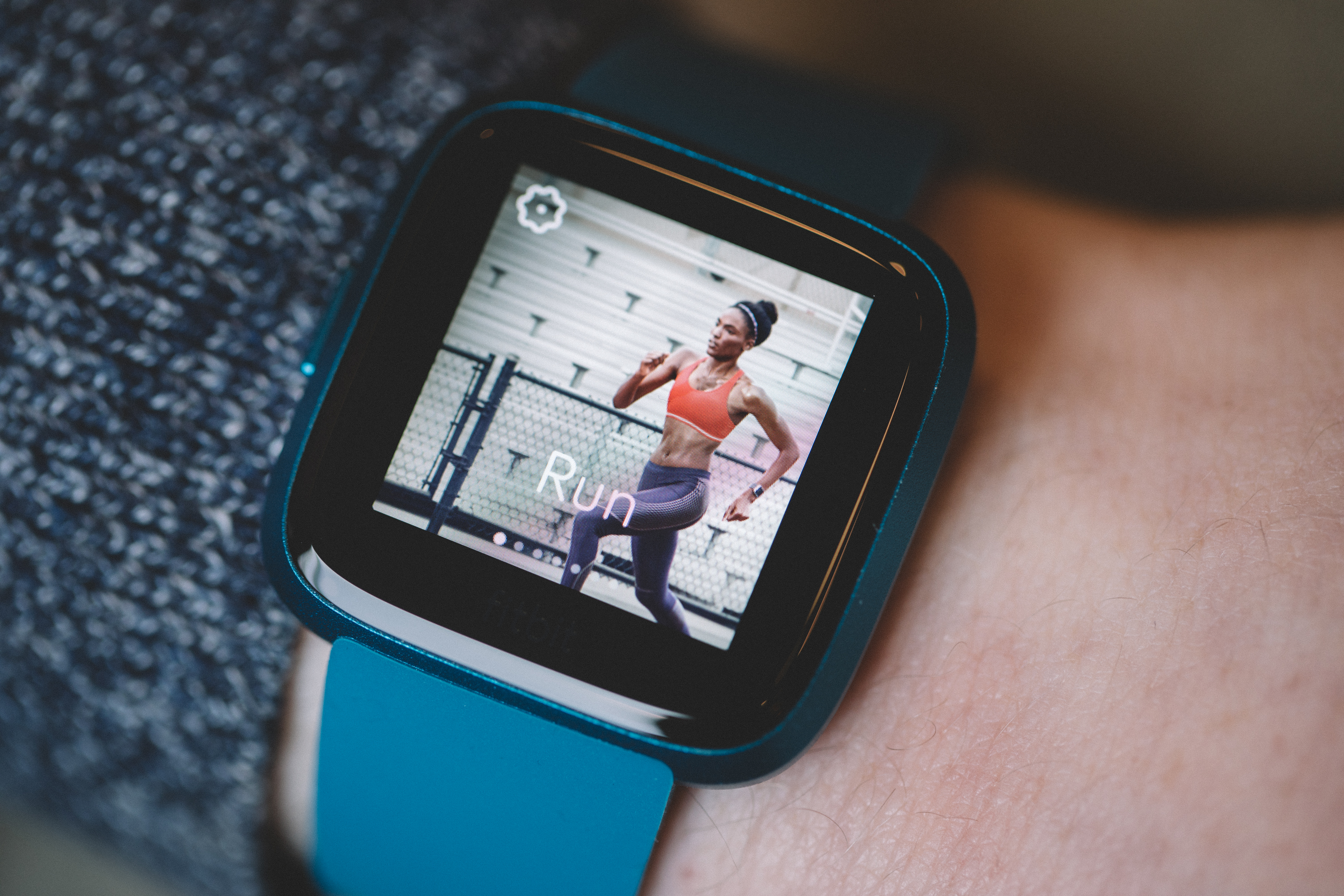
The rumors are true. A week after word surfaced that Google planned to buy Fitbit, the companies have confirmed the purchase. The match could ultimately prove beneficial for both parties. Google has struggled to make much of a dent in the wearables category, leading the software giant to purchase a large chunk of IP from watchmaker, Fossil.
Fitbit, meanwhile, has had issues maintaining growth in recent years. The company, which first pioneered and then dominated the wrist-worn tracker space, struggled as smartwatches grew and ultimately dominated the space. While late to the category, the company has had luck with the Versa watch, the result of its own acquisition of Pebble, Vector and Coin, while working to pivot much of its focus into healthcare.
Hello and welcome back to Equity, TechCrunch’s venture capital-focused podcast, where we unpack the numbers behind the headlines.
This week Kate and Alex broke the discussion into two main themes. The first dealt with early-stage companies, and the second, as you can imagine, later-stage affairs. Don’t worry, we don’t get to SoftBank for quite some time.
After that it was time to leave the auspices of the early-stage market and move to, of all things, a public company. GrubHub reported earnings this week. It went poorly. Alex wanted to riff over the company’s earnings report and what it could mean for startups that are competing with GrubHub, a leader in the food delivery space that DoorDash and Postmates would prefer to lead themselves.
What impact GrubHub may have on the highly-valued on-demand companies isn’t clear yet, but will be pretty damn interesting to see when it does land.
Sticking to the later-stage markets, Alex dug into the problems at Wag which is struggling and looking for a sale despite raising a castle of cash from the Vision Fund. Kate followed that up with notes on problems at Katerra. The Information is reporting this week that the business is going through a number of layoffs and we’re wondering if it will suffer the same fate of some of SoftBank’s other investments.
And, finally, the changing face of things at SoftBank itself. The great money spigot is slowly cutting flow. How many unicorns that will strand isn’t yet clear. But surely it can’t be zero.
Chinese autonomous air mobility company EHang has filed with the SEC the paperwork required to go public in the U.S. on the NASDAQ exchange, with a $100 million initial public offering. The company, which has been flying demonstration flights with passengers on board for a while now, is gearing up to launch its first commercial service in Guangzhou after getting approval from local and national regulators to deploy its drones in the area.
At launch, EHang will be using its two-seater vertical take-off and landing craft (VTOL), which has room for two passengers on board. EHang doesn’t just build the aircraft, though – its goal is to build full, multi-aircraft (as many as ‘thousands,’ according to Forbes) autonomous transportation networks that it hopes will serve to alleviate and avoid congested ground traffic. Guangzhou, with an estimated population of over 13 million, suffers from considerable traffic.
EHang is also building out logistics and cargo transportation capabilities as well as passenger services. The company believes it can offers short designate cross-city transportation that can cut down on time by as much as 40 to 60 percent, and once it achieves scale, it also says that costs have the potential to be reduced by as much as 50 percent.
Founded in 2014, EHang last announced funding in 2015, when It raised $42 million in a Series B round led by GP Capital, with GGV Capital, ZhenFund, Lebox Capital, OFC and PreAngel also participating.
Apple has launched its streaming video subscription service, making available a varied and sizeable library of content immediately for subscribers. To access the service, you do need to sign up for a$4.99 per month subscription, but if you’ve purchased any new iPhone, iPad, iPod touch, Apple TV or Mac since the beginning of September, and you’re signed in to the Apple ID associated with those devices on those devices, the subscribe button should show that you get one full year of free trial service applied automatically.
Apple TV+ content lives in the Apple TV app that’s available across macOS, Apple TV, iOS and iPadOS devices, and which should be pre-installed already unless you’ve deleted it form your device or you’re running an older version of the operating system. Shows from the new program will then show up in a dedicated AppleTV+ row in the app’s home screen, as well as throughout the interface in various places.
At launch, you’ll find ‘The Morning Show,’ ‘See,’ ‘For All Mankind,’ ‘Dickinson,’ ‘Snoopy in Space,’ ‘Ghostwriter,’ ‘Helpsters,’ as well as documentary feature ‘The Elephant Queen’ and talk show ‘Oprah’s Book Club.’ Some of these offer the first three episodes, with others to follow on a staged release schedule, while others include the full season all available to view at launch.
Of course, you can either stream or download these for offline viewing, and AppleTV+ will remember your progress so long as you have an internet connection and then pick up where you left off across your connected devices. All Apple TV+ content is in 4K, and most also offer Dolby Vision and Dolby Atmos support.
I literally just turned on ‘The Morning Show’ for a few seconds to make sure everything was working, so no opinions yet on the quality of the actual content. But if you’ve recently picked up any new Apple hardware, it’s definitely worth checking out for the free trial period, at least.
Calling all tech-minded students, nonprofit and government employees — this is your moment. Come and join us at Disrupt Berlin 2019 on 11-12 December at a price you can afford — because great ideas and innovation come from every sector.
Apply for our discounted Innovator passes for students and nonprofit or government employees and enjoy all the early-stage startup goodness of Disrupt Berlin.
Here’s what comes with your Innovator pass: access to the full conference agenda and all stages — including the Startup Battlefield competition. Interactive workshops, more than 400 startups and sponsors in Startup Alley, networking events, access to the full attendee list (via TechCrunch Events Mobile App) and CrunchMatch, the attendee networking platform. You’ll also have access to exclusive video content after the conference ends.
Here’s how the discounts work and what you need to know to qualify.
Discounts for students: You must be enrolled in a grade school, high school, college or university program or have graduated within the last six months. Coding schools don’t qualify for a discount, sorry.
Bring a valid student ID, proof of current enrollment or transcripts at registration, otherwise you’ll pay the full on-site price. Note: if you’re less than 21 years old, you may not have access to some venues. Your reduced Innovator pass costs €135 plus VAT. Tickets are non-refundable.
Discounts for nonprofit and government employees: You must be full-time employees of nonprofit organizations, federal, state or local government agencies, international government agencies or active military employees.
Nonprofit employees — you must provide your email address from your organization during the online registration process. Government and military employees — you must provide your valid .gov email address during the registration process.
At the Disrupt Berlin on-site registration check-in, you must show proof of current employment at your nonprofit (copy of 501c3 documentation) or government organization. Government contractors, including contractors working on government “Cost Reimbursable Contracts,” are not eligible for the government discount.
We accept the following forms of valid government ID:
Government-issued Visa, Mastercard or American Express
Government picture ID
Military picture ID
Federally Funded Research Development Corp (FFRDC) ID
If you don’t present valid nonprofit documentation or government ID at registration, you’ll have to pay the full on-site price. The discounted Innovator pass costs €295 + VAT, and tickets are non-refundable.
Students, nonprofits and government employees — Disrupt Berlin 2019 takes place on 11-12 December. Take advantage of these deep discounts and join us to learn, share and experience early-stage startup culture at its best. Apply for a discounted Innovator pass today.
Is your company interested in sponsoring or exhibiting at Disrupt Berlin 2019? Contact our sponsorship sales team by filling out this form.
Accusonus, the Greece and U.S.-based AI company helping content creators improve the audio in their videos, has raised $3.3 million in Series A funding.
The round is led by Athens-based Venture Friends, with participation from Big Pi, IQBility, PJ Tech, along with a syndicate of U.S.-based investors led by Michael Tzannes, who is actually the co-founder of Accusonus (and the former CEO of Aware Inc.).
Launched in 2014, Accusonus has been using AI for various audio and music applications longer than most. The company’s first product was Drumatom, which allows recording engineers to control microphone leakage (also known as bleed or spill) in drum recordings. In 2017, Accusonus followed up with the release of Regroover, an AI software instrument that un-mixes audio loops into stems so that new beat making workflows are possible.
Its products are said to have been used by engineers working with musicians such as Bob Dylan, Lou Reed, Goo Goo Dolls, Super Furry Animals, Wilco, Jennifer Lopez, and many others.
However, more recently the company has developed a suite of simple-to-use tools aimed at video content and podcast producers that need to repair or “clean up” audio in their creations. With the amount of content being created growing exponentially — often recorded on smartphones and other consumer equipment or turned around quicker than ever — the market beyond music production is huge.
The company’s thinking, explained co-founder and CEO Alex Tsilfidis, is that Accusonus wants to democratise access to high quality audio via AI-driven tools that remove the learning curve required by traditional audio software.
He says that inventing new algorithms and “painstakingly” fine-tuning the UX of Accusonus’ products has enabled it to offer audio tools that provide ease-of-use to entry-level users while simultaneously speeding up the workflows of audio and video professionals.
Specifically, the Accusonus Enhancement and Repair of Audio (ERA) tools are able to clean up audio recordings via turning a single “virtual” knob within the software. The ERA tools work as plugins and are compatible with major video and audio platforms. These include entry level editors, such as Audacity and Garageband, and more high-end offerings, such as Adobe Premiere Pro, Apple Final Cut, Avid Pro Tools, Apple Logic Pro, and Da Vinci Resolve.
Meanwhile, Tsilfidis says there is some advantage to serving both customer groups, too. The company’s professional users often provide feedback which then helps improve its non-professional targeted products (even if there is likely some overlap between the two groups).
Forecast, a Denmark-based startup that has developed “AI-powered” project management software, has raised $5.5 million in new funding.
The round is led by Crave Venture Partners, with participation from existing backers SEED Capital and Heartcore. Forecast has raised $10 million in total funding to date.
Founded in late 2016, Forecast describes itself as an AI-powered project management solution that automates manual project management tasks, and brings extra visibility and predictive capabilities to to project management. The idea is to help increase collaboration across teams with a better workflow and to improve planning.
Forecast claims that by using its project management software, customers reduce their administrative tasks by 20-40% and gain much better insights into “project risk, resource management and more”.
“Work is going more project-based… leading to an increased need for project management skills and expertise,” Forecast co-founder and CEO Dennis Kayser tells TechCrunch. “Plus, projects are getting more complex. Project management depends on many manual, ongoing updates to stay on time, on budget and on track. That’s why 66% of all projects fail due to human error”.
In addition, as projects become more complex and the data associated with a project increases exponentially, Kayser says the problem is getting worse, which, of course, is where machine intelligence can help. “We don’t learn from our mistakes because no one can keep track of every influencing factor to make crucial adjustments,” he adds.
To tackle this, Forecast uses AI to help keep projects on track and make project management more efficient. The software integrates with existing tools — such as Trello, Slack, Gdrive, Githum and Salesforce — and uses these various external data-points as key indicators for how well a project is running.
“[It pulls in] data from disparate systems and synthesizes it into something human-readable with powerful AI,” explains Kayser. “Everyone on your team can continue to use the tool they prefer without sacrificing dead-simple scheduling, reporting and collaboration for project managers and senior executives. With better insights and tools, project managers can be more efficient and gain insights from increasingly complex projects”.
The use of AI is proactive, too. This includes matching the best person and role to the task, automation of time registration, forecasting the size and duration of tasks, and being alerted before a project is in trouble.
With regards to target customer, Kayser says that Forecast is focused on helping IT & services, marketing, and computer software development companies that “rely on capacity being predictable and project delivery being successful”.
Forecast currently has “hundreds of customers” in over 40 countries. The software has helped customers manage more than 40,000 projects with more than 1,000,000 tasks created.