Thursday, 1 October 2020

Google now has three mid-range Pixel phones

Google now has three mid-range Pixel phones

The Pixel has always been a mixed bag. The first-generation product was announced roughly this time four years ago, with Google finally offering a full-throated entry into the smartphone space after years of device partnerships.

Of course, by 2016, the market was already mature — particularly for Android phones. But while it was easy to write off those initial devices as Nexus-like references for future software updates, Google made it clear that it was taking the line seriously. It put any doubts to rest two years later, with its $1.1 billion acquisition of the design team from a struggling HTC.

But Google’s had struggles of its own. Slow Pixel 3 sales left the company in a tough spot, as the overall market took a hit. Google was able to correct the ship with the launch of the Pixel 3a, joining the likes of Apple and Samsung in offering budget versions of its smartphone flagship as consumers grew weary of premium prices.

It’s a strategy that makes sense. Two primary devices: a flagship and a budget model. Of course, the line has never been particularly clear for Google. For one thing, the company just doesn’t chase premium hardware in the same way that Apple, Samsung or Huawei does. Rather, it insists setting itself apart with its software — even for things like imaging. That often results in a less pronounced gap between devices. It also dulls the company’s edge with features that, more often than not, come to other Android devices.

But today’s hardware event blurred those lines more than ever. The dual-launch of the Pixel 5 and 4a 5G was arguably the most confusing element about a morning event with words “Launch Night” in its title.

Image Credits: Google

While pre-show rumors and leaks revealed a lot about the devices that ultimately proved true, they didn’t do much to distinguish the differences between the products. Turns out there’s an obvious reason: There really isn’t that much of a difference. If anything, the 4a 5G feels like a stepping stone toward the Pixel 5 — a device that would, perhaps, more fittingly have been named the Pixel 5a, if the company’s naming conventions worked that way.

We already knew that both devices were going to sport 5G. That seems to be Google taking advantage of Qualcomm’s aggressive push to bring the next-gen wireless technology to more budget devices. Really, the big driver here is that both devices utilize the same processors: Qualcomm’s Snapdragon 765G. It is, as I’m sure you’re aware, a mid-tier processor. It’s a step down from the 865 currently found in the majority of this year’s flagships.

Likely, the decision was a cost-cutting measure, but we’ve seen evidence from a number of manufacturers that it’s possible to produce an 865-sporting device priced in the middle six digits. Both devices also sport the same dual-camera set up on the rear and the same resolution screens — though the 4a 5G’s is actually bigger (albeit with a lower pixel density), at 6.2 inches to the 5’s 6.0.

There are some differences between the products to justify the $200 pricing gap. For starters, the 5 features a 100% recycled aluminum body, whereas the 4a 5G is polycarbonate. The cheaper phone lacks waterproofing and the reverse wireless charging found on the 5. It also sports a smaller battery, though both devices have been upgraded in that respect over the 4 and 4a. Battery life, after all, was the biggest complaint against the Pixel 4 — and either way you’re going to need more milliamp hours to handle the strains of 5G and, in the case of the 5, reverse charging.

So, are you clear on all of this? Me neither, to be honest. Google’s smartphone line now contains three devices. There’s a mid-tier handset, a slightly lower-mid-tier handset and an even lower-mid-tier handset. That’s three distinct devices with about a $300 price difference, all released within months of one another. It’s as if Google saw the 3a’s successes and decided “screw it, we’re making all of our products mid-range.” Affordability isn’t a bad thing, of course, but if you’re going to release three separate products over roughly a two-month span, you owe it to yourself and your fans to offer clearer value propositions.

Some of this is going to self-correct. For starters, it seems likely that the three devices will turn into two by this time next year. I don’t foresee the company keeping both an LTE and 5G model around in late-2021. There’s also the fact that the company has been undergoing a bit of an executive shakeup among the Pixel line — something that appears to point to a dramatic rethink of the line. It’s likely that the 4a, 4a 5G and 5 were already pretty far into development when Google started its executive shuffling.

Hopefully all of this will cause the company to rethink the Pixel line from the ground up and determine what Google can bring to the table that the competition can’t.




Microsoft enhances customer data platform as pandemic drives need for personalization

Microsoft enhances customer data platform as pandemic drives need for personalization

When Microsoft introduced its customer data platform last February the focus was on simply connecting silos of data to help customers get the data into the system, but as the pandemic has taken hold this year, customers need deeper insight into their customers and Microsoft has made some enhancements to the platform today.

James Phillips, president of Microsoft business applications says the goal of the platform is about understanding customers at a deeper level. “From that depth of understanding our customers can engage their customers through the entirety of the customer lifecycle,” Phillips told TechCrunch.

That could involve a variety of activities such personalizing offers, speaking to them in a way that they know their customers want to be spoken to, offering them new products and services that better meet their needs or supporting them better, he said.

He adds that COVID-19 has changed customer priorities and forced them to make adjustments to the way they do business and how they interact with customers. “As everything’s gone digital, the need to deeply understand your customer and to increase the efficacy of those engagements has really been heightened through this pandemic,” he said.

The company is announcing several new components to the customer data platform product to help customers build that understanding. The first is called Customer Engagement, which as the name implies takes all that data they’ve pushed to the CDP to help understand that customer better and deliver more meaningful interactions. That goes into preview today.

“Engagement Insights is about directly funneling web, mobile and connected product data back into Customer Insights to help continue to enrich that understanding of the customer in order to better serve them,” he said.

The next piece is about putting AI to work on all that data to allow marketers to make more educated predictions about the customers based on what they know about them. This takes advantage of Azure Synapse Analytics and provides a set of pre-built AI templates to help customers with elements like predicting customer churn, automating product recommendations and estimating customer lifetime value.

In addition, the company is offering a data governance product to help protect that data and it’s integrating with Microsoft Customer Voice, the company’s survey tool to give customers the ability to fill in the blanks in the data by asking the customers when all of the data doesn’t provide an answer.

Phillips says all of these capabilities are about helping customers to be more agile, so that as the world shifts, as it has so dramatically this year, businesses can be in a better position to react to those changes more quickly and meet the changing customer requirements.

It’s worth noting that Microsoft clearly isn’t alone in this type of offering, as every big company that sells marketing tools from Adobe to Salesforce to SAP is offering similar products for similar reasons.


Twitter confirms some service flakiness today — now fixed

Twitter confirms some service flakiness today — now fixed

Twitter users around the world have reported some short partial outages today, with the platform not displaying certain tweets or not able to retrieve any at all.

TC’s own geographically distributed staff reported issues with accessing tweets in Europe, India and the US, for example, while DownDetector‘s map indicated some service issues across the world — with a more severe outage apparently concentrated in Japan.

In a support tweet, Twitter confirmed it’s had an issue — writing: “You may have had trouble sending and seeing Tweets” — but added the problem had been fixed. It didn’t offer further details about the issue.

Service outages aren’t unusual for Twitter, although the platform’s stability has improved greatly since the iconic ‘fail whale’ days. In recent years more major outages have been reported in 2017, 2018 and 2019.

Today’s flakiness appears to be pretty minor — resolving after a few minutes for users in Europe, for example.


News apps in the US and China use algorithms to drive engagement, discovery

News apps in the US and China use algorithms to drive engagement, discovery

Algorithms are reshaping many parts of our lives, including how news gets to us. Around the world, entrepreneurs make use of algorithms to program their ideal news apps, and while they normally agree on universal objectives like fighting fake news, their views diverge elsewhere, leading to different applications of machines and user experiences.

No one has a monopoly over the “right” approach to build an algorithmic news app, but it’s perhaps timely and necessary to examine various players in the field and ask how their black boxes affect people’s content consumption. We need look no further than China and the U.S., where machine-driven news platforms are in full bloom.

Show me more of what I want

Before ByteDance became synonymous with TikTok globally, it was known in China for its algorithm-powered news app Jinri Toutiao, or Today’s Headlines. The Chinese app has not disclosed its user numbers for years, but third-party data suggests it had 360 million monthly active users by January 2020, eight years after launching.

Zhang Yiming, the founder of ByteDance, built Toutiao with the goal to give users more of what they want.

“We pictured Toutiao’s feed to be a smart antenna linked to an infinite ocean of information. When you swipe, you retrieve what you’re most interested in right now and in this place,” said Zhang at the company’s seventh anniversary. His remark echoes the app’s catchy tagline: Only what you care are headlines.

To achieve its mission, the app predicts user preferences based on a few parameters, Toutiao’s scientist Cao Huanhuan revealed in a speech in 2018: profiles per the app’s understanding of user demographics; content’s timeliness and popularity; users’ locations; and what similar users like to consume. The app then measures the success of its recommendations by tracking clicks, time spent, likes, comments and shares.

Having world-class algorithms is just part of the story; the other challenge is to create Zhang’s “ocean of information.” Early on, Toutiao relied on crawling the internet to fill its reservoir; these days, the app runs a publishing platform with creators ranging from news outlets, bloggers, celebrities, through to influencers. To sustain the torrent of information available, the app doles out subsidies and devises monetization methods for creators, sharing ad revenue and allowing them to sell products.


SAP continues to build out customer experience business with Emarsys acquisition

SAP continues to build out customer experience business with Emarsys acquisition

SAP seemed to be all in on customer experience when it acquired Qualtrics for $8 billion in 2018. It continued on that journey today when it announced it was acquiring Austrian cloud marketing company Emarsys for an undisclosed amount of money.

Emarsys, which raised over $55 million, according to PitchBook data, gives SAP customer personalization technology. If you talk to any marketing automation vendor over the last several years, the focus has been on using a variety of data and touch points to understand the customer better, and deliver more meaningful online experiences.

With the pandemic closing or limiting access to brick and mortar stores, personalization has taken a new urgency as customers are increasingly shopping online and companies need to meet them where they are.

With Emarsys, the company is getting an omnichannel marketing solution that they say is designed to deliver messages to customers wherever they are including e-mail, mobile, social, SMS, and the web, and deliver that at scale.

When SAP announced it was spinning out Qualtrics a couple of months ago, just 20 months after buying, it left some question about whether SAP was fully committed to customer experience business.

Brent Leary, founder and principal analyst at CRM Essentials says that the acquisition shows that SAP is still very much in the game. “This illustrates that SAP is serious about CX and competing in a highly competitive space. Emarsys adds industry-specific customer engagement capabilities that should help SAP CX customers accelerate their efforts to provide their customers with the experiences they expect as their needs change over time,” Leary told TechCrunch.

As an ERP company at its core, SAP has traditionally focused on back office kind of operations, but Bob Stutz, president, SAP Customer Experience sees this acquisition as a way to continue bringing back office and front office operations together.

“With Emarsys technology, SAP Customer Experience solutions can link commerce signals with the back office and activate the preferred channel of the customer with a relevant and consistently personalized message, allowing customers the freedom to choose their own engagement,” Stutz said in a statement.

The company, which is based in Austria, was founded back in 2000 when marketing was a very different world. It has built a customer base of 1500 companies with 800 employees in 13 offices across the globe. All of this will become part of SAP, of course and come under Stutz’s purview.

As with all transactions of this type it will be subject to regulatory approval, but the deal is expected to close this quarter.


Macrometa, an edge computing service for app developers, lands $7M seed round led by DNX

Macrometa, an edge computing service for app developers, lands $7M seed round led by DNX

As people continue to work and study from home because of the COVID-19 pandemic, interest in edge computing has increased. Macrometa, a Palo Alto-based that provides edge computing infrastructure for app developers, announced today it has closed a $7 million seed round.

The funding was led by DNX Ventures, an investment fund that focuses on early-stage B2B startups. Other participants included returning investors Benhamou Global Ventures, Partech Partners, Fusion Fund, Sway Ventures, Velar Capital and Shasta Ventures.

While cloud computing relies on servers and data centers owned by providers like Amazon, IBM, Microsoft and Google, edge computing is geographically distributed, with computing done closer to data sources, allowing for faster performance.

Founded in 2018 by chief executive Chetan Venkatesh and chief architect Durga Gokina, Macrometa’s globally distributed data service, called Global Data Network, combines a distributed noSQL database and a low-latency stream data processing engine. It allows developers to run their cloud apps and APIs across 175 edge regions around the world. To reduce delays, app requests are sent to the region closest to the user. Macrometa claims that requests can be processed in less than 50 milliseconds globally, making it 50 to 100 times faster than cloud platforms like DyanmoDB, MongoDB or Firebase. One of the ways that Macrometa differentiates from competitors is that it enables developers to work with data stored across a global network of cloud providers, like Google Cloud and Amazon Web Services (for example), instead of a single provider.

As more telecoms roll out 5G networks, demand for globally distributed, serverless data computing services like Macrometa are expected to increase, especially to support enterprise software. Other edge computing-related startups that have recently raised funding including Latent AI, SiMa.ai and Pensando.

A spokesperson for Macrometa said the seed round was oversubscribed because the pandemic has increased investor interest in cloud and edge companies like Snowflake, which recently held its initial public offering.

Macrometa also announced today that it has added DNX managing partner Q Motiwala, former Auth0 and xnor.ai chief executive Jon Gelsey and Armorblox chief technology officer Rob Fry to its board of directors.

In a statement about the funding, Motiwala said, “As we look at the next five to ten years of cloud evolution, it’s clear to us that enterprise developers need a platform like Macrometa to go beyond the constraints, scaling limitations and high-cost economics that current cloud architecture impose. What Macrometa is doing for edge computing, is what Amazon Web Services did for the cloud a decade ago.”


Motif Foodworks preps commercial production for its first ingredient, improving the flavor of beef substitutes

Motif Foodworks preps commercial production for its first ingredient, improving the flavor of beef substitutes

Motif Foodworks, the Ginkgo Bioworks spinout focused on developing new plant-based flavorings and food ingredients, is readying commercial scale production of its first product an ingredient to improve the flavor of beef substitutes.

The expansion of Motif’s manufacturing capacity presages the commercial availability of its new flavoring, which should be on folded into consumer products by the fourth quarter of 2021, according to Motif chief executive Jonathan McIntyre.

“We’re making the product at pilot scale and we’re happy with the pilotization and now we’re scaling up to do large scales in formula development and characterization and talking to contract manufacturers about getting the product put in,” McIntyre said.

There’s a second product under development that’s focused on nutritional attributes for applications in sports nutrition and nutritional supplements, McIntyre said.

In all, Motif has nine ingredients under development with academic partners that will soon be coming to market.

“The first wave of those [ingredients] is targeted at plant-based meats,” McIntyre said. “Ground beef is the first one and the thing that you usually validate in.”

As the industry matures, there’s a growing sense among the lab grown meat and plant-based meat substitute manufacturers that the process isn’t as simple as just coming up with novel proteins to replicate the bloody taste of meats (like plant-based heme). Instead there’re going to be an array of ingredients and proteins that need to be identified and developed to replicate the fibrous textures and fats that make meat taste like meat.

It’s not just the muscle meat, what is critical is getting the flavor attributes and the other tissue attributes. When you get a steak and you see the marbleizing. That marbleizing creates a relationship between the protein fibers and the fat… has a lot to do with taste… that does not occur in a plant based product. Even when you cook a plant based burger next to a beef burger you see the fat behavior differently.”

So Motif is working on new ways to make that connective tissue using plant-based substitutes. It’s part of the company’s mission to be the plant-based ingredient company that can replace the chemicals and animal byproducts currently used to add texture and flavor to a whole range of food products.

“The technology is a plant-based set of ingredients that have been transformed to have properties that have connective tissue,” McIntyre said. “We don’t lock in to just one technology. We lock into what is the issue that is going to taste better. We have been building as strong as a food science, food application, culinology approach as we have protein science. Those ingredients are in the late analysis stage.. Where we’ll be making tens of kilos of material and getting those in front of consumers quickly.”

Looking ahead McIntyre said that Motif Foodworks is looking to create what he called new “food forms”. The idea, McIntyre said is to start making foods that have their own unique flavor profiles and ingredients that won’t necessarily need to be compared to an animal substitute.

“If you’re figuring out a way to make the plant-based option taste better, can you do other food forms that may not suffer by comparison to a burger?” McIntry said. “We want to show the plant-based food world it’s not about replacements.”

This is the next step in the evolution of a company that’s not yet two years old.

Motif spun out of Ginkgo Bioworks in February 2019 with a $90 million investment from Fonterra, the New Zealand-based multinational dairy company; the global food processing and trading firm Louis Dreyfus Co.; and Breakthrough Energy Ventures, the climate focused investment fund financed by a global gaggle of billionaires including Marc Benioff, Jeff Bezos, Michael Bloomberg, Richard Branson, Bill Gates, Reid Hoffman, John Doerr, Vinod Khosla, Jack Ma, Neil Shen, Masayoshi Son, and Meg Whitman.

Motif isn’t just focused on making new ingredients and alternatives to traditional meat-based products. The company is also looking at ways to make existing food healthier with novel ingredients.


“That fortification game has been played a lot. We need to figure out how to get more servings of fruits and vegetables to consumers,” said McIntyre. “It could be that our list of ingredients could be more expansive to include not just plant protein.. It might be having two servings of vegetables combined with all of that in a great new food.”


Cisco acquires PortShift to raise its game in DevOps and Kubernetes security

Cisco acquires PortShift to raise its game in DevOps and Kubernetes security

Cisco is making another acquisition to expand its reach in security solutions, this time specifically targeting DevOps and the world of container management. It is acquiring PortShift, an Israeli startup that has built a Kubernetes-native security platform.

Terms of the deal are not being disclosed. PortShift had raised about $5.3 million from Team8, an incubator and backer of security startups in Israel founded by a group of cybersecurity vets. Cisco, along with Microsoft and Walmart, are among the large corporates that back Team8. (Indeed, their participation is in part a way of getting an early look and inside scoop on some of the more cutting edge technologies being built, and in part a way to help founders understand what corporates’ security needs are these days.)

The deal underscores not just how containerization, and specifically Kubernetes, has taken hold of the enterprise world, but also how those working in this area, and building businesses around containerization and Kubernetes, are paying increasing attention to security around them.

Others are also sharpening their focus on containers and how they are secured. Earlier this year, Venafi acquired Jetstack, which runs a certificate controller for Kubernetes; and last month StackRox raised funding for its own approach to Kubernetes security.

Cisco has been a longtime partner of Google’s around cloud services, and it has made a number of acquisitions in the area of cybersecurity in recent years. They have included Duo for $2.35 billion, OpenDNS for $635 million, and most recently Babble Labs (which helps reduce background noise in video calls, something that both improves quality but also helps users ensure unwanted or private chatter doesn’t inadvertently get heard by unintended listeners).

But as Liz Centoni, the SVP of the Emerging Technologies and Incubation (ET&I) Group, notes in a blog post, Cisco is now turning its attention also to how it can help customers better secure applications and workloads, alongside the investments that it has made to help secure people.

In the area of containers, security issues can arise around container architecture in a number of ways: it can be due to misconfiguration; or because of how applications are monitored; or how developers use open-source libraries; and how companies implement regulatory compliance. Other security vulnerabilities include the use of insecure container images; problems with how containers interact with each other; the use of containers that have been infected with rogue processes; and having containers not isolated properly from their hosts.

Centoni notes that PortShift interested them because it provides an all-in-one platform covering the many aspects of Kubernetes security:

“Today, the application security space is highly fragmented with many vendors addressing only part of the problem,” she writes. “The Portshift team is building capabilities that span a large portion of the lifecycle of the cloud-native application.”

PortShift provides tools for better container configuration visibility, vulnerability management, configuration management, segmentation, encryption, compliance and automation.

The acquisition is expected to close in the first half of Cisco’s 2021 fiscal year, when the team will join Cisco’s ET&I Group.


Altinity grabs $4M seed to build cloud version of ClickHouse open source data warehouse

Altinity grabs $4M seed to build cloud version of ClickHouse open source data warehouse

Earlier this month, cloud data warehouse Snowflake turned heads when it debuted on the stock market. Today, Altinity, the commercial company behind the open source ClickHouse data warehouse announced a $4 million seed round from Accel along with a new cloud service, Altinity.Cloud.

“Fundamentally, the company started out as an open source services bureau offering support, training and [custom] engineering features into ClickHouse. And what we’re doing now with this investment from Accel is we’re extending it to offer a cloud platform in addition to the other things that we already have,” CEO Robert Hodges told TechCrunch.

As the company describes it, “Altinity.Cloud offers immediate access to production-ready ClickHouse clusters with expert enterprise support during every aspect of the application lifecycle.” It also helps with application design and implementation and production assistance in essence combining the consulting side of the house with the cloud service.

The company was launched in 2017 by CTO Alexander Zaitsev, who had created and open sourced ClickHouse. Up until now the startup has been bootstrapped with revenue from the services business.

Hodges came on board last year after a stint at VMware because he saw a company with tremendous potential, and his background in cloud services made him a good person to lead the company as it built the cloud product and moved into its next phase.

ClickHouse at its core is a relational database that can run in the cloud or on-prem with big improvements in performance, Hodges says. And he says that developers are enamored with it because you can start a project on a laptop and scale it up from there.

“We’re very simple to operate, just a single binary. You can start from a Docker image. You can run it anywhere, literally anywhere that Linux runs from an Intel Nuc all the way up to clusters with hundreds of nodes,” Hodges explained.

The investment from Accel should help them finish building the cloud product, which has been in private beta since July, while helping them build a sales and marketing operation to help sell it to the target enterprise market. The startup currently has 27 people with plans to hire 15 more.

Hodges says that he wants to build a diverse and inclusive company, something he says the tech industry in general has failed at achieving. He believes that one of the reasons for that is the requirement of a computer science degree, which he says has created “a gate for women and people of color,” and he thinks by hiring people with more diverse backgrounds, you can build a more diverse company.

“So one of the things that’s high up on my list is to get back to a more equitable and diverse population of people working on this thing,” he said.

Over time, the company sees the cloud business overtaking the consulting arm in terms of revenue, but that aspect of the business will always have a role in the revenue mix because this is complex by its nature even with a cloud service.

“Customers can’t just do it entirely by having a push button interface. They will actually need humans that work with them, and help them understand how to frame problems, help them understand how to build applications that take care of that […] And then finally, help them deal with problems that naturally arise when you’re when you’re in production,” he said.


Microsoft adds the $549 Laptop Go to its growing Surface lineup

Microsoft adds the $549 Laptop Go to its growing Surface lineup

Microsoft just added a couple of key additions to its ever-growing lineup of Surface devices. There are a bunch of new accessories and an update to the Surface Pro X, which you can read about here. The biggest news of the morning, however, is the arrival of the Surface Laptop Go — an affordable take on the company’s well-received Surface Laptop.

The device borrows the naming convention from the Surface Go, a lightweight and cheap entry point into the line. At $549, the Laptop Go is $50 more than that tablet, but is still an extremely affordable take on the category — and if its predecessor is any precedent, you should be getting a pretty decent bang for your buck here.

The specs aren’t exactly exciting. The device ships with either 4 or 8GB of RAM, paired with an 10th gen quad-core Intel i4 processor and 64, 128 or 256GB of storage. Most customers are going to want to pump things up from those base-level specs for all but the most basic applications, which is obviously going to start driving that price up a bit.

Image Credits: Microsoft

The display is an inch and half larger that than the Surface Go 2 at 12 inches and smaller either the 13.5 or 15-inch you get on the standard Laptop. The screen generally is a pretty sizable downgrade from the Laptop, at 1536 x 1024 (148 PPI) to the flagship’s 2256 x 1504 (201 PPI). That’s to be expected, of course, for a product that runs around half the price.

Microsoft is quick to point out the inclusion of a full-size keyboard with 1.3mm of key travel. That’s no doubt designed to contrast it with tablet keyboard cases that are a kind of direct competitor here, not to mention all of the issues Apple has run into with its own laptop keyboards in recent years.

Image Credits: Microsoft

The device weighs 2.45 pounds — making it the lightest Surface Laptop thus far. The ports are, unsurprisingly, fairly limited. There’s a USB-A, USB-C and, of course, that proprietary Surface port the company just can’t quit, on account of all of the existing accessories. The on-board battery can be fast charged and should get about 13 hours of life, per MS’s numbers.

It goes up for pre-order today alongside the new Pro X and will start shipping October 13. Microsoft is also bringing Surface devices to a number of new European countries, including, Bulgaria, Croatia, Czech Republic, Estonia, Greece, Hungary, Latvia, Lithuania, Romania, Slovakia and Slovenia.


Microsoft updates its Arm-based Surface Pro X tablet with a faster CPU

Microsoft updates its Arm-based Surface Pro X tablet with a faster CPU

Microsoft today announced the second generation of its Arm-based Surface Pro X tablet. The first generation of the Pro X launched last October and since then, Microsoft worked with Qualcomm to design the second generation of the SQ2 processor that powers it. The SQ2 doesn’t fully replace the first-generation SQ1 chip, though. Instead, Microsoft is only using it for the top-end SKUs of the Pro X.

Except for the new processor, we’re still pretty much talking about the same Pro X here that launched last year, with built-in LTE connectivity, two USB-C ports and a 13-inch touchscreen.

Image Credits: Microsoft

Microsoft is also introducing a new color in the form of a new platinum finish, in addition to the existing matte black finish. It’s also launching three new colors for the Pro X keyboards: Ice Blue, Poppy Red and Platinum.

There are some other key updates here, though. Thanks to some software improvements, the Surface Pro X now promises up to 15 hours of battery life.

Image Credits:

But more importantly, Microsoft notes that more software partners are now optimizing their Windows apps for the Arm architecture (Microsoft still spells it ARM in its materials, but Arm PR will surely reach out to them and correct them). When it launched the first iteration, Microsoft saw its fair share of negative reviews because support for third-party drivers was lacking and with that, some apps also failed, while others were simply running slow because they had to rely on emulation – unless their developers released Arm-compatible versions.

Earlier this week, the company already noted that its Edge browser on Arm was getting an update to make it less battery hungry. In addition, Microsoft also noted that it would increase support for running x64 apps with a new x64 emulation rolling out to Windows Insiders in November. Visual Studio, too, has been updated and optimized for Windows 10 on Arm.


Imperva to acquire database security startup jSonar

Imperva to acquire database security startup jSonar

Cybersecurity giant Imperva will acquire jSonar, a database security startup that recently landed $50 million from Goldman Sachs.

Financial terms of the deal weren’t disclosed.

The acquisition of jSonar, which provides security and compliance to databases on-premise or in the cloud, will help bolster Imperva’s data security business. As part of the deal, jSonar founder Ron Bennatan will join Imperva to lead its new data security division.

Imperva provides enterprise security, including distributed denial-of-service attacks, to more than 6,200 companies. Earlier this year the company acquired Distil Networks, adding bot protection to its security roster.

“Enterprises have shifted focus from compliance to data security while demanding lower costs and more measurable benefits,” said Imperva chief executive Pam Murphy. “This combination of two uniquely qualified trailblazers will signal a new approach to data security that puts an emphasis on usability and value with sustained and complete coverage for three initiatives organizations need to implement – security, compliance and privacy.”

Last year, private equity firm Thoma Bravo bought Imperva in a $2.1 billion deal to take the company private.

The Imperva-jSonar acquisition is expected to close by mid-October.


Combining machine learning tools for medical imaging with genetic sequencing nets Sophia Genetics $110M

Combining machine learning tools for medical imaging with genetic sequencing nets Sophia Genetics $110M

SOPHiA GENETICS, the shoutily and poorly capitalized named startup that’s combining machine learning tools for medical imaging and genetic sequencing to come up with a more holistic view of diseases for better patient care, has raised $110 million in new funding.

The Series F round for the company was led by aMoon an Israeli healthcare and life sciences investment fund, and HItachi Ventures, the investment arm of the Hitachi Group.

Financial services firms like Credit Suisse and the PIctet Group, along with previous investors including Swisscom Ventures, Endeavour Vision, Generation Investment Management, and Eurazeo Growth also participated in the financing.

The company’s technology uses multiple sources of medical data to come up with potentially novel insights about how diseases spread in the body and offer better ways to coordinate care among different . The Boston and Lausanne, Switzerland-based company’s tech is currently used by over 1,000 healthcare institutions and has analyzed 600,000 genomic profiles, according to a statement.

The goal, the company said, is better patient care.

According to a statement, the new funding will be used to expand the company’s footprint in the US and Asian markets.

It also appears that the company may be gearing up for a public offering. It’s added Didier Hirsch, the former chief financial officer of Agilent, to its board of directors and has created an audit committee (usually a stepping stone on the way to a dive into public market waters).

“We believe that SOPHIA’s decentralized model will play a pivotal role in empowering health organizations to offer better patient care,” said Dr. Tomer Berkovitz, Partner & CFO of aMoon, in a statement.


Jüsto adds another $5 million in funding to build its online, delivery-only grocery store for Latin America

Jüsto adds another $5 million in funding to build its online, delivery-only grocery store for Latin America

As it begins expanding beyond its home base in Mexico City, the on-demand, online only grocery store Jüsto has  added another $5 million in early stage funding.

The new money came from Bimbo Ventures, the strategic investment arm of one of the world’s largest bakery companies, Bimbo, and Sweet Capital, the investment fund from the founders of King.com.

Over the summer, the company expanded its services beyond Mexico City to Carretaro and saw explosive growth. According to Jüsto co-founder and company spokesman Manolo Fernandez. With sales in the first week equaling what had taken the company 200 days to achieve in Mexico City. Tavarez said it was an indicator of the demand for the company’s service across the country.

The $5 million top-up comes only a few months after Jüsto raised $12 million in funding from a slew of well-known global and Latin American investors and shows just how robust the early stage investment scene in Latin America is becoming.

As the company expands it may look to engage in some joint ventures with delivery services in other countries to expand its footprint, according to Fernandez, but for now, the focus is on growing its footprint independently.

The company will look to open operations in cities in Colombia, Peru, and potentially Ecuador in the next year, Fernandez said.


Google to pay out $1B to publishers to license content for new Google News Showcase

Google to pay out $1B to publishers to license content for new Google News Showcase

Google has long had a frenemy position with regards to the world of news: it can direct a lot of traffic to online publishers, but that’s only if people bother to click on links after getting the gist of the story from Google itself (and that’s before considering Google’s AMP approach on mobile that keeps users on Google URLs after they click). Publications built around advertising have felt beholden to the search and ad giant, leading those that have survived over the years to try to forge alternative revenue models around paid content, events, and more to offset that dependency.

Now Google is offering another, complementary, option to these publishers, or at least some of them.

Today the company unveiled its latest effort to claw back more credibility in the news publishing world, launching the Google News Showcase. Sundar Pichai, CEO of the search giant, said in a blog post that it would collectively pay some $1 billion to news publishers in licensing fees “to create and curate high-quality content” for new story panels that will appear on Google News. Initially, these will appear on Android devices and eventually also on Google News on iOS.

The new initiative is going live today, after it was initially unveiled by Google in broad strokes earlier this summer.

Google News Showcase is rolling out first in Germany and Brazil before expanding to other markets, according to Pichai. The company has already inked deals with 200 publications in Germany, Brazil, Argentina, Canada, the U.K. and Australia. The first publications to launch will be Der Spiegel, Stern, Die Zeit, Folha de S.Paulo,BandInfobaeEl Litoral, GZH, WAZ and SooToday. India, Belgium and the Netherlands will be next on the list for expansions after the other countries go live, Pichai said.

As you can see here, Google News Showcase seems primarily to be focused on how news is consumed on mobile devices rather than desktop computers.

Like Apple with its efforts around Apple News, as a major mobile platform operator Google has worked on a number of ways to play nice with publishers and the news publishing industry over the years, some on its own steam and some in response to pressure from outside.

They have included funding local news research initiatives; its $300 million news initiative that includes providing grants to journalists and journals, as well as research; emergency grants to publications in hot water; and building tools to help journalists do their work.

Picking Germany as one of the first markets to roll this out is notable, given that publishers in the country were involved in a years-long lawsuit over copyright fees related to how their content was repurposed in Google.

Google ultimately won that case in court, but arguably, it didn’t win in the court of public opinion. Given that Google continues to face a lot of antitrust scrutiny in Europe and elsewhere, it’s important that it works (or at least appear to work!) on rehabilitating its image as too-powerful and uninterested in the fate of institutions that are central to how democratic society works — like the free press.

As Pichai notes, this latest effort is different from what Google has built before because it’s based on publishers doing the curating and creating themselves.

Google is infamous for starting a lot of projects, rolling them out, and then abandoning them when they fail to get market traction. With that understanding, and knowing that it’s one of the biggest companies in the world (not just in tech) it has in theory committed to the Showcase for three years, but Pichai said the plan is for it to “extend beyond the initial three years”, with the company “focused on contributing to the overall sustainability of our news partners around the world.”

It’s not clear how much money individual publishers will make out of this initiative, now how or if it could be used to drive business models that don’t cut Google in on the action. The latter has been a prime focus for many publishers for the last several years. At best, similar to Apple News, it could help publishers hedge their bets or even bolster them (as in the case of paywalls and driving people to using them), rather than cannibalize those other efforts. Google, at the least, seems aware of the stakes and seems to argue that it’s not the only reason publishers are feeling the heat.

“The business model for newspapers—based on ads and subscription revenue—has been evolving for more than a century as audiences have turned to other sources for news, including radio, television and later, the proliferation of cable television and satellite radio,” wrote Pichai. “The internet has been the latest shift, and it certainly won’t be the last. Alongside other companies, governments and civic societies, we want to play our part by helping journalism in the 21st century not just survive, but thrive.”


Cazoo, the UK used car sales platform, raises another $311M, now valued at over $2.5B

Cazoo, the UK used car sales platform, raises another $311M, now valued at over $2.5B

A lot of people are opting to use cars instead of taking public transportation in the UK at the moment, as a way of ensuring more social distancing, and today one of the startups that’s built a more efficient way of selling and buying cars is announcing a big round of funding. Cazoo, which provides an app-based way to browse and buy used cars (it’s modeled on the likes of Vroom in the US), has picked up £240 million ($311 million).

The funding comes only six months after the company raised $116 million. A Cazoo spokesperson has confirmed that the company is now valued at over £2 billion (or over $2.5 billion), double its previous valuation. (For some context, the company confirmed a $1 billion valuation this summer and others had estimated it at a much lower amount.)

This latest funding is being led by General Catalyst, D1 Capital Partners and funds managed by Fidelity Management & Research Company and Blackrock, with other new and existing investors participating. The list includes L Catterton, Durable Capital Partners, The Spruce House Partnership, Novator, Mubadala Capital and dmg ventures. It brings the total raised by the company to date to £450 million ($582 million).

The company has come back to us to confirm that this is an all-equity round, no debt. (Debt plays a big role in funding for companies that need to take on a lot of assets, like cars, in order for the business model to function. As we’ve seen with others in the same category of disrupting car sales, like Fair, sometimes the debt far outstrips equity funding, and as we’ve seen with Fair, sometimes even a lot of money cannot help a business work.)

A spokesperson confirmed that the funds will be used to grow the team, brand and infrastructure and to continue to develop the proposition as we continue to make car buying better for all UK consumers.

Founded by Alex Chesterman, who had also founded LoveFilm (acquired by Amazon and used as the first step in its move into building its Netflix competitor, Amazon Prime Video) and the property sales site Zoopla, Cazoo says that it has hit £100 million in revenues since launching less than a year ago, selling and delivering “thousands” of cars every month. It does not disclose whether it is profitable.

The company’s boost comes from a new surge of interest not just from more people having a car for getting from A to B — and I’ll say as a London resident that traffic definitely feels worse these days — but also from people looking for online, virtual ways of doing this to avoid the physical contact that typically comes with more traditional ways of buying vehicles.

“Over the past few months we have seen an acceleration in the shift from offline to online car buying as UK consumers have continued to embrace our unique and market-leading proposition,” said Chesterman in a statement. “This latest funding demonstrates the conviction of some of the world’s best investors in both our business model and team as well as the UK market and gives Cazoo the firepower to deliver on our plans to provide the best possible car buying experience for UK consumers.”

Chesterman’s pedigree as a founder helps with raising money and opening doors.

“I have known Alex for seventeen years since our days building LoveFilm,” said Adam Valkin, MD of General Catalyst, in a statement. “He has made a career out of identifying large consumer markets where technology can drive change and then leading that transformation by focusing on the customer and delivering value, convenience and a trusted service. With Cazoo, Alex is taking his proven playbook to perhaps his largest opportunity yet for the benefit of used car buyers across the UK.”

Dan Sundheim, Founder of D1 Capital added, “We’re excited to partner with Alex and the team at Cazoo. They have generated enormous value for customers and shareholders in their previous internet ventures and we are confident that Cazoo will greatly accelerate the digital transformation of the used car industry and dramatically improve the car buying experience for consumers in the UK.”

Updated with more information about the valuation and details about equity vs debt.


France’s Sendinblue, an all-in-one digital marketing platform, raises $160M

France’s Sendinblue, an all-in-one digital marketing platform, raises $160M

As more companies and brands put the internet at the core of how they run their businesses these days, it’s giving a strong push to the growth of startups that are building tools to help them. In the latest development, Sendinblue, an eight-year-old French startup that has built a platform to help small and medium organizations run all of their marketing — from email, SMS and chat marketing through to automation services, Facebook ads and retargeting — has picked up $160 million in funding.

Bridgepoint, Bpifrance, Blackrock, and previous investor Partech (which led Sendinblue’s $35 million in Series A in 2017) all invested in the round.

The money will be used to help the company build out its presence in North America — where it grew 100% last year — and to continue to add more tools to the mix, both organically and by positioning itself as a consolidator, acquiring smaller marketing tech startups. The company is also building CRM tools and other adjacent areas in the SMB back office so you can see how it might evolve. It’s profitable and is active already in some 60 countries with some 180,000 customers on its books.

The huge funding, for a startup that may not have been on many people’s radar — you could say Sendinblue has come out of the blue — is a sign of the times.

SMBs (like retailers and brands doubling down on e-commerce) have long used the internet for marketing, but the recent pandemic, with its social distancing measures, has highlighted just how many people are spending time (and spending money) online, which has led to a boost in how organizations are using the internet to communicate with customers.

“The whole covid pandemic has accelerated our business,” said Steffen Schebesta, who runs the company’s North American operations (and joined the company when his startup, Newsletter2Go, was acquired several years ago). “We’ve seen a lot of SMBs finding that they need to digitize in order to survive.”

It’s also notable that it’s a French startup raising a large growth round: it’s a signal of how companies from the country are scaling, filling out a mission that French President Emmanuel Macron set out to see the country produce (and invest in) more unicorns.

Sendinblue’s funding news comes on the heels of another French martech company, Sarbacane, also raising a lot of money in recent weeks (France has been known for adtech, but seems that it also has a strong line in marketing tech). Further afield, we’ve seen a number of other startups in the space raising significant rounds this year, including Yotpo, Movable Ink, Adverity, and more.

There seems to be room for all of these, and more. Schebesta described a typical customer for Sendinblue — whose primary goal is to “enable small and medium businesses to be on equal footing with bigger companies in terms of the tools they can use, having access to everything in one platform at an affordable price — as one that may have “outgrown” Mailchimp with a need for more tools and more sophistication. 

While the company’s bread and butter and focus will always be SMBs, in the meantime it’s also picked up a number of high-profile and high-end customers too, including Louis Vuitton, the candy giant Haribo, Fujitsu, Amnesty International and Greenpeace. 

“Sendinblue is positioned in a growing market as more and more SMBs are going digital, especially in the past few months of lockdown,” said Olivier Nemsguern, Partner at Bridgepoint, in a statement. “We seek investments that meet a critical market need. Sendinblue is the perfect example of a company that will make an impact.”

“We have invested in Sendinblue because the company offers innovative solutions for SMBs and has a strong track record of achieving high growth in the U.S. and European market,” added Louis Molis, investment director at Bpifrance. “We’ve seen that Sendinblue’s value is globally extensible and will increase in importance as integrated marketing becomes more important.”

“Sendinblue has quickly become the leading digital-marketing platform for SMBs,” said Bruno Crémel, General Partner at Partech. “As demand for all in one platforms increases, Sendinblue has a unique ability to succeed. We are thrilled to continue to support Sendinblue as the company accelerates its next phase of international growth.”


Wednesday, 30 September 2020

eFounders unveils its next batch of enterprise SaaS startups

eFounders unveils its next batch of enterprise SaaS startups

Since 2011, European startup studio eFounders has launched 27 companies with a focus on software-as-a-service companies trying to improve the way we work. Some of them have been quite successful, such as Front and Aircall.

And the company is working on its next batch of startups. “We're particularly inspired by the new wave of productivity tools, that is ever more collaborative and flexible,” eFounders co-founder Thibaud Elziere said in a statement

In exchange for financial and human resources, eFounders keeps a significant stake in its startups. Ideally, startups raise a seed round and take off on their own after a year or two.

Here’s what’s coming up from eFounders.

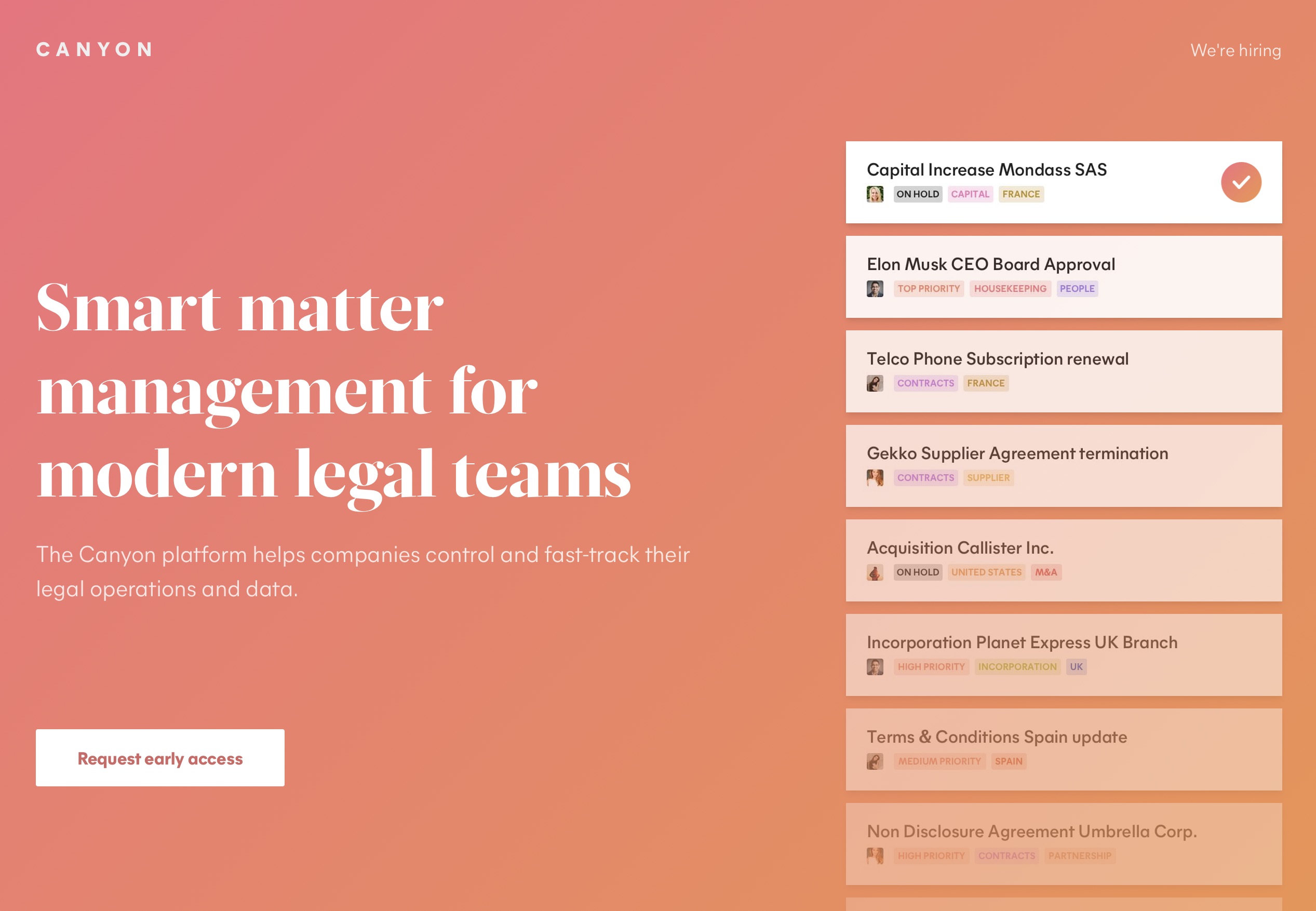
Canyon

Canyon is a product for legal teams that want to ditch Word, PDF documents and emails. It starts with a central hub to hold all your drafts and documents. This way, you can track progress, get the latest document version and see the context around a document. Given that it is tailored for legal teams, it should work a bit better than a shared Dropbox folder.

You can create templates to reuse them later, see related emails directly in Canyon’s interface and invite other people so that they can have a look at what you’ve been working on.

Image Credits: Canyon

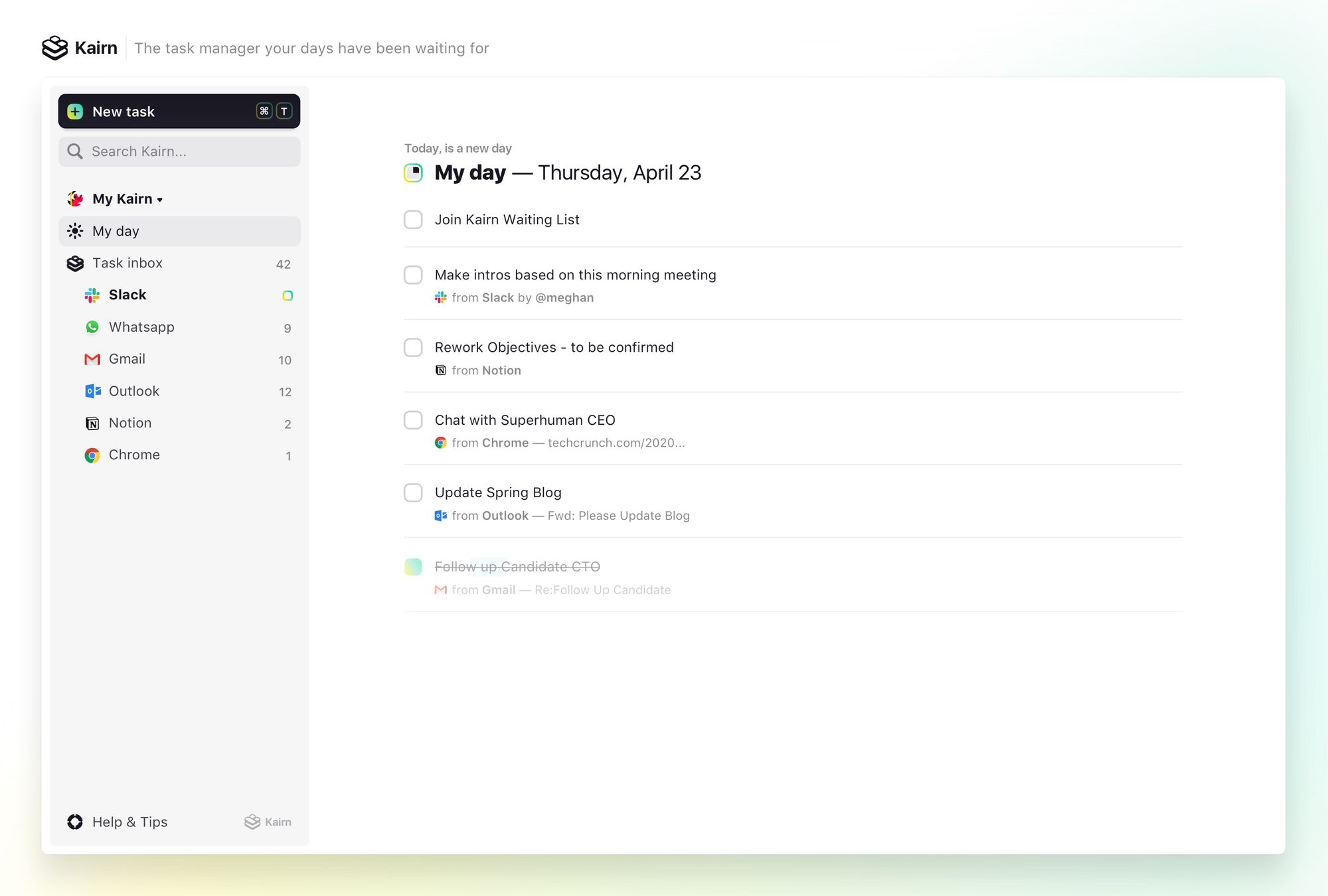
Kairn

Kairn is a task manager that tries to get out of the way as much as possible. When you’re working on your computer, you can add tasks directly from the app that you’re already using.

For instance, you can imagine adding a task by starring an email conversation in Gmail, forwarding a message to a WhatsApp bot or starring a message in Slack. There’s also a quick add window that you can trigger with a keyboard shortcut.

Read my full article on Kairn:

Image Credits: Kairn

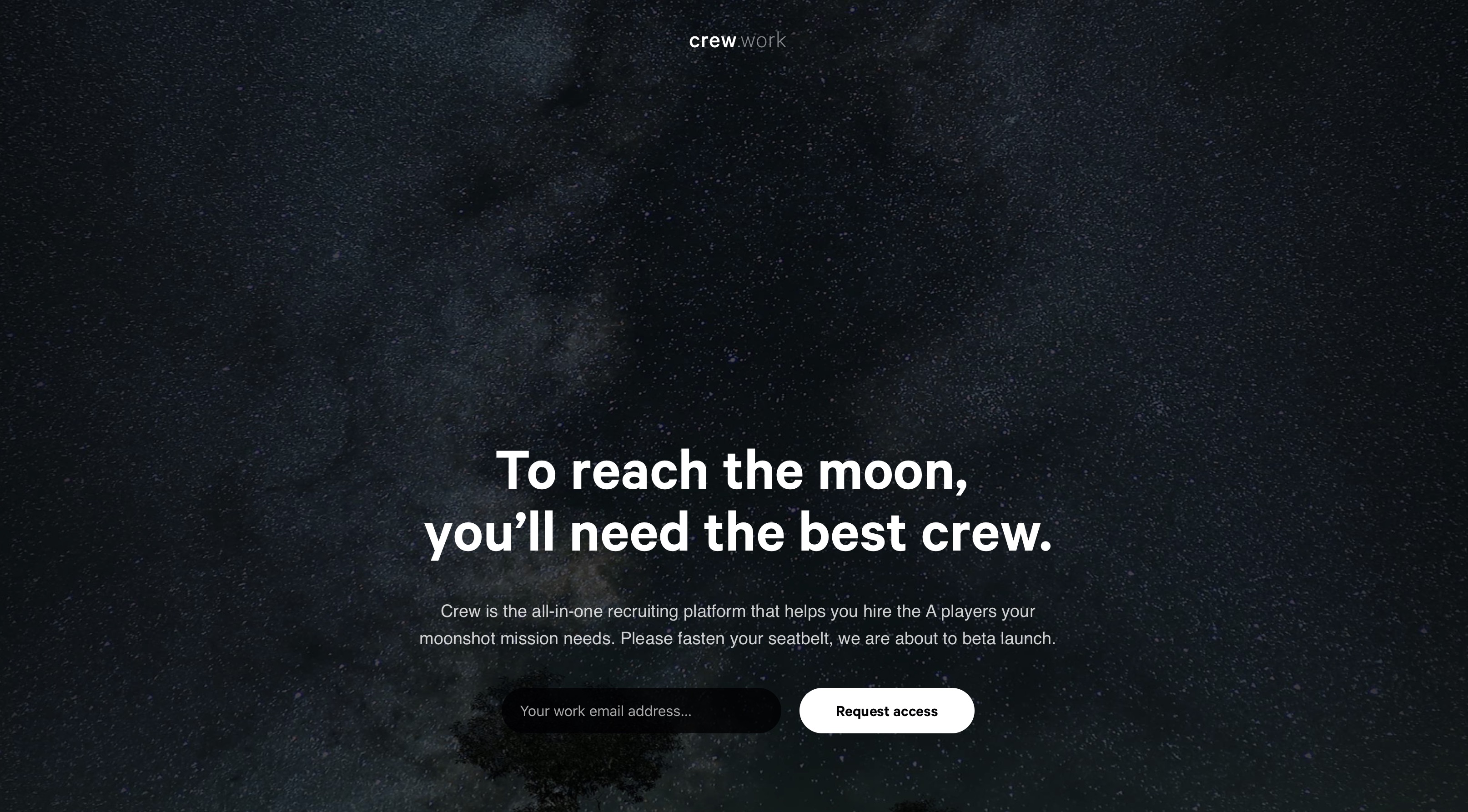
Crew

Crew is focused on new hires and job applications. Given that many companies are actively looking for interesting candidates, Crew isn’t just a way to passively collect applications.

It lets you create automated workflows and handle everything you’d expect from a recruitment platform.

Image Credits: Crew

Collective

Collective is a product for freelancers who want to work together and form groups. It should make it easier to send a contract to a client that involves multiple freelancers working on the contract. Collective will make it easier to remain legally compliant.


Allbirds CEO Joey Zwillinger on the startup’s $100 million round, profitability, and SPAC mania

Allbirds CEO Joey Zwillinger on the startup’s $100 million round, profitability, and SPAC mania

As people spend less time out and about and more time daydreaming about when a vaccine will arrive, lifestyle shoes are only gaining traction.

One obvious beneficiary is Allbirds, the San Francisco-based maker of comfortable, sustainable kicks that launched in 2016 and quickly became a favorite in Silicon Valley circles before taking off elsewhere.

Though the company saw its business slow this year because of the pandemic, its products are now available to purchase in 35 countries and its 20 brick-and-mortar stores are sprinkled throughout the U.S. and Europe, with another outpost in Tokyo and several shops in China.

Investors clearly see room for more growth. Allbirds just closed on $100 million in Series E funding at roughly the same $1.6 billion valuation it was assigned after closing on $27 million in Series D funding earlier this year, and blank-check companies have been calling, says cofounder and CEO Joey Zwillinger. He talked with us  earlier this week in a chat that has been edited for length and clarity.

TC: Your shoes are sold worldwide. What are your biggest markets?

JZ: The biggest market by far is the U.S., and the same day that we started here in 2016, we also launched in New Zealand, so that’s been very good to us over the last four years, too. But we’ve seen growth in Japan and Korea and China and Canada and Australia. We have a network of warehouses globally that lets us reach 2.5 billion people [who], if they were so inclined, could get their product in three days. We’re proud of the infrastructure we’ve set up.

TC: We’ve all worn shoes a lot less than we might have expected in 2020. How has that impacted your business?

JZ: We’re growing but definitely not at the same pace we would be had the pandemic not occurred. We’re predominantly digital in terms of how we reach people, but stores are important for us. And we had to switch [those] off completely and lost a portion of our sales for a long time.

TC: Did you have to lay off your retail employees?

JZ: A large portion of our retail force was unable to work, but we were luckily able to keep them fully paid for four months, plus [some received] government benefits if they got that. And now all of our 20 stores are up and running again in a way that’s totally safe and everyone feels really comfortable.

We also donated shoes to frontline workers — 10,000 pairs or around a million dollars’ worth.

TC: What does Allbirds have up its sleeve, in terms of new offerings?

JZ: We just launched our native mobile app, and through it we’re able to give our more loyal fans exclusives. It’s a really cool experience that blends technology with fashion. You can try on shoes in a virtual mirror; you’re given information [about different looks] that you wouldn’t have otherwise.

We also launched wool-based weather-proofed running shoes in April that have blown away our expectations but [were fast discovered by] people who haven’t really been running for 10 to 15 years and are running again [because of gym closures]. It’s a super high-stakes category and one that’s hard to break into because people buy on repeat. But we spent two years making it. It’s not like we launched it because of the pandemic. It’s a shoe for 5K to 10K distances — it’s not a marathon shoe or a trail shoe — and that we’ve been able to clearly articulate that speaks to its success, I think.

TC: What about clothing?

We launched underwear and socks last year in a small launch. We developed a textile that hasn’t been used before — it’s a blend of tree fiber and merino wool because our view is that nature can unlock magic. Underwear is typically synthetic — it’s made from plastics — or cotton, which isn’t a great material for a whole bunch of reasons. [Meanwhile] ours is phenomenal for temperature control; it also feels like cashmere.

TC: Patagonia really advertises its social and environmental values. Do you see Allbirds evolving in a similar way, with a growing spate of offerings?

JZ: I’m incredibly humbled by [the comparison]. Given their environmental stewardship of the retail sector, we hope we’re compared to them. But they are much more of an outdoor brand — not a competitor so to speak. And we’d love to share more of the retail world with them so we can do our environmental thing together.

TC: You just raised funding. Are you profitable and, if not, is profitability in sight?

JZ: We’ve been profitable for most of our existence. Having some discipline as we grow is good. We’re not close to the profitability that we’ll eventually have, but we’re still a small company in investment mode. After we emerge from the pandemic, we’ll enter a ramping-up phase.

TC: Everyone and their brother is raising money for a blank-check company, or SPAC, which can make it a lot faster for a private company to go public. Have you been approached, and might this option interest you?

JZ: Yes and no. Yes we’ve been approached, and no, we’re [not interested]. We want to build a great company and being public might be something that helps enable that for a whole bunch of reasons. But we want to do it at the right time, in a way that helps the business grow in the most durable and sustainable fashion. Just jumping at the opportunity of a SPAC without doing the rigorous prep the way we want to, we’re not super focused on that