Thursday, 1 April 2021

Holler raises $36M to power ‘conversational media’ in your favorite apps

Holler raises $36M to power ‘conversational media’ in your favorite apps

Holler, described by founder and CEO Travis Montaque as “a conversational media company,” just announced that it’s raised $36 million in Series B funding.

You may not know what conversational media is, but there’s a decent chance you’ve used Holler’s technology. For example, if you’ve added a sticker or a GIF to your Venmo payments, Holler actually manages the app’s search and suggestion experience around that media. (You may notice a little “powered by Holler” identifier at the bottom of the window.)

Montaque told me the company started out initially as a news and video content app before focusing on messaging in 2016. Messaging, he argued, is “the most important experience for people online,” since “it’s where we communicate with the people who are closest to us.”

He continued, “It seemed bizarre that we haven’t seen much innovation in the text messaging experience since the first text message was sent in 1992.”

So Holler works with partners like PayPal-owned Venmo and The Meet Group to bring more compelling content into the messaging side of their apps — or as Montaque put it, the startup aims to “enrich conversations everywhere.”

Holler/Venmo screenshot

Image Credits: Holler

There’s both an art and a science to this, he said. The art involves creating and curating the best stickers and GIFs, while the science takes the form of Holler’s Suggestion AI technology, which will recommend the right content based on the user’s conversations and contexts — the stickers and GIFs you want to send in a dating app are probably different from what you’d in a work-related chat. Montaque said that this context-focused approach allows the company to provide smart recommendations in a way that also respects user privacy.

“I believe that the future is context, not identity,” he said. “Because I don’t really need to know about Anthony, I just need to know someone is in need of lunch. If I know you’re in the mood for Mexican food, I don’t need to know every aspect of the last 10 times you went to a Mexican restaurant.”

Holler monetizes this content by partnering with brands like HBO Max, Ikea and Starbucks to create branded stickers and GIFs that become part of the company’s content library. Montaque said the startup has also worked with brands to measure the impact of these campaigns across a variety of metrics.

Holler’s content now reaches 75 million users each month, compared to 19 million users a year ago, while revenue has grown 226%, he said. (Apparently, last year was the first time the company saw significant revenue growth.)

The startup has now raised more than $51 million in total funding. The Series B was co-led by CityRock Venture Partners and New General Market Partners, with participation from Gaingels, Interplay Ventures, Relevance Ventures, Towerview Ventures and WorldQuant Ventures.

“Holler is more than simply a groundbreaking technology company,” said CityRock Managing Partner Oliver Libby in a statement. “Under Travis Montaque’s visionary leadership, Holler boldly stands for a new era of ethics in social media, and also deeply reflects the values of diversity, inclusion, and belonging.”

Montaque (who, as a Black tech CEO, wrote a post for TechCrunch last year about bringing more diversity to the industry) said that Holler will use the funds to continue developing its product and advertising model. For one thing, he noted that although stickers and GIFs were an obvious starting point, the company is now looking to explore and create new media formats.

“We want to invent a new kind of content consumption paradigm,” he said.


UK’s antitrust watchdog takes a closer look at Facebook-Giphy

UK’s antitrust watchdog takes a closer look at Facebook-Giphy

Potential threats to the free flow of GIFs continue to trouble the UK’s competition watchdog.

Facebook’s $400M purchase of Giphy, announced last year, is now facing an in-depth probe by the CMA after the regulator found the acquisition raises competition concerns related to digital advertising. It now has until September 15 to investigate and report.

The watchdog took a first look at the deal last summer. It kept on looking into 2021. And then last week the CMA laid out its concerns — saying the (already completed) Facebook-Giphy acquisition could further reduce competition in the digital advertising market where the former is already a kingpin player (with over 50% share of the display advertising market).

The regulator said it had found evidence that, prior to the acquisition, Giphy had planned to expand its own digital advertising partnerships to other countries, including the UK.

“If Giphy and Facebook remain merged, Giphy could have less incentive to expand its digital advertising, leading to a loss of potential competition in this market,” it wrote a week ago.

The CMA also said it was worried a Facebook-owned Giphy could harm social media rivals were the tech giant were to squeeze the supply of animated pixels to others — or require rivals to sign up to worse terms (such as forcing them to hand over user data which it might then use to further fuel its ad targeting engines, gaining yet more market power).

On March 25 the companies were given five days by the regulator to address its concerns — by offering legally binding proposals intended to allay concerns.

An in-depth ‘phase 2’ investigation could have been avoided if concessions were offered which were acceptable to the regulator but that is evidently not the case as the CMA has announced the phase 2 referral today. And given the announcement has come just five working days after the last notification it appears no concessions were offered.

We’ve reached out to Facebook and the CMA for comment.

A Facebook spokesperson said: “We will continue to fully cooperate with the CMA’s investigation. This merger is good for competition and in the interests of everyone in the UK who uses Giphy and our services — from developers to service providers to content creators.”

While Facebook has already completed its acquisition of Giphy, the CMA’s investigation continues to put a freeze on its ability to integrate Giphy more deeply into its wider business empire.

Albeit, given Facebook’s dominant position in the digital advertising space, its business need to move fast via product innovation is a lot less pressing than years past — when it was building its market dominance free from regulatory intervention.

In recent years, the CMA has been paying close mind to the digital ad market. Back in 2019 it reported report substantial concerns over the power of the adtech duopoly, Google and Facebook. Although in its final report it said it would wait for the government to legislate, rather than make an intervention to address market power imbalances itself.

The UK is now in the process of setting up a pro-competition regulator with a dedicated focus on big tech — in response to concerns about the ‘winner takes all’ dynamics seen in digital markets. This incoming Digital Market Unit will oversee a “pro-competition” regime for Internet platforms that will see fresh compliance requirements in the coming years.

In the meanwhile, the CMA continues to scrutinize tech deals and strategic changes — including recently opening a probe of Google’s plan to depreciate support for third party cookies in Chrome after complaints from other industry players.

In January it also announced it was taking a look at Uber’s plan to acquire Autocab. However on Monday it cleared that deal, finding only “limited indirect” competition between the pair, and not finding evidence to indicate Autocab was likely to become a significant and more direct competitor to Uber in the future.

The regulator also considered whether Autocab and Uber could seek to put Autocab’s taxi company customers that compete against Uber at a disadvantage by reducing the quality of the booking and dispatch software sold to them, or by forcing them to pass data to Uber. But its phase 1 probe found other credible software suppliers and referral networks that the CMA said these taxi companies could switch to if Uber were to act in such a way — leading to it to clear the deal.


Facebook launches profile frames that help you encourage friends to get the Covid-19 vaccine

Facebook launches profile frames that help you encourage friends to get the Covid-19 vaccine

As Covid-19 vaccines are becoming more readily available to larger groups of the U.S. population, Facebook has teamed up with the U.S. Department of Health and Human Services (HHS) and Centers for Disease Control and Prevention (CDC) to launch new Facebook profile frames that allow users to share their support for getting vaccinated with their family and friends. The effort follows a similar launch in the U.K. through a partnership with National Health Services (NHS), which has already resulted in a quarter of Facebook users in the U.K. having seen a Facebook friend with the profile frame.

At launch, users in the U.S. can pick between frames which include banners that say either “Let’s Get Vaccinated” or “I Got My Covid-19 Vaccine” in English or Spanish. The banner will appear overlaid on the edge of their profile picture next to a blue bubble that reads “We Can Do This.”

Although there were already a variety of vaccine-promoting profile frames to choose from on Facebook, these were all third-party efforts until now. The new frames were created, in part, by Facebook, which will allow the company to better track their usage over time.

Image Credits: Facebook

In the weeks ahead, Facebook says it will show people a summary in their News Feed of all your friends, family members and people you follow who are using the new Covid-19 vaccine profile frames. For that reason, adopting the first-party frames will be important, if you want to be a part of that list that’s shown to others.

Facebook notes that it’s launching the frames because research shows how social norms can have a major impact on people’s attitude and behavior when it comes to their health — a notable assertition, given that the company wants otherwise downplay the power its network has when it comes to the spread of disinformation or anti-vax sentiments.

For this effort, Facebook believes, and the research supports, that when people see others who they know and trust getting the vaccine, and they’ll be encouraged to do the same. This can be particularly effective when it comes to encouraging those who were otherwise unsure about getting the vaccine.

Leveraging social media to encourage vaccinations has been part of the CDC’s toolkit as well, which is why you likely saw several photos from healthcare workers and essentials workers sharing their vaccination photos and talking about their experience. The CDC had also provided a sets of sample social media graphics and messages that could be used by organizations that wanted to promote vaccinations across Facebook, Twitter and LinkedIn.

The new profile frames are rolling out starting today to Facebook users in the U.S.


Kintent nabs $4M seed to automate compliance questionnaire process

Kintent nabs $4M seed to automate compliance questionnaire process

Every tech vendor has to pass security muster with customers, typically a tedious activity involving answering long questionnaires. Kintent, a new startup that wants to automate this process, announced a $4 million seed today led by Tola Capital with help from a bunch of tech industry angel investors.

After company co-founder and CEO Sravish Sridhar sold his previous startup Kinvey, which provided Backend as a Service to mobile app developers, he took a couple of years off while he decided what to do next. The sale to Progress Software in 2017 gave him that luxury.

He knew first-hand from his experience at Kinvey, that companies like his had to adhere to a lot of compliance standards and the idea for the next company began to form in his head. He wanted to create a new startup that could make it easier to figure out how to become compliant with a given standard, measure the current state of compliance and get recommendations on how to improve. He created Kintent to achieve that goal.

“So the big picture idea is can we build a system of record for trust and our first use case is information security and data privacy compliance, specifically if you’re a company that is building a SaaS business and you’re storing customer data or PHI, which is health information,” Sridhar explained.

The company’s product is called Trust Cloud. He says that they begin by looking at the lay of your technology land in terms of systems and the types of information you are storing, looking at how compliant each system is with whatever standard you are trying to adhere to.

Then based on how you classify your data, the Trust Cloud generates a list of best practices to stay in compliance with your desired standard, and finally it provides the means to keep testing to validate what you’ve done and that you are remaining in compliance.

The company launched in 2019, spent the first part of 2020 developing the product, and began selling it last October. Today, it has 35 paying customers. “We’re in the high six figures in revenue. We’ve been growing at about 20-30% month-over-month consistently since we launched in October, and the customers are across 11 verticals already,” he said.

With 14 employees and some money in the bank from this funding round, he is thinking ahead to adding people. He says that diversity has to be more than something you just talk about, and he has made it one of the core founding values of the company, and one he takes very seriously.

“I’m very conscious with every hire that we make that we’re really pushing to extend ourselves to [find] people from different walks of life, different statuses and so on,” he said.

The company is also working on a DEI component for the Trust Cloud, which it will be offering for free, which enables companies to provide a set of diversity metrics to measure against and then report on how well you are doing, and how you can improve your numbers.


mmhmm introduces usage-based enterprise accounts and a beta for Windows

mmhmm introduces usage-based enterprise accounts and a beta for Windows

mmhmm, the software that allows folks to personalize their appearance on video chat, has today announced that its introducing usage-based enterprise accounts.

In a conversation with TechCrunch, founder and CEO Phil Libin said this is a natural evolution, remarking that mmhmm has had hundreds of registrations from users all at the same company.

“It was clear that there was a big demand for enterprise accounts,” said Libin. “Not only for central management, to keep it as easy as possible, but also for getting everything on brand. Companies and organizations of all kinds are realizing video is a permanent part of how we’re going to do business and it needs to be on brand.”

The enterprise accounts are priced the same as individual Pro accounts, at $10/month or $100/year. However, when an organization signs up with an enterprise account, they only pay for the number of users who were active on mmhmm each month, rather than worrying about seats.

Enterprise accounts can also share design system assets built specifically for mmhmm to ‘stay on brand’ as Libin said. Folks who opt in to enterprise can also control employee accounts under one umbrella, invite via link, claim an email domain and enjoy a single bill.

Libin also gave us a glimpse into the financials of the business, explaining that while it’s too early to tell, the conversion rate to Pro accounts is outpacing that of Evernote, one of Libin’s earlier ventures.

He said that, with freemium tools like both mmhmm and Evernote, the likelihood of a user upgrading to premium grows with every month they’re on the platform. At Evernote, it was half a percent after the first month, and then five percent by the end of the first year, and after two years it would jump to 12 percent.

Obviously, mmhmm doesn’t have 24 months worth of data. That said, the product is doing 10x better than Evernote did.

But revenue is not the focus, according to Libin. The company is far more concerned with ensuring the onboarding process is easy for casual users and that they really understand what they can do with the platform. In the spirit of that, mmhmm is launching new interactive tutorial videos on the platform to ensure people are fully aware of the features.

mmhmm first came on the scene in the summer of last year in a closed beta, and eventually opened up to everyone who has a Mac in November 2020. Alongside the launch of enterprise, mmhmm is also launching a Windows version of the app in open beta.

Libin said that mmhmm is in a growth stage, and that after starting five different companies, he knows the biggest challenge is people.

“I’ve been in some startups now that have been through this hyper growth stage,” said Libin. “The toughest thing at this stage is getting people, keeping people from burning out, and doing career development. This is my fifth startup, so I’m trying to demonstrate some learning behavior and apply lessons learned from previous mistakes. We’ll see how it goes.”

Editor’s Note: An earlier version of this article incorrectly stated that mmhmm was introducing Windows in a closed beta. It has been updated for accuracy. 


Big box robots

Big box robots

So, let me preempt this by saying that there are plenty of robotics verticals worth getting excited about. But at the moment, everyone sure seems focused on warehouse fulfillment. It’s understandable, of course. Right now, it’s Amazon versus the world, and the retail giant certainly has a leg up on much of the world on the robotics front — questions around human labor are a different conversation entirely (though that’s also one I’m happy to have).

I’ve spoken to a number of executives at top fulfillment robotics companies, and the message is pretty much the same across the board: How can they stay competitive with Amazon? There’s an answer to that question dripping with more existential dread than I would care to impart in a robotics roundup on a Thursday morning, so I’ll just say that, for better or worse, the easiest answer it automation.

There’s a reason, after all, that Boston Dynamics’ latest robot is designed for the warehouse. It may be the company’s second commercially available robot when it arrives this summer, but in a lot of ways, it’s BD’s first purpose-built robot. Spot, after all, was a direct outgrowth of the quadrupedal robotics research that basically dates back to the company’s founding. The company regularly describes Spot as a platform, and the applications are about as varied as you’d expect.

Image Credits: Boston Dynamics

Stretch evolved from Handle, which evolved from Atlas, but the robotic was created with one very specific thing in mind: moving boxes. Of course, that means a lot of things in the warehouse setting — and Boston Dynamics will get around to many in the future. For now, however, that mostly means unloading trucks and building orders on pallets. This is obviously a huge growth market, so it will be fascinating to see how an organization like Boston Dynamics scales — especially if/when the Hyundai deal goes through.

Some raises worth mentioning in the category. I’ve mentioned before that China is worth watching for fulfillment robots, and this week Beijing-based ForwardX Robotics made a big splash with a $63 million raise. Led by CDH, Eastern Bell and Dohold Capital, the Series B finds the company expanding growth in the U.S. and China, as well as expanding into additional markets, including Japan, the U.K. and Germany.

Here’s founder/CEO Nicolas Chee on the round:

Our customers in the warehousing and manufacturing industries come to us to transform their operations and help them unlock new levels of efficiency that were previously unattainable. ForwardX Robotics’ flexible automation platform enables supply chain facilities to elevate worker performance, reduce growing labor costs pressures, and adapt quickly and effectively to changes in the market.

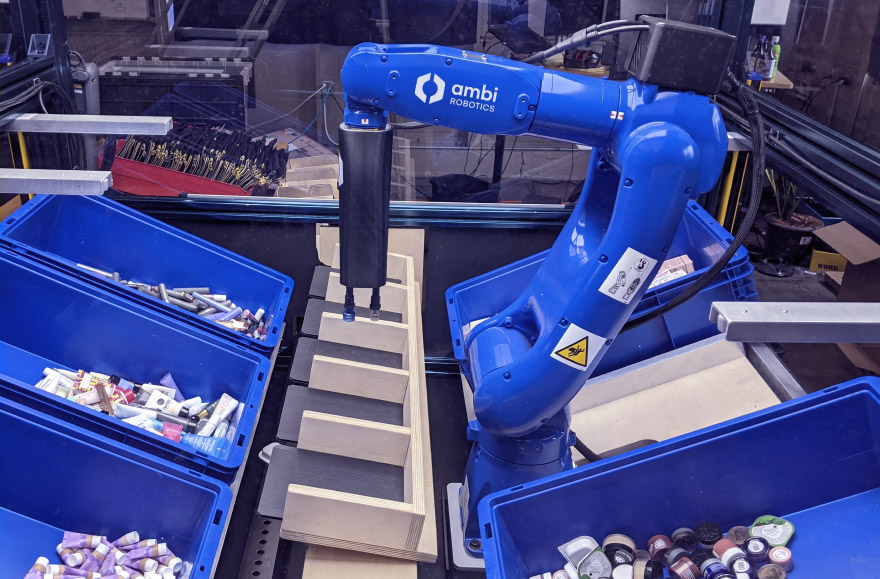
Image Credits: Ambi Robotics

There was a decent-sized round for Ambi Robotics, which is also using the opportunity to come out of stealth. Founded by UC Berkeley professor (and frequent TC Sessions: Robotics guest) Ken Goldberg, the company announced a $6.1 million seed. The startup specializes in pick and place robotics, starting with a pair of machines: the AmbiSort and AmbiKit. Goldberg has a pretty devoted following in the category, so this will definitely be one to watch.

Image Credits: Skycatch

This week we broke the news of Skycatch’s $25 million raise. We’ve covered the drone startup a number of times over the years. While countless companies are currently taking great pains to put drones to work in the real world, Skycatch has actually turned theory into practice. Its 3D imaging drones have already been deployed to thousands of sites all over the world.

Speaking of actually deploying robots into the real world, the delivery category has been doing a decent job of this. With COVID-19 still very much an issue in much of the country and world, now’s a pretty good time to start testing these system.

Image Credits: REEF Technologies

Granted, the tech isn’t in any real danger of replacing delivery people outright any time soon, but we are seeing a number of companies and cities get pretty aggressive about testing. You can add Cartken to that list. The company, founded by former Google engineers, has begun testing in Miami — a city, I’m told, by countless breathy thinkpieces and at least one Will Smith song, that is the place to be.

Image Credits: Toyota

Nuro, meanwhile, has had very little issue building excitement, event without the Fresh Prince’s encouragement. The delivery startup announced a massive $500 million Series C, back in November. More insight into that round arrives this week, as the Toyota-powered Woven Capital announces it was part of the round. The fund’s head of investments and acquisitions, George Kellerman, tells TechCrunch:

Nuro was a good jumping off point, because a lot of the work that we’re doing is really focused on developing autonomous passenger vehicles, so this is a way for us to learn and advance through a partner that is laser-focused on local goods delivery. There’s a lot of opportunity to learn from them, and potentially over time, to collaborate and help them expand globally.


Thrasio raises $100M for its Amazon roll-up play, appoints retail CFO heavyweight for its next steps

Thrasio raises $100M for its Amazon roll-up play, appoints retail CFO heavyweight for its next steps

Thrasio, an early mover and leading player in the wave of startups emerging to consolidate and scale companies that sell their goods mainly via Amazon’s Marketplace, has raised some more funding and is making a key executive appointment to do some scaling of its own. The company, which to date has acquired and consolidated some 6,000 companies selling on Amazon, has picked up $100 million, and alongside that it’s announcing a new CFO, retail vet Bill Wafford, as it eyes up its next steps, including a public listing.

The $100 million is an extension to Thrasio’s Series C — a round that saw a $750 million injection only about 6 weeks ago, and a previous close of $260 million last July.

Josh Silberstein, who is the co-founder and co-CEO with Carlos Cashman, said Thrasio is not disclosing valuation except to note that it is 50% higher than the it was a month ago for Thrasio, which today is profitable.

For some context, when we reported on the $750 million round, we noted that the valuation was potentially between $3 billion and $4 billion. All a spokesperson would tell us at the time was that it was “less than $10 billion” although a debt round in January put the valuation at around $3 billion.

Silberstein said the latest $100 million is coming from previous backers that didn’t get the allocation they hoped for in the previous financing. The list of past backers includes Oaktree, Advent, Peak6, Western Technology Investment, and Jason Finger, the co-founder of one of the early players in food delivery startups, Seamless.

Giving insiders are little more of a share also seems to hint at the fact that the company looks to be preparing for its next steps as a business, which might include a public listing via a SPAC or a more traditional IPO route.

“We are engaged in conversations where valuation where may once again become a topic so holding off on additional commentary for now,” said Silberstein in response to the question. “We’ve reached a point that there are legal consequences to being anything other than vague.”

As part of that process, Wafford is coming on as CFO from a previous role as CFO at JC Penney and before that, CFO of Vitamin Shoppe, in a longer resume that also includes finance roles at retailers like Walgreens and Target. He is replacing Joe Falcao, a longtime employee of the company, who is taking a role as SVP, Finance and Treasurer, to scale the company’s treasury, tax, and international finance functions.

Wafford’s experience across a range of bigger brick-and-mortar retailers that work with and partner with smaller brands across a number of categories from fashion to health and household goods is notable, in that it’s an analogue of what Thrasio is essentially building in the online world, where its 6,000-plus brands run the gamut from a therapeutic sock maker, to a company that has developed a spray to remove pet odors and stains, to a high-end kitchen goods maker.

“Thrasio’s trajectory and the speed at which it has achieved growth is impressive to say the least, especially how they’ve capitalized on the market changes that have occurred over the last twelve months,” said Bill Wafford, CFO, in a statement. “I’ve been delighted to discover an energizing, team-minded culture that embraces experimentation and adaptability. I’m thrilled to take on the role to prepare the organization for its next phase of growth.”

By one estimate there are about 5 million third-party sellers on Amazon today, a number that appears to be growing exponentially, with more than 1 million sellers joining the platform in 2020 alone. Thrasio’s business model is based around the premise that most of them are not that well prepared to scale when and if the most successful of this lot see their products take off.

Silberstein and Thrasio estimate that there are probably 50,000 businesses selling on the Amazon platform with FBA (Fulfillment by Amazon) that are making $1 million or more per year in revenues.

“What happens when you get into that price range is that it gets hard to grow your business and manage it,” he said, citing SEO, marketing, and supply chain management as some of the challenges. “That means as you grow from $1 million to $10 million, the margins would decrease and it gets even harder to make returns. We simply observed that reality that all these great companies had reached a point between a lack of access to capital and simply not being able to keep doing what they do. We thought, if we acquire 10-20 of these we would have the scale to build best in breed supply chain, marketing, and so on. We would fix the problem.”

It realised quickly, though, that there was an opportunity to take that even further and make that the business itself. And so Thrasio has been building a huge analytics engine that digs into Amazon data and a lot more to determine which companies are interesting, how to help them sell better, and eventually to conceive of even bigger businesses outside of the Amazon ecosystem, covering other marketplaces, other sales channels and direct D2C sales.

It hasn’t been the only one. Possibly spurred by Thrasio’s success we’ve seen launches and major funding for a plethora of these roll-up plays. Branded launched its own roll-up business on $150 million in funding earlier this year, and others including Berlin Brands GroupSellerXHeydayHeroesPerch and more — collectively raising or committing from their own balance sheets well over $1 billion in aid of their own efforts to buy up small but promising third-party merchants.

With Amazon only getting bigger by the day, and the challenge of weeding out quality from quite a lot of me-too knock-offs also growing, there is a clear role for improving discoverability and connecting consumers to the most interesting products, and helping those products succeed. At the same time, it will be worth watching how the roll-ups themselves grow and if they manage to deliver on all that they are promising to the brands they are buying, and to their investors.


Next Insurance raises $250M, doubling its valuation to $4B in under a year

Next Insurance raises $250M, doubling its valuation to $4B in under a year

Next Insurance recently announced that it has raised a $250 million round, valuing the SMB-focused insurance provider at $4 billion. The company last raised another $250 million in September 2020, at a valuation of $2 billion. This funding also comes after Next Insurance acquired Juniper Labs in December, and AP Intego more recently.

Next sells small-business coverage across a number of categories (workers comp, commercial auto, general liability, etc.) for different classes of workers. Think fitness companies, or construction concerns. Put together, Next’s bet is that its ability to price coverage across different categories and industries will allow it to scale its gross written premium (GWP) quickly by attracting myriad small businesses, and upselling them to other products over time.

Next Insurance’s new round and new valuation come at an interesting time for the insurtech space more broadly. Some air has come out of Lemonade’s share price, the rental-insurance unicorn being an early public debut for the broader tech-enabled, neo-insurance niche.

Since Lemonade’s debut, we’ve seen Root Insurance go public as well. The car insurance tech startup has struggled since its debut, losing value and attracting lawsuits despite besting investor growth expectations. MetroMile, another neo-insurance company focused on automotive went public via a SPAC-led combination, has been slightly uneven since starting to trade. Hippo, which focuses on home insurance, intends to list via a SPAC itself at a $5 billion valuation.

Inside those numbers you can find optimism, and some lackluster trading results. How to parse the mix will depend on one’s perspective.

For Next Insurance’s backers, however, it’s all systems go. And there’s reason to believe that their enthusiasm is not misplaced, despite some chop in Next’s broader market.

Next says its GWP in the half-year after its last round. That makes its valuation doubling seem somewhat reasonable — if private investors were willing to pay for its shares at a certain GWP multiple, why not re-up at double the price and double the GWP while the company continues to scale?

Just how big is Next today? It reached a GWP run rate of $100 million back in February of 2020. And it reached a $200 million GWP run rate in February of this year. So, larger than that by a few months’ growth, exclusive of the AP Intego business, which had around $185 million in active premium around the time its deal with Next Insurance was announced.

To clarify the numbers, TechCrunch reached out to Next Insurance for detail on when it doubled its GWP, and when the AP Intego deal started to count towards its numbers. Per an email from CEO Guy Goldstein, the doubling metrics regarding GWP was “in relation to that 2020 figure and [was calculated] before the AP Intego acquisition.” So, we can presume that the firm is now well north of the $200 million GWP run rate that it had previously cited.

Finally, TechCrunch asked the company about the SPAC boom and if it intended to avoid that rapid path to the public markets. “We’re always evaluating our options but right now, the main focus remains on growing the business,” Goldstein responded.

That’s a no.


Collabio lets you co-edit documents without the cloud

Collabio lets you co-edit documents without the cloud

Meet Collabio Spaces: An office suite app with a cloudless co-authoring twist that looks helpful if you need to collaborate on documents without having to worry about losing control of your data or the thread of changes.

The p2p software lets multiple people co-edit a document locally — from a mobile device or desktop computer — without A) the risk of uploading sensitive information to the cloud (i.e. as you must if you’re using a shared document function of a service like Google Docs); or B) the tedium of emailing a text to multiple recipients and then having to collate and resolve changes manually, once all the contributions trickle back.  

There’s more coming down Collabio’s pipe too. Document collaborating will be possible from anywhere in the future, not only (as now) via a local network: A major release slated for next month will add p2p collaboration that works via the Internet — but still without the privacy risk of having a remote server in the loop.

Collabio’s app is MacOS and iOS only for now — but Android and Windows versions are in the works, slated for release this year.

Current supported text formats are DOCX, ODT, XLSX and ODS. Other features of Collabio’s office suite include the ability to scan and recognise texts and images using a camera; annotate and comment on PDFs (including via audio); e-sign text documents and PDFs; and view presentations.
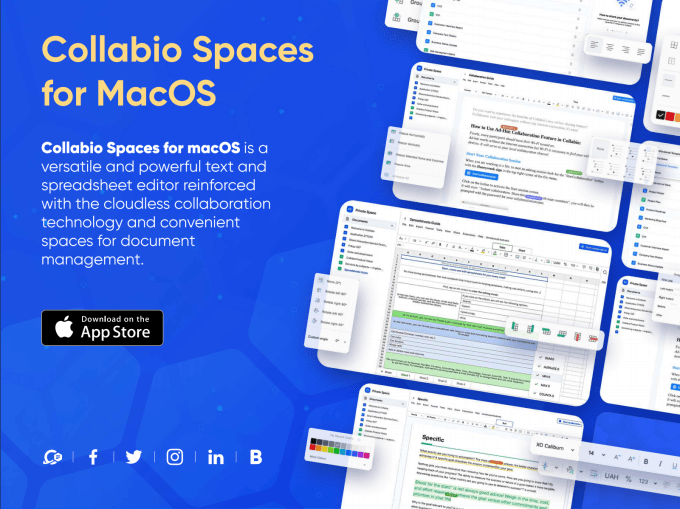
Image credit: XCDS/Collabio

Its maker XCDS (aka “eXtended Collaboration Document Systems”), which is headquartered in London, UK with an R&D hub in Prague in the Czech Republic, has been in business for around a decade at this point — but working on office tools for some seven years, per CTO Egor Goroshko, who says they see Collabio as a startup in its own right.

The app is being funded by (an undisclosed amount of funding from undisclosed) private investors, with the team planning to take in further funding to continue development in the near future as they build momentum for the product.

With the coronavirus supercharging remote working over the past 12 months there is certainly opportunity to improve on the current crop of collaboration and productivity tools — and help to safely break down any unwelcome workflow barriers which have been erected as a result of scores of office workers no longer being co-located. Although the current version of Collabio is designed for nearby, rather than remote collaboration — so its next major release looks the most interesting from that perspective.

The early team behind Collabio included some devs who worked on Quickoffice but didn’t go to Google as part of that 2012 acquisition. Instead they focused on thinking about how to improve the user experience around documents — finally bringing their long-developed p2p document collaboration product to market last fall.

“When we started with Collabio we were ready for the long game,” Goroshko tells TechCrunch. “We knew that we would need to implement most of the features [office suite software] users were familiar with, before we could start developing our own ideas.”

“Long story short, our cloudless collaboration works exactly the same way as a cloud one. Of course there is some difference in the way you connect to the document but after that, you have exactly the same experience as if you work in the cloud,” he continues.

“We started with an iOS app in September 2020 and introduced a macOS version in October. With our early releases, we mainly concentrate on testing the app with real users and prove our ideas. Starting from our launch, we’ve got almost 15K of installs and valuable feedback on what users need and what can be improved. We pushed intensively on the market starting in February 2021 this year and got more than one thousand users during this month.”

There are some key differences between Collabio’s p2p cloudless collaboration and the (more typical) upload-to-a-server flavor that are worth flagging.

Notably, the lack of constant access to the document that you’re co-authoring/co-editing. Although that limitation may also be desirable if you want to tightly manage collaborative access to your data.

“In Collabio we call cloudless collaborative editing ‘Ad-Hoc collaboration’, because without a cloud your peers have no constant access to the document, so this thing is essential for occasional document discussion and updates,” Goroshko notes.

Another important difference he points to is that a shared document remains on the owner host devices only — and a copy can only be saved by the owner (at least for now).

“Other peers have session document access but the application does not upload/transfer files to collaborators’ devices,” he explains. “[The] session lasts til the host keeps the document open. As soon as you close the document, peers lose their access and can’t save the document locally. This is made for reasons of privacy but we are now considering giving users the option to allow connected peers to save a copy of the document.”

Given that all document work is done on devices on a local network there’s no need for an Internet connection to be able to collaborate via Collabio — which the team argues can itself be pretty useful, such as in situations like business travel (remember it?) when a stable Internet connection may not be readily available.

For this local p2p connectivity Goroshko says Collabio uses both wi-fi and Bluetooth — “to achieve better discovering quality”. “This is a common approach used, for example, in AirDrop technology. When peers’ addresses are identified, the application establishes connection via WiFi to achieve better speed and the quality of data exchange,” he says.

“All work is done only on devices in the local network so our Ad-Hoc collaboration does not need the Internet, the same way as you do not need the Internet to exchange files via AirDrop,” he goes on. “Just like with AirDrop, you do not need any specific configuration for Collabio Spaces, everything is done automatically. You start a session and peers see it on their devices, they simply connect to a selected document, and if they know the code, they can edit the document.”

Goroshko says Collabio’s team has been inspired by Apple’s technology — and the tech giant’s ‘it just works’ philosophy. But are committed to bringing the product to non-Apple platforms, aiming for a release later this year.

“It is a large, complex and ambitious project but we believe we can introduce game-changing approaches,” he continues. “The Office software market is quite conservative and market expectations from new software are really high. This is the reason why it has taken so much time to get to a public release stage. But with such a high entrance threshold and with slow innovations in the area of office document management and editing, this creates great opportunities.”

He argues that Collabio has been able to get efficiency gains vs office suites that had to bolt collaboration onto a legacy product exactly because it was being developed from scratch — with “collaborative editing in mind from the first step of proof of concept”. Hence its implementation of collaborative editing algorithms can work “with minimal resources consumption even on mobile phones”.

Goroshko says a Collabio user can have up to five peers simultaneously connected if they launch a collaboration session via a mobile device — with all participants able to edit the document. (Desktops support more connections.)

“You launch a collaboration session with a honeycomb icon, and any nearby devices with [the] Collabio Spaces app show shared documents,” he explains. “Under the hood, it works the similar way as sharing files through AirDrop or streaming audio/video through AirPlay. People nearby can join editing, if they know the security code assigned to the session.”

These p2p connections are encrypted with “standard end-to-end encryption”, according to Goroshko — who admits to “some tricks to allow trusted connections in the local network without access to the Internet”, adding: “We believe that this is enough for the start but in the future we will probably improve this approach.”

So — as with any nascent and non-independently security-tested product — prospective users should approach with caution, weighing up the sensitivity of any data they might wish to share for co-editing purposes before trusting it to Collabio’s novel implementation.

The startup, meanwhile, sees plenty of potential growth coming from frustrated office workers trying to find smarter ways to work remotely.

“Our goal is to create an editor specifically for team work, to help people get the most from collaboration,” says Goroshko. “Working together with others gives you a lot of advantages but requires more effort to sync with others. Planning, tracking, discussions, reviews — currently most of this work is performed separately from the document or locked inside the document. We want to cover this gap and give our users the most from collaboration with each other.”

“We consider two main types of competitors on the market,” he adds. “Classical office document editing suites like MS Office, Google Docs and Libre Office. We do not consider direct competition with them because their features set is enormous. However, many people simply do not use most of these features!

“And now a few newcomers have appeared on the market like Notion or Airtable, introducing smart ways how the document editing process can be integrated into your business. We see ourselves somewhere in between these products and classical office suites.”

A subscription payment is required to use Collabio Suites but a free trial version is available for up to a week.

We’re also told there’s an option for free of charge usage where the user is able to view and edit documents as a peer but can’t be the host of a collaboration session.

The major release that’s coming in May looks set to expand Collabio’s utility greatly — enabling it to tap into the remote work boom — by adding the ability to do p2p collaboration from anywhere via the Internet, also without the need for a remote server sitting in the loop.

How will that forthcoming functionality work? In a word: Math. Goroshko says the implementation will rely on an Operations Transformation algorithm keeping the document consistent “at any moment” during co-editing — avoiding the need for true real-time operations.

“It does not matter what co-editors type for in the end they all have absolutely the same content,” he says. “The algorithm does not guarantee that the result will be meaningful. If several people type in the same place, they will get an abracadabra. But this will be exactly the same abracadabra after all changes have been synced between all participants. This is the point. Operations Transformation does not require true real-time operations, changes can come early or later, even after sufficient delays. In either case they will be transformed to become inline with other changes. So regardless of cloud or cloudless collaboration mode, you do not need specific infrastructure or high speed processing to support collaborative editing.”




Pair Eyewear raises $12M to bring more personality to your glasses

Pair Eyewear raises $12M to bring more personality to your glasses

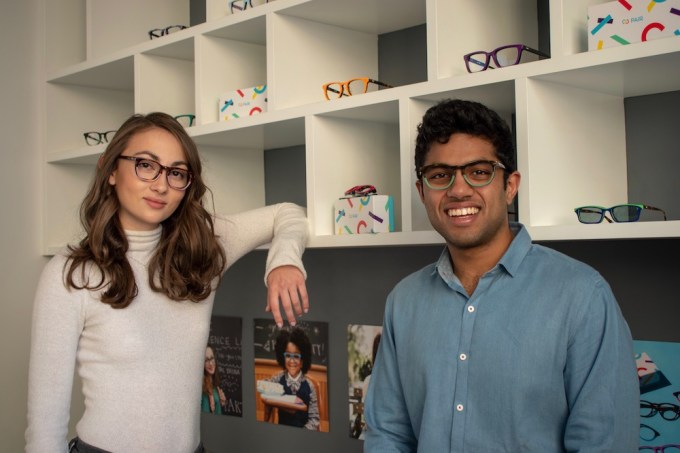
Pair Eyewear has raised a $12 million Series A to help glasses-wearing kids and adults turn those glasses into what co-CEO Sophia Edelstein called “a form of self-expression.”

After all, Edelstein (who founded the company with her co-CEO Nathan Kondamuri) noted that “you’re spending a lot of money on [glasses], and then you’re stuck with that choice, unlike everything else you wear.”

Pair Eyewear provides more flexibility by turning a pair of glasses into a two-piece ensemble. There’s the underlying base frame, which includes your prescription lenses, and then a variety of top frames that attach magnetically — you can swap out them out for a new look whenever you want.

“You can be loud one day and more subtle the next,” Edelstein said.

The startup releases three new limited edition collections of top frames each month, and it’s also struck partnerships to create branded top frames tied to Marvel, Harry Potter and NBA teams.

“Our average customer owns five of these top frames, but the range is incredible,” Edelstein added. “Some people have over 90 of them, and they’ve completely covered their fridge at home.”

The funding was led by Alex Gurevich at Javelin Venture Partners, with participation from Norwest Venture Partners, Precursor Ventures, Gingerbread Capital, NFL player Christian McCaffrey, Masterclass CEO David Rogier and others.

Gurevich, who’s joining Pair’s board of directors, told me that the idea was something that resonated with him personally. He recalled struggling to convince his four-year-old son to wear the glasses needed for his astigmatism — and only succeeding after telling his son that they’d make him look like Clark Kent.

“A few weeks later, I met with the team and they literally me showed me Spider-Man and Superman glasses,” Gurevich said. “I said, ‘I’ve been trying to convince my kid to wear glasses! If I’d had these, it would have been game over.'”

Gurevich said he was also impressed by the team (“I was blown away by how passionate Sophia and Nathan are about building a lasting, iconic consumer brand”) and the business model. After all, he said this looks like the first successful attempt to bring the “printer and cartridge, razor blade, high repeat usage model” to glasses.

Pair Eyewear founders Nathan Kondamuri and Sophia Edelstein

Pair Eyewear founders Nathan Kondamuri and Sophia Edelstein

Pair charges $60 for a base frame and then $25 for each additional Top Frame. The company accepts payments from HSA and FSA accounts, and customers can also get reimbursed as an out-of-network vision insurance benefit — but Edelstein said that with the glasses priced well below the $300 average, many people don’t bother.

Apparently Pair is able to offer these savings thanks to its unique manufacturing process, as well as its rejection of “industry standard” markups.

“We still retain incredible margins on the base frames and on the lenses,” she said.

Since appearing (and receiving funding) on Shark Tank in March of last year, Pair has has been seeing 30% month-over-month growth. Edelstein argued that this shows the business is “recession-proof,” and that people are interested in customizable eyewear even if it’s just to show off on a Zoom call or to enjoy at home.

Pair was initially focused on children’s eyewear, but 60% of the company’s purchases are now for adults — and that’s despite the fact that all five of the base frames were originally designed for children, and only two of them actually fit adults. Edelstein said that the new funding will allow the team to continue expanding the product lineup, particularly with more options for those adults.


Collaborative iOS app Craft Docs secures $8M, led by Creandum and a ‘Skyscanner Mafia’

Collaborative iOS app Craft Docs secures $8M, led by Creandum and a ‘Skyscanner Mafia’

Launched in only November last year, the Craft Docs app — which was built from the ground up as an iOS app for collaborative documents — has secured an $8 million Series A round led by Creandum. Also participating was InReach Ventures, Gareth Williams, former CEO and co-founder of Skyscanner, and a number of other tech entrepreneurs, many of whom are ex-Skyscanner.

Currently available on iOS, iPadOS and MacOS, Craft now plans to launch APIs, extended integrations, and a browser-based editor in 2021. It has aspirations to become a similar product to Notion, and the founder and CEO Balint Grosz told me over a Zoom call that “Notion is very much focused around writing and wikis and all that sort of stuff. We have a lot of users coming from Notion, but we believe we have a better solution for people, mainly for written content. Notion is very strong with its databases and structural content. People just happen to use it for other stuff. So we are viewed as a very strong competitor by our users, because of the similarities in the product. I don’t believe our markets overlap much, but right now from the outside people do switch from Notion to us, and they do perceive us as being competitors.”

He told me this was less down to the app experience than “the hierarchical content. We have this structure where you can create notes within notes, so with every chunk of text you add content and navigate style, and add inside of that – and notion has that as well. And that is a feature which not many products have, so that is the primary reason why people tend to compare us.”

Craft says it’s main advantages over Notion are UX; Data storage and privacy (Craft is offline first, with real-time sync and collaboration; you can use 3rd party cloud services (i.e. iCloud); and integrations with other tools.

Orosz was previously responsible for Skyscanner’s mobile strategy after the company acquired his previous company, Distinction.

Fredrik Cassel, General Partner at Creandum, said in a statement: “Since our first discussions we’ve been impressed by both the amount of love users have for Craft, as well as the team’s unique ability to create a product that is beautiful and powerful at the same time. The upcoming features around connectivity and data accessibility truly set Craft apart from the competition.”

Craft ipad app

Craft ipad app

Roberto Bonazinga, Co-founder at InReach Ventures, added: “We invested in Craft on day zero because we were fascinated by the clarity and the boldness of Balint’s vision – to reinvent how millions of people can structure their thoughts and write them down in the most effective and beautiful way.”

The launch and funding of the Craft startup suggests there is something of a “Skyscanner Mafia” emerging, after its acquisition by Trip.com Group (formerly Ctrip), the largest travel firm in China, $1.75 billion in 2016.

Other backers of the company include Carlos Gonzalez (former CPO at Skyscanner, CTPO at GoCardless), Filip Filipov (former VP Strategy at Skyscanner), Ross McNairn (former CEO at Dorsai, CPO at TravelPerk), Stefan Lesser (former Technology and Partnership Manager at Apple) and Akos Kapui (Former Head of Technology at Skyscanner, VP of Engineering at Shapr3D).


Airtel Africa receives additional $100M for its mobile money business from Mastercard

Airtel Africa receives additional $100M for its mobile money business from Mastercard

Two weeks ago, TPG’s Rise Fund invested $200 million in Airtel Mobile Commerce BV (AMC BV) — the mobile money business of London-listed telecom Airtel Africa. After closing the deal, the Bharti Airtel subsidiary noted that it was still in discussions to give up more minority stake (25% of the issued share capital) to more potential investors

Today, it has announced another investor — global payments provider Mastercard in a deal that will see Airtel Africa receive an additional $100 million for its mobile money business.

From the statement released, Airtel Africa and Mastercard have “extended commercial agreements and signed a new commercial framework which will deepen their partnerships across numerous geographies and areas including card issuance, payment gateway, payment processing, merchant acceptance and remittance solutions, amongst others.”

AMC BV’s $2.65 billion valuation on a cash and debt-free basis remains unchanged from the last time. This means TPG’s Rise Fund and Mastercard will own 7.55% and 3.775.% stake respectively upon the completion of their deals. For Mastercard, the transaction will close in two tranches — $75 million invested at first close (which will be finalized in the next four months), and $50 million to be invested at the second close.

By selling off a minority stake in the mobile money business to The Rise Fund, Mastercard and other potential investors, the telecom operator believes it can raise enough cash to monetize its mobile money business and pursue a possible listing in four years

In addition to receiving investments from TPG’s Rise Fund and Mastercard, Airtel Africa has begun selling off some assets as well. Last week, the company sold 1,424 telecommunications towers companies in Madagascar and Malawi to Helios Towers for $119 million. Both Helios and Airtel Africa also agreed to trade tower assets in Chad and Gabon, although the details remain undisclosed.

These efforts are geared towards the company’s pursuit of strategic asset monetisation, investment opportunities, and, ultimately, debt reduction.

“With today’s announcement, we are pleased to welcome Mastercard as an investor in our mobile money business, joining The Rise Fund, which we announced two weeks ago,” CEO of Airtel Africa, Raghunath Mandava said of the investment. “This is a continuation of our strategy to increase the minority shareholding in our mobile money business with the further intention to list this business within four years. We are significantly strengthening our existing strategic relationship with Mastercard to help us realise the full potential from the substantial opportunity to improve financial inclusion across our countries of operation.” 


Bilibili ups the ante in games with $123 million investment in TapTap

Bilibili ups the ante in games with $123 million investment in TapTap

Competition in China’s gaming industry is getting stiffer in recent times as tech giants sniff out potential buyouts and investments to beef up their gaming alliance, whether it pertains to content or distribution.

Bilibili, the go-to video streaming platform for young Chinese, is the latest to make a major gaming deal. It has agreed to invest HK$960 million (about $123 million) into X.D. Network, which runs the popular game distribution platform TapTap in China, the company announced on Thursday.

Dual-listed in Hong Kong and New York, Bilibili will purchase 22,660,000 shares of X.D.’s common stock at HK$42.38 apiece, which will grant it a 4.72% stake.

The partners will initiate a series of “deep collaborations” around X.D.’s own games and TapTap, without offering more detail.

Though known for its trove of video content produced by amateur and professional creators, Bilibili derives a big chunk of its income from mobile games, which accounted for 40% of its revenues in 2020. The ratio had declined from 71% and 53% in 2018 and 2019, a sign that it’s trying to diversify revenue streams beyond distributing games.

Tencent has similarly leaned on games to drive revenues for years. The WeChat operator dominates China’s gaming market through original titles and a sprawling investment portfolio whose content it helps operate and promote.

X.D. makes games, too, but in recent years it has also emerged as a rebel against traditional game distributors, which are Android app stores operated by smartphone makers. The vision is to skip the high commission fees charged by the likes of Huawei and Xiaomi and monetize through ads. X.D.’s proposition has helped it attract a swathe of gaming companies to be its investors, including fast-growing studios Lilith Games and miHoYo, as well as ByteDance, which built up a 3,000-people strong gaming team within six years.

Bilibili’s investment further strengthens X.D.’s matrix of top-tier gaming investors. Tencent is conspicuously absent, but it’s no secret that ByteDance is its new nemesis. The TikTok parent recently outbid Tencent to acquire Moonton, a gaming studio that has gained ground in Southeast Asia, according to Reuters. Douyin, the Chinese version of TikTok, is also vying for user attention away from content published on WeChat.


LINE Ventures merges with YJ Capital, launches $271M fund

LINE Ventures merges with YJ Capital, launches $271M fund

LINE completed its merger with Yahoo! Japan owner Z Holdings last month, and now the two firm’s venture capital arms have also combined. Z Holdings announced today that its subsidiary, YJ Capital, has merged with LINE Ventures to form Z Venture Capital.

The new firm also announced the launch of a 30 billion JPY (about $271 million USD) fund, which it claims makes it one of the largest corporate venture capital funds in Japan. The fund will look in Japan, as well as global markets like South Korea, the United States, China and Southeast Asia, for investment opportunities, with the aim of creating collaborations between startups and Z Holdings’ commerce, media and fintech services.

In Japan, Z Venture Capital will focus on data and AI technologies in sectors like healthcare, cybersecurity and B2B, investing in all stages of startups from seed to late-stage.

The firm will take a “sector-agnostic in principal” approach to its global investments based on local market trends, but plans to hone in on consumer internet, e-commerce, fintech and mobility companies. In the United States, it will also look for robotics, deep tech and blockchain opportunities.


How SOSV-backed Achiko pivoted from financial services to health tech during the COVID-19 pandemic

How SOSV-backed Achiko pivoted from financial services to health tech during the COVID-19 pandemic

Many companies had to adapt during the COVID-19 pandemic. For SOSV-backed Achiko, this meant shifting its focus from mobile payment services to affordable COVID-19 screening. Achiko’s platform combines an app called Teman Sehat (“Health Buddy” in Indonesian) for payments and keeping test records, and proprietary low-cost testing kits using DNA aptamers, or synthetic strands of DNA, that are cheaper to manufacture than rapid or PCR tests.

The testing kits, formerly code-named Gumnuts and now called Aptamex, were developed in a partnership with Barcelona-based biotech company RegenaCellx.sl and completed the first phase of its clinical validation trials in January, with the goal of moving to production in the second quarter of this year. Teman Sehat, meanwhile, was built on technology that Achiko had developed for a payments aggregator called Mimopay.

Founded in 2018, Achiko listed on the Swiss Stock Exchange the next year. Chief executive officer Steven Goh told TechCrunch that the company was in the process of expanding into buy now, pay later services in 2020 when COVID-19 disrupted international travel. As a result, the compliance process would have been much more lengthy and expensive. Achiko decided to see what could be created with its existing technology to address the pandemic instead, and launched Teman Sehat as a result.

The app offers incentives for people to get tested, take payments and keep records of test results that could be used for check-ins by workplaces and businesses. While working on Teman Sehat, however, Goh said Achiko’s team realized that the cost of COVID-19 PCR and rapid tests were too high for many people in emerging markets. While frequent mass testing might eventually be accessible in the United States and Europe, Goh told TechCrunch “the actual wholesale costs of rapid tests would be $5 to $8. By the time, you’re actually delivering a rapid test in the field, it could be anything between $20 and $70, and if you’re in a country like the Philippines or Indonesia, that sort of price point is too high.”

Achiko decided Teman Sehat’s potential would be limited unless it was coupled with a low-cost testing solution, and began working with Regenacellx.sl. In January, it appointed Dr. Morris Berrie, co-founder and chairman of TTS Global Initiative, as president to help with the development and production of Aptamex.

Achiko’s team emphasizes it is not meant to be a replacement for PCR and rapid tests. Instead, Aptamex will serve as an affordable screener, costing under 25 cents USD per kit, that can be used frequently (daily or every other day), and people who test positive will be referred to PRC or rapid tests.

Berrie told TechCrunch that the benefit of aptamers is that they are inexpensive to produce and can be ordered from suppliers of synthetic DNA. “It is incredibly cheap and synthetic and the test itself is non-invasive. All these things are big pluses. The most important of all is the price point is a fraction of other testing kits available,” he said.

To use Aptamex, people gargle a mouthwash, spit a sample into a tube and drop it off at a testing center. Then the saliva sample is diluted in Aptamex’s aptamer test conjugate and scanned with a spectrophotometer to see if the aptamers bind to the COVID-19 spike protein. Results are available within an hour and can be sent through Teman Sehat. Phase 1 testing for Aptamex in Indonesia showed results of 91% sensitivity (or how often it correctly showed a positive result) and 85% specificity (or how well it identified true negatives) in field tests.

Procurement and manufacturing for Aptamex tests is currently underway in Taiwan, and Achiko is preparing filings with Indonesia’s Ministry of Health with the target of shipping kits by the beginning of the third quarter. It is also applying for CE certification in Europe and plans to apply for FDA approval in the United States, too.

Goh said aptamers can used to develop tests for other pathogens, and applied in other formats, including microfluidics and electronic sensors. This means Aptamex can be adapted for COVID-19 mutations and eventually be used to screen for other diseases. One potential barrier to the use of aptamers in diagnostics is the lack of standardized protocols and kits, but Achiko believes those can be developed as the cost of chemical synthesis decreases and databases of aptamers are created.

In the future, Achiko will continue to focus on health tech instead of financial products. “There’s no intention to be a financial services platform going forward,” Goh said. “The vision of being able to use a new technology stack to detect first with COVID, but any universe of other pathogens or indications of possible ailments, and having a platform to integrate these things in a contemporary way is something we believe is worthwhile.”


Cendana has raised a $30 million ‘fund of funds’ for VCs managing $15 million or less

Cendana has raised a $30 million ‘fund of funds’ for VCs managing $15 million or less

Cendana Capital, a San Francisco-based fund of funds manager, has amassed stakes in more than 100 venture firms since launching in 2010. For the most part, it did this by focusing on managers who are raising funds of $100 million or less in capital, even foregoing stakes in beloved outfits like Forerunner Ventures and Uncork Capital as their assets under management ballooned well beyond that amount.

Yet as the market changed, however, Cendana founder Michael Kim began to play with that formula. Last spring, for example, when he closed on $278 million in new capital commitments, he said planned to invest in the seed-stage managers he has always backed, but that he planned to funnel a small amount of capital to pre-seed managers raising $50 million or less, as well as to invest in a sprinkling of international managers.

Now Kim is back with a brand-new fund that sees him covering even more ground. Called Cendana’s Nano fund, it has raised $30 million in capital from existing Cendana backers to invest in up to 12 investment managers who are piecing together funds of $15 million or less capital. There are too many smart people right now making smaller bets for Cendana not to make the move, he suggests. We talked with Kim about the fund — and the changing landscape more broadly — in a chat has been edited lightly for length.

TC: What’s the thesis behind this Nano fund?

MK: The seed market has evolved a lot over the last 18 months to 24 months. You have this whole world of Twitter VC, meaning people who have a lot of strong opinions and an operator-investor perspective, but who may not have substantial funds behind them. You have solo capitalists like Lachy Groom and Josh Buckley, who’ve gone out and raised hundreds of millions of dollars. You also have the AngelList rolling funds. I think there are probably more than 100 rolling funds out there, and probably 95% of them are [headed by] people who are working at the big tech or private tech companies, and it’s more of a vehicle of convenience for their friends to invest alongside them.

TC: And you think they need more capital than is floating out there already?

MK: I think we are the only institutional LP that is focused at this stage, because as you know, many of the funds of funds and university endowments and family offices have to write big checks, so they’re not going to be investing a little bit into a tiny $10 million fund.

TC: What are you looking for exactly?

MK: The goal is to find the next Lowercase Capital. Not everyone knows this, but Chris Sacca’s first fund was $8 million and it returned 250x. Manu Kumar of K9 Ventures — his first fund was $6.25 million and returned 53x. So you can generate substantial alpha with these smaller funds.

Historically, we would meet with fund managers, and when they said, ‘We’re going to raise a $10 million to $15 million fund,’ we were like,’Okay, sounds interesting. Let’s talk when you’re raising your second fund.’ But we realized that we’re missing out an entire segment of the market. So Nano was created to capture that.

TC: Why draw a line in the sand at $15 million?

MK: First, if you’re going to be running a $100 million seed fund, you have to be writing $1.5 million to $2 million checks, and that’s a super competitive space right now, because not only are there other seed funds but also a lot of firms — Founders Fund, Sequoia Capital, Lightspeed, General Catalyst — that are very active at the seed stage. We’re coming across a lot of these managers who want to stay small, because by writing $300,000 to $400,000, they’re not competing against Sequoia or Forerunner Ventures; they’re just sliding into the round.

TC: Do you worry they will just get washed out of that investment later through subsequent checks from bigger players?

MK: Right now, we now have more than 100 portfolio funds within Cendana, and we did some data analysis. We looked at the fund size, and then the average ownership of each fund. And it turns out there’s a baseline of about 15% of a fund, meaning if you’re a $100 million fund, the average ownership stake [you have in your startups] is around 15%. If you’re a $50 million fund, the average ownership is about 7.5%.

We then looked at performance across our fund managers, and it turns out that of funds with $50 million in capital — our better-performing funds — have more ownership than 7.5%. They have more like 10% to 12%. Now, when you look at these tiny funds, if you’re a $15 million fund, 15% of that [should equate to] 2.2% ownership, but we are seeing that these tiny funds are actually getting more like 4% to 5% ownership. They’re punching above their weight because of who is involved.

TC: Who have you backed so far?

MK: The first one is Form Capital, a fund from Bobby Goodlatte and Josh Williams. Both were early at Facebook; Bobby led the team that designed Facebook Photos and was later an [entrepreneur-in-residence] at Greylock. Josh cofounded Gowalla (acquired by Facebook).

TC: How big a fund are they raising and how much are you giving them?

MK: They raised a $15 million fund, and our strategy is to [account for] 20% of [each of these funds], so we wrote them a $3 million check.

The second fund manager is Jeff Morris Jr.; he runs a fund called Chapter One. He was a senior product guy at Tinder and and an active angel, and he raised a $10 million fund last year into which we wrote a $2 million check.

TC: And the third?

MK: The third manager hasn’t closed the fund, so I can’t disclose his name, but he was a very early employee at Uber and ran their data teams.

The last is an interesting example because this person could probably go out and raise $100 million, but to my point about not wanting to compete against everyone in the world in writing a big check, he’s content to write [sub $500,000] checks into interesting data analytics and AI and machine learning companies, and everybody wants him involved because of his experience and his network of data scientists worldwide.

TC: When Chris Sacca dove in, it was his full-time job, I think. Do you care if these managers are focused solely on investing?

MK: No. With Nano we’re investing in people who may actually have a day job, which would not be a fit for our main fund, but with our Nano fund, our aperture is wider. We welcome anyone out there looking to manage $15 million or less to reach out.

TC: Well, to be clear, you have some criteria. What is it?

MK: No matter who we invest in, they have to have investment experience and an investment track record. What we really look for at the end of the day is a person who has some sort of advantage — whether it’s domain expertise or networks. So you could be an amazing computer scientist in Pittsburgh at Carnegie Mellon and if you’ve made some investments [we’d talk with you]. It could be someone coming out of Stripe or PayPal or Facebook or an entrepreneur in Atlanta.

TC: A $30 million fund of funds is going to get committed pretty fast in this market. Is the plan to raise maybe one every year?

MK: We have an incredible top of the funnel, and as you’re alluding, we’re going to be inundated. But we walk in there and try to meet with everybody.

We’re also in discussions with our existing fund managers to create a nano fund for [some of] them. So, you know, imagine one of our fund managers, running a $100 million fund. Why not create a $10 million nano vehicle with them where they could write $250,000 to $500,00 check? They don’t want to fill up their fund with these small checks, but you could see how, if they were to create this smaller vehicle, it could be very interesting for them for a returns perspective.

TC: So you’d write them a check for a third of this nano fund . . .

MK: And their LPs would fill in the rest. I’m sure they’d be excited to do it.