Thursday, 2 June 2022

Temasek’s Pavilion Capital backs South Korean AI chip maker Rebellions with $50M investment

Temasek’s Pavilion Capital backs South Korean AI chip maker Rebellions with $50M investment

Global venture capital firms are pouring money into the semiconductor startups developing the next generation of chips. Semiconductors, which have become a valued asset, are used in virtually almost every industry, including 5G networks, automation, the Internet of Things, financials, smart homes, smart cities, virtual reality (VR), augmented reality and self-driving cars.

Sunghyun Park, a former quant developer at Morgan Stanley in New York, launched artificial intelligence semiconductor startup Rebellions with four co-founders to enter this red-hot industry in 2020. Today, the South Korea-based company that builds chips designed for artificial intelligence applications, announced it has raised a $50 million (62 billion KRW) Series A from investors, including Temasek’s Pavilion Capital, Korean Development Bank, SV Investment, Mirae Asset Capital, Mirae Asset Ventures, IMM Investment, KB Investment and KT Investment.

Its existing backers Kakao Ventures, GU Equity Partners and Seoul Techno Holdings also participated in the round, Park told TechCrunch. 

The Series A, which was oversubscribed — the firm initially targeted around $40 million — and wrapped up in less than three months, brings Rebellions’ total funding raised to about $80 million (100 billion KRW) at an estimated valuation of $283 million (325 billion KRW), CEO of Rebellions Park said in an interview with TechCrunch. 

The startup will use the capital to mass-produce its second AI chip prototype, called ATOM, which will be used in enterprise servers, Park said. Additionally, the funding will be used to double its headcount to 100 employees, and set up an office in the U.S. by the end of this year, Park continued. 

Rebellions is in talks with potential customers to get its first AI Chip, called ION, into the market. The company’s ION customers could include global investment banks, and its second chip ATOM targets large companies in the cloud sector and data centers, Park added. It has lined up Taiwan Semiconductor Manufacturing Company (TSMC) to begin manufacturing the ION chips as early as next year.  

The company claims that its first chip ION, released in November 2021, improves trading speeds and reduces latencies and is two times faster than Intel Habana Labs’ AI Chip Goya in terms of execution. That means Rebellions’ ION enables faster data execution, so that lead orders can be processed more quickly and profitably than traders with slower execution speeds. High-frequency trading (HFT), or systematic trading, is an automated trading platform used by large investment banks, hedge funds and institutional investors to transact a large number of orders.  

Rebellions' AI chip ION

Image Credits: Rebellions’ AI chip ION

Park had previously helped design a Starlink ASICs chip at SpaceX, and worked as an engineer at Intel Labs and Samsung Electronics. 

There are more than 50 AI chip makers in the world, including Samba Nova, Graphcore, Groq and Cerebras, looking to challenge AI processors from Nvidia, Intel and Qualcomm, according to Gartner analyst Alan Priestley. Intel acquired Israeli AI chipmaker Habana Labs for about $2 billion in 2019 while Qualcomm picked up Nuvia for approximately $1.4 billion in early 2021. The AI chip market is projected to be worth over $83.2 billion by 2027, up from $56 billion in 2018, per a 2019 report by Insight Partners. 

Venture capital funding for global chip startups more than tripled year over year in 2021, with $9.9 billion invested across 170 deals, per PitchBook.  


Cruise can finally charge for driverless robotaxi rides in San Francisco

Cruise can finally charge for driverless robotaxi rides in San Francisco

Cruise, the autonomous vehicle unit of General Motors, has finally been given the green light to start charging fares for its driverless robotaxi service in San Francisco.

The California Public Utilities Commission (CPUC) voted Thursday to award Cruise with a driverless deployment permit, the final hurdle the company needed to jump to begin operating its autonomous ride-hail service commercially.

Cruise will be operating its passenger service at a maximum speed of 30 miles per hour between the hours of 10 p.m. to 6 a.m. on select streets in San Francisco, adding another one and a half hours to its current service. The company will need additional state regulatory approval to charge members of the public for driverless rides in the rest of the city, according to a Cruise spokesperson. These preconditions come as part of Cruise’s “passenger safety plan” that limits the service to overnight hours and doesn’t include the city’s dense urban core, according to the CPUC’s draft resolution.

“In the coming months, we’ll expand our operating domain, our hours of operation and our ability to charge members of the public for driverless rides until we have fared rides 24/7 across the entire city,” a spokesperson for Cruise told TechCrunch.

Screenshot of Cruise's proposed autonomous ridehail service in San Francisco

Screenshot of Cruise’s proposed autonomous ride-hail service in San Francisco per CPUC agenda. Image Credits: California Public Utilities Commission

Cruise has been offering free driverless rides to San Franciscans in its autonomous Chevrolet Bolts between the hours of 10:30 p.m. to 5 a.m. since February. The company began testing its autonomous vehicles without a driver in the front seat in the city in 2020, and started giving passengers free test rides in June 2021. In October last year, Cruise received a driverless deployment permit from the California Department of Motor Vehicles, which meant it could begin charging for autonomous vehicle services, like delivery. Crucially, the limits of the DMV’s permit stop at charging for robotaxi rides.

With this CPUC permit, Cruise is the only AV company in the city that can operate a commercial driverless ride-hailing service. Waymo, Cruise’s biggest competitor and the self-driving arm of Alphabet, also recently received a permit from the CPUC to charge for robotaxi, but only if a human safety operator is present during rides. Waymo has been offering a fully autonomous commercial ride-hail service in Phoenix since 2020, and recently expanded its driverless program in the city.

While Cruise’s CPUC permit allows for a fleet of up to 30 all-electric autonomous vehicles, Cruise has not been shy about promoting its plans to scale rapidly in the near future. Last year, former CEO Dan Ammann laid out Cruise’s plans for growing its fleet of purpose-built Origin AVs to thousands, even tens of thousands, in the coming years.

Last week, a group of San Francisco agencies — including the city’s municipal and county transportation authorities, the Bureau of Fire Prevention and Investigation, the Mayor’s Office on Disability and the SF Police Department — raised concerns about the lack of clarity within the CPUC’s draft resolution regarding limitations to Cruise scaling its fleet.

The draft resolution stated that Cruise must submit an updated passenger safety plan in the form of a Tier 2 advice letter before modifying “any changes to the hours, geography, roadway type, speed range, or weather conditions in which Cruise intends to operate…”

Notably, that language doesn’t oblige Cruise to have to appeal to the CPUC if it wants to increase its fleet size, a distinction which the SF stakeholders argue will “increase the negative impacts of driverless Cruise AV deployment” given Cruise’s “current approach to passenger loading,” another item of concern in the city’s comments on the draft resolution.

“Cruise’s current approach to passenger pickup and drop-off, stopping exclusively in the travel lane even when curb space is available, is below the level expected for human drivers,” the comments read, emphasizing the danger that an ever-growing fleet of AVs stopping in the travel lane could pose to vulnerable road users, like emergency responders, people with disabilities and older people and cyclists.

As part of its comments, the city provided a list of recommendations for the CPUC to integrate into its final resolution, including:

  • Clarifying that increases in fleet size and vehicle model require Cruise to submit an advice letter, given Cruise’s goals to not only expand its fleet size rapidly, but to do so with a new, purpose-built vehicle.
  • Requiring CPUC staff to post on its website the geographic area in which operation of driverless Cruise AVs is authorized. Cruise told TechCrunch it currently offers driverless rides for members of the public in about 70% of the city, which is detailed in a rough map CEO Kyle Vogt recently tweeted, but did not provide the specific areas in which it will charge passengers for driverless rides. However, the CPUC’s agenda included a photo of Cruise’s initial service area, including certain streets that are excluded from the geofence, which is likely where the company will begin charging for rides. The zone spans north to south from Richmond District to Sunset District, and northeast into Pacific Heights and Cole District.
  • Convening a regular working group to address data collection around pickup and drop-off of customers and AV interactions with first responder and street-based workers in San Francisco.
  • Collecting data on wheelchair accessibility.

“The [draft resolution] applies the same ‘wait and see’ approach that the Commission used in regulating Transportation Network Companies (TNCs),” read the comments. “That approach undermined San Francisco’s climate goals, reduced transportation options for people who use wheelchairs, and significantly increased congestion and travel time delays on San Francisco streets used for robust public transit services. These outcomes are likely to be repeated unless the issues identified in these comments are addressed.”

The CPUC’s decision to award Cruise with a deployment permit sets a precedent for how the state will continue to regulate commercial AV services in the future, so feedback from the public is crucial. And indeed some of the city’s recommendations did made it into the final draft language.

For example, the deployment decision directs the Consumer Protection and Enforcement Division (CPED) of the CPUC to include whether or not a citation was issued in a collision or incident involving law enforcement in its categories of incidents for reporting. In addition, to support easier access, CPED conceded to post Cruise’s driverless deployment operational design domains on its website.

However, the final language in the decision doesn’t require Cruise to necessarily submit an advice letter if it wants to add vehicles to its fleet, though it does commit Cruise to engaging with the CPED to discuss whether such a letter might be necessary in the future as changes to fleet size could materially affect the passenger safety plan.

Finally, while the Commission encourages Cruise to provide wheelchair accessible vehicles and services for people with disabilities, the resolution doesn’t require it to run a commercial service.

This article has been updated to include information on which of the city’s recommendations made it to the final deployment permit language. 


Social app IRL lays off 25% of team, says it has enough cash to last well into 2024

Social app IRL lays off 25% of team, says it has enough cash to last well into 2024

“We have all seen the state of the market,” IRL CEO and co-founder Abraham Shafi wrote in a company-wide memo where the social app announced it would be dramatically cutting staff. Similar to dozens of startups over the past few weeks, IRL has just announced it’s laying off 25% of its team, or around 25 people, citing market dynamics. The cut comes around a year after the startup landed a $170 million SoftBank-led Series C and hit coveted unicorn status. 

What’s different from recent layoffs, though, is the company’s tone.

“Courage is a decision, and we will choose courage,” Shafi wrote in the memo, obtained by TechCrunch. “Whatever we are facing today can’t be any worse than the uncertainty we met at the beginning of the COVID 19 pandemic.”

Regardless of the state of the pandemic, though, layoffs force workers into an unexpected period of precariousness, augmented by the impending loss of health insurance.

Regarding the decision to cut staff, Shafi wrote that IRL has “more than enough cash to last well into 2024.” Over the last year, the startup increased its head count by 3.5 times, but Shafi noted that WhatsApp was able to grow to 450 million users with a team of 55. This suggests that the workforce reduction was less about trying to reduce runway and more about right-sizing the team after a period of overhiring.

“Becoming one of these iconic, impactful companies is akin to winning a gold medal in the Olympics. In fact, probably more challenging,” the CEO wrote. “Like the Olympics, we know most people don’t want to be Olympians. In the same way, not everyone will want to walk the path we are walking. But for those that want to push their limits and find out what they are capable of, this culture is for you.”

Throughout the memo, Shafi emphasizes the employees’ necessity to “adapt” and be “disciplined.”

“I have been reflecting on Darwin’s observation that the highest indicator of survival for any living organism is not brute force strength, but how quickly it can adapt to its changing environment,” Shafi wrote. “This company is a living organism, and our ability to adapt to our changing environment is of the utmost importance.”

Going forward, IRL is focused on being an engineering-led organization, suggesting that the layoffs impacted other teams.

An employee at IRL, who spoke to TechCrunch on the condition of anonymity, confirmed the layoffs and said that they “support the move and respect it.”

“It shows a SoftBank company is taking responsibility, usually SoftBank companies get criticized a lot,” they said. “Financially, I know we’re good because I heard we have around $100 million still in the bank…years and years of runway.” The employee, who was not impacted by this layoff, said that the startup has a ton of new features, partnerships and prototypes in the works to create a more meaningful service in the future.

IRL was founded in 2017 as a way to help users find real-world events, but when the pandemic hit, the platform pivoted to prioritize the discovery of online events. The company told TechCrunch at the time of its Series C that it had 20 million registered users, with 400% growth over a 15-month period. But some employees told The Information that they were skeptical of the accuracy of these numbers. It’s unclear if IRL’s user growth played a role in today’s layoffs, but it’s more likely a combination of factors, including also the current economic downturn that’s impacting the tech industry more broadly.

Even as global lockdowns have eased, IRL remained dedicated to its new, digital-first strategy while also allocating money from its Series C to help bring back in-person events. At the same time, IRL also invested in its integration with TikTok and thought of itself as a potential “WeChat of the West.” It later acquired the “digital nutrition” startup AeBeZe Labs with an eye on making its service a “healthier social app.”

While the co-founder cites macroeconomic environment as reasoning to adapt, he also talked about how both individual economic hardship and recent tragedies like mass shootings could increase the demand for “humans’ need to feel connection and intimacy,” which is IRL’s mission.

“Now, our mission is not for the faint of heart. There will be naysayers, critics, hackers, spammers and so on, he continued. “We will succeed as long as we focus on what we know and what we can control. Not just for us but our users worldwide.”

Shafi confirmed the layoffs, and provided the following statement to TechCrunch:

“As we assess our path forward, we’ve had to make the unfortunate decision to reduce our team. We’re grateful for each of these individuals’ contributions in bringing IRL’s mission to life as well as the impressive business acumen that they brought to the table everyday. We wish our former teammates the best on their journeys ahead; They are talented people, and we have no doubt they will thrive anywhere. As such, along with the offered severance, we’ll provide any support where we can for those who may want it in their search for their next endeavor. As for what’s next for IRL, we’ll remain focused on building a product and community that creates more fulfilling human connections for the next generation.”

You can read the memo he sent to staff, per sources, in its entirety below:

Dear IRL Team,

Today was tough. We had to lay off many talented people, which is never easy. The journey ahead isn’t easy either, but I am confident that it will be easier with all of you.

We have all seen the state of the market. It is the worst since 2007-2008, but this is not a time to panic. Instead, this is a time to make the most of constraints. Courage is a decision, and we will choose courage. Whatever we are facing today can’t be any worse than the uncertainty we met at the beginning of the COVID 19 pandemic. Let’s remember that great tech companies were forged during more challenging economic times. Many of the great products and services we all use today (Uber, AirBnB, etc…) caught their stride during a downturn, and we will be no different.

We can’t control market dynamics, but we can control how we invest our time and resources in any market dynamic. To increase our success, we will continue to be more disciplined with our time and resources. We also needed to downsize our team to the fundamentals in service of our focus. Exercising discipline and adaptation to our current environment means moving from a 100-person team to a ~75-person team. With a focus on being an engineering led organization. To put it into perspective, this is still a 3.5x increase in headcount from a year ago. Gratefully we have more than enough cash to last well in 2024 and now is the time to be offensive, diligent, and proactive. Whatsapp was able to grow to 450M users with a team of 55. I am inspired by that and I believe we will forge our own amazing story with a small but incredibly amazing team.

I have been reflecting on Darwin’s observation that the highest indicator of survival for any living organism is not brute force strength, but how quickly it can adapt to its changing environment. This company is a living organism, and our ability to adapt to our changing environment is of the utmost importance.

Our goal remains the same, to provide a product and a set of tools that helps to truly bring the entire world closer together through shared interests, communities, and more intimate and meaningful conversations.

The world is going through a collective struggle of inflation, higher cost of goods, layoffs, school shootings, and many experiencing loneliness and depression. During these kinds of shifts, humans’ need to feel connection and intimacy through tough times increases massively.

Our mission has never been more critical than it is now. I am not saying we can solve all human suffering or loneliness entirely, but if we can even play our role enabling any meaningful impact, it’s worth it .

The way things get better is by everyone doing their best to help make the world a little nicer, a little softer, and a little more friendly. All of that compounds into real impact. One of the intentional decisions I made in building our product is to focus on making the business success symbiotic with consumer success. It is a virtuous loop. As long as we focus everything we have on being of service and to people, connecting and feeling less alone in this world,  we will be building a deeply meaningful business.

We have already seen the people who are adopting IRL are doing so because they don’t want to use Facebook and no other product fits their core needs around groups, events, and communities. I have always believed that every excellent consumer company reflects and amplifies a part of humanity. And each product satisfies a specific and unique human need, impulse, or compulsion.

  • Tiktok is for entertainment.

  • Twitter caters to venting.

  • Instagram is for showing off your lifestyle.

  • Snapchat is for sharing moments.

  • IRL is for your communities.

The original, fundamental thing that makes us human is to be in community. Given this truth, it is incredible no single company is winning across the globe. This is our opportunity. To become the place for humans to organize and find their community. Big or small. Public or private.

We see the impact we are making on our users and the thriving communities and conversations people have found in our product to date, and we are just getting started. A small handful of companies in the social space have made such an impact on people that they can consider themselves iconic and meaningful for decades to come. I fundamentally believe that if we are successful in our mission, we will cement ourselves as one of them as well.

For us at IRL, it’s critical to deliver a measurable sense of progress in digital interactions and relationships so they don’t feel swift and superficial; or utterly repetitive and removed from real life. We can (and must) develop prompts, nudges, design in delight that makes people smile, and create an incredible product to improve the human experience online.

Now, our mission is not for the faint of heart. There will be naysayers, critics, hackers, spammers, and so on. We will succeed as long as we focus on what we know and what we can control. Not just for us but our users worldwide.

Becoming one of these iconic, impactful companies is akin to winning a gold medal in the Olympics. In fact, probably more challenging. Like the Olympics, we know most people don’t want to be Olympians. In the same way, not everyone will want to walk the path we are walking. But for those that want to push their limits and find out what they are capable of, this culture is for you.

I have worked my entire life for a moment like this, and I am dedicated to putting every ounce of blood, sweat, and tears into making this a reality. Life is short, and I want to make the most of every moment. I am grateful that every day I get to wake up and obsess over helping others connect through community. I believe all of you feel this way, and I am so deeply honored to work alongside you all.

I wish our former teammates the best on their journeys ahead. They are talented people, and I have no doubt they will thrive elsewhere.

For those of us who remain at IRL, this is a new chapter for all of us to see what we are capable of.

Here in service to you,

Abraham Shafi

Dominic-Madori Davis and Sarah Perez contributed reporting to this piece.


Pear VC’s Anand Iyer goes solo with new $200M fund for crypto developer tools

Pear VC’s Anand Iyer goes solo with new $200M fund for crypto developer tools

Engineers are the bedrock of any tech product, and blockchains are no exception. As the race between different chains heats up, communities of loyalists are duking it out to attract developers to their blockchain of choice in hopes that doing so will turbocharge growth. And competition aside, without adequate infrastructure and tooling, the big ideas and promises of web3 don’t have any shot of seeing the light of day.

That’s why Anand Iyer, who has worked at Microsoft as a “developer evangelist” trying to incentivize engineers to build on the company’s stack, is looking to do the same in crypto — this time, as an investor. Iyer, a serial entrepreneur with two successful exits, spent the majority of last year honing in on his interest in web3 as a visiting partner at Pear VC and an instructor teaching a DeFi masterclass to over 2,000 students.

Now, the blockchain aficionado who got his start in trading Bitcoin in 2013 is joining the ranks of a growing group of solo GPs raising venture funds built on their own name and reputation. Iyer has raised $20 million in what he says was an oversubscribed round for his inaugural fund, Canonical Capital, he told TechCrunch. Participants in the fundraise include a number of family offices and individuals from the VC and tech communities, including Coinbase Ventures’ Shan Aggarwal, a16z’s Marc Andreessen and Chris Dixon, Judith Elsea,  Lux Capital, Mar Hershenson, Haseeb Qureshi from Dragonfly Capital, Dan Romero, Semil Shah, Amy Wu from FTX Ventures and Bilal Zuberi, among others, the firm says. 

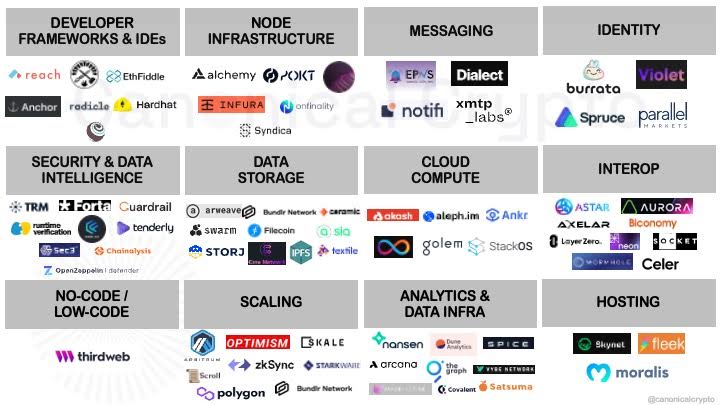
Canonical has already made 16 investments in seed and pre-seed startups spanning the developer infrastructure landscape, Iyer said. Its portfolio includes Solana-based NFT marketplace FormFunction, low-code multi-chain dApp tool Thirdweb, and web3 messaging startup Notifi. The firm expects to make 40 to 50 investments in its first fund, writing checks between $250,000 to $500,000, it says.

Canonical Crypto's market map of opportunities in web3 infrastructure

Canonical Crypto’s market map of various segments within the web3 developer infrastructure landscape Image Credits: Canonical Crypto

Iyer sees his fund’s relatively small size as a key differentiator in a competitive space. Traditional venture firms such as Sequoia, a16z, and Silver Lake have all made recent forays into web3 developer infrastructure startups.

“I didn’t want this to be a fund that was too big, or greater than 20 million, because I can participate in many rounds. I can also invest in the very, very early stages, so I’m not trying to compete necessarily for a certain percentage of ownership. I can write relatively small checks and still be a meaningful part of the startup journey very early on,” Iyer said.

Despite that developer infrastructure is a hot space for venture investors of late, Iyer says he still sees it as an untapped area within crypto.

“If you look at DeFi apps, or dApps today, I feel like they’re built by early adopters for early adopters,” Iyer said, adding that in order to expand its reach, crypto needs more product people building infrastructure tools.


JupiterOne raises $70M at a $1B+ valuation to help track, manage and secure complex cyber assets

JupiterOne raises $70M at a $1B+ valuation to help track, manage and secure complex cyber assets

One of the by-products of today’s IT environments — which can involve multiple clouds and data warehouses, on-premise servers, thousands or even millions of connected devices and users, a multitude of apps and more — is that this size and complexity is a minefield when it comes to security. Malicious hackers have a lot of potential points of entry to exploit, so the aim for security specialists is to have a complete picture of how things are looking across the whole of the network — regardless of how fragmented those operations might actually be.

Today a company called JupiterOne that’s built a platform that aims to do just this is announcing $70 million in funding at a valuation it says is over $1 billion — a sign not just of its own success but also of the opportunity investors see for growth.

Tribe Capital is leading the round, with participation from a number of others, including new backers Intel Capital and Alpha Square Group, and existing investors Sapphire, Bain Capital Ventures, Cisco Investments, and Splunk Ventures. It brings the total raised by JupiterOne — based out of Morrisville, NC — to $119 million.

You’ll notice a number of tech companies in that list. Part of JupiterOne’s special sauce is how it integrates leverages data effectively from the many tools and vendors an organization might work with, and so all of these are strategic. Case in point: just yesterday the company announced a deep integration with Splunk to provide better data visibility for Splunk users. Another example of that is a recent launch with Cisco for a new product, Cisco Secure Cloud Insights with JupiterOne.

“JupiterOne directly complements our cloud-first portfolio and our Splunk Ventures investment, coupled with a new integration partnership, will make it easier for organizations to analyze security insights,” said Varoon Bhagat, vice president of corporate development for Splunk Ventures, in a statement. “Splunk and JupiterOne share a commitment to offering our customers deep visibility to stay ahead of the threat landscape, the ability to safely scale, and use data to help power digital transformation opportunities.”

Erkang Zheng, JupiterOne’s founder and chief executive, launched the company initially as a spinout of LifeOmic, with Zheng himself having a long history of working in security for a number of major enterprises, including also Fidelity and IBM. His thesis, which continues to today, is that you cannot conceive of “assets” simply as infrastructure, but that data and really anything and everything on the network (or existing in any way to connect to it) has to be considered part of that bigger picture of “cyber asset attack surface management”, as the bigger space that JupiterOne is in is called.

“JupiterOne was created from my own pain points and my own digital transformation journey,” he said. “How do we transform security organizations into more than just engineering? That is what digital transformation is about, helping use data to run more efficiency, so that for example remote work is not so painful, and so on. The only way to do that is to have some fundamental understanding and visibility into the entire digital operation. Those are the cyber assets.”

That firsthand experience is what helped inform him of the challenges of the fragmentation of the IT environment as it existed, and the fact that this would only become more complex over time (which it has). Customers number in the hundreds and include the likes of Robinhood and Hashicorp, and while it’s not disclosing many other current names or any other metrics today, others that have been mentioned in the past include Reddit, Databricks and Auth0.

“We’ve seen a tremendous amount of exponential growth to get the valuation we got,” Zheng told me in an interview. “We are definitely in your top tier in terms of customers, recurring revenue and team size.”

While the company will continue to invest in developing more tools and more integrations to built out the powerhouse of managing “assets” in the most general sense that Zheng described, that gives the startup the opportunity to take that data into new areas.

One of these is to start being able to do more with that data intelligence and analytics, it sounds like.

“We fundamentally believe that if you have all the right data aggregated into the right place and as a single source of truth, then you can fundamentally ask any question regardless of use case,” Zheng said. “It’s like Google.”

Second of all is a deeper move into open source.

Right now JupiterOne’s customers are primarily in the larger enterprise space, there is an opportunity for the company to work more closely with potentially smaller or more cutting-edge organizations that are still scaling, in some ways similar to some of its existing customers that have been with the company “almost since the beginning,” Zheng said. “There is a sizable pool of customers who are still early stage.”

For them, they are offering a free version of its tools as part of its mission to “democratize” security, and alongside that it continues to develop an open source set of tools to help build out its wider community. There are just under 170 OS repos out there right now, Zheng told me. “It’s still early but we will continue to build out that community,” he said.

“JupiterOne supercharges cybersecurity teams by centralizing data from all their cyber assets and showing the relationship between them at all times,” said Sri Pangulur, Partner, Tribe Capital, in a statement. “Aggregating the assets and making it possible to query is difficult, but JupiterOne has solved this problem and is becoming the centerpiece of any cybersecurity program. We couldn’t be more excited to partner with JupiterOne on their journey to help every security organization reach its full potential.”


Visa and Kenya’s Safaricom launch virtual card to support global digital payments via M-Pesa

Visa and Kenya’s Safaricom launch virtual card to support global digital payments via M-Pesa

Global digital payments giant, Visa, and East Africa’s biggest telecom Safaricom, the operator of the M-Pesa mobile money product, have today launched a virtual card, enabling millions of M-Pesa users to make digital payments globally, and giving Visa extended reach across Africa.

The launch of the M-Pesa GlobalPay Visa virtual card follows a partnership between the two companies forged in 2020 to develop “products that will support digital payments for M-Pesa customers.”

The virtual card will enable 30 million M-Pesa users to make cashless payments at Visa’s global network of more than 100 million merchants spread across 200 countries. Users can activate the virtual card through the M-Pesa mobile app or by USSD. Previously, M-Pesa users could only make mobile money payments within M-Pesa’s network of nearly 400,000 merchants.

“Safaricom has changed how money moves in Kenya. We are pleased to be working together to build new and innovative payments products and services that will help merchants and customers in Sub-Saharan Africa overcome hurdles to global trade,” said Visa vice president and general manager for East Africa, Corine Mbiaketcha, during the launch of the new service.

“We are thrilled to be collaborating with Safaricom, especially given the current environment where we are seeing a hastened shift away from cash and toward digital payments. We are forging a new path for local payments by combining our large global network and experience with Safaricom’s local know-how and subscriber base,” said Mbiaketcha.

Launched in March 2007, M-Pesa remains one of the most powerful mobile money payment networks across the globe, with a user-base of 51 million (30 million in Kenya alone). It is also arguably the most recognized fintech product across Africa through its multiple integrations including with financial firms to provide digital banking services, and other partners in promoting cashless transactions.

Kenya remains the most vibrant mobile money market in Africa and across the globe, with almost every adult using M-Pesa frequently to send, receive, withdraw or save money, or to pay bills to merchants. This popularity has made it Safaricom’s biggest revenue earner. The telco’s latest financial announcement indicates that M-Pesa revenue grew by 38.3% to $927 million in the year ended March 2022.

Safaricom operates M-Pesa in Kenya, while South Africa’s Vodacom runs the service through its subsidiaries in Tanzania, the Democratic Republic of Congo, Mozambique, Lesotho, Ghana and Egypt. Safaricom and Vodacom operate M-Pesa Africa as a joint venture after acquiring the M-Pesa brand and platform from their UK parent firm Vodafone Plc in April 2020.

Following the Kenya launch, Visa hinted that it will forge similar partnerships across Africa, opening up a huge market for merchants tapping Africa for growth.

“Visa is committed to expanding the payments ecosystem across Africa by opening up the global marketplace for every single consumer. This partnership with Safaricom is an important step in helping to achieve this,” said Mbiaketcha.

Other Safaricom global partnerships include with PayPal, AliExpress and Western Union, that enable customers to receive and send money globally.

As pointed out in a previous TechCrunch article, Visa has over the last few years been on a VC and partnership spree with African fintech companies having announced collaborations with payment startups Paga and Flutterwave, and invested $200 million in Nigerian financial services provider Interswtich.


Yummy’s super-sized round helps grow its delivery, ride-sharing super app in LatAm

Yummy’s super-sized round helps grow its delivery, ride-sharing super app in LatAm

Less than a year after taking its first funding, Latin American local on-demand delivery and transportation super app Yummy is back with an upsized round of $47 million.

The round was led by Anthos Capital, with the participation of JAM Fund, Soma Capital, WIND Ventures, Ethos Capital and YC Continuity. The new investment gives Yummy a total of $69 million in funding to date.

Yummy was founded in 2020 by CEO Vicente Zavarce, a Venezuelan native and former Postmates and Getaround director of user acquisition. It started out as a food-delivery app and was part of Y Combinator’s summer 2021 cohort.

Today, the free super app provides delivery of items — from food to medicine to clothing — ride-sharing, grocery delivery in under 20 minutes and the purchase of experiences like concerts and sporting events. The company has also moved on from its initial markets of Venezuela and Bolivia and into Peru and Panama, Zavarce told TechCrunch. In addition, it partnered with quick-serve restaurants, including KFC, Arturo’s and Burger Shack to provide exclusive offerings for customers.

This latest investment is nearly three times higher than the amount Yummy announced last October. Around this time last year, the company had about 200,000 registered super app users, and that now sits at 2.5 million users, Zavarce said. It is also providing thousands of gig worker jobs in the region.

Yummy app

Yummy app Image Credits: Yummy

For its grocery business, Zavarce’s goal last year was to have 50 active dark stores by the end of 2022. It has 21 of its own microfulfillment centers and also works with partner-owned facilities. Meanwhile, Zavarce tells me the ride-sharing business, which includes both motorcycle and car options, became the first of Yummy’s business units to achieve profitability.

Altogether, Yummy is working with over 8,000 merchants, processing 800,000 monthly transactions across its markets and growing over 40% quarter over quarter. The average cart size varies per category, but on the prepared food side, it is $14, while groceries are $30.

With the new capital, Yummy plans to invest in product development, increasing density within its current categories and expanding coverage in its more mature markets, including Venezuela and Bolivia.

The company initially started in Panama and Peru with groceries, but now that it has had some success there, Zavarce expects to expand more categories.

“This round is going to focus on going deeper where we already are,” he added. “We realize that e-commerce penetration in Latin America is still low, and we have also identified access to modern financial services as a need and opportunity for us.”

Zavarce noted that he didn’t want to speak too early on what plans for the financial services would look like, but he did reveal that with consumers using the Yummy app to purchase food and groceries, “there is no reason why we couldn’t add a fintech layer to make everyday life in Yummy easier.”

Online food delivery in Latin America continues to grow, and Statista estimated the market grew 30% in 2019 and 2020, valuing it at about $6.8 billion. That is poised to be a $9.3 billion sector by 2026.

The market there is dominated by companies like Rappi, whose valuation is $5.2 billion from its last funding round; Uber Eats; iFood; and Jüsto, which raised $152 million in Series B funding in April. A market that big is also attracting younger startups like Orchata.

Zavarce believes what will separate Yummy from its competitors is the group of people leading the company. As part of the investment, Barney Harford, former COO of Uber Technologies and CEO of Orbitz Worldwide, was appointed to the Yummy board of directors.

“We have identified a way to grow a sustainable business, and having the former Uber COO joining the board is just strengthening the platform around me,” Zavarce added.


Sanlo, a startup that offers app and game developers access to financial tools and capital, raises $10M

Sanlo, a startup that offers app and game developers access to financial tools and capital, raises $10M

Sanlo, a San Francisco-based fintech startup that offers small to medium-sized game and app companies access to tools to manage their finances and capital to fuel their growth, has raised $10 million in Series A funding led by Konvoy.

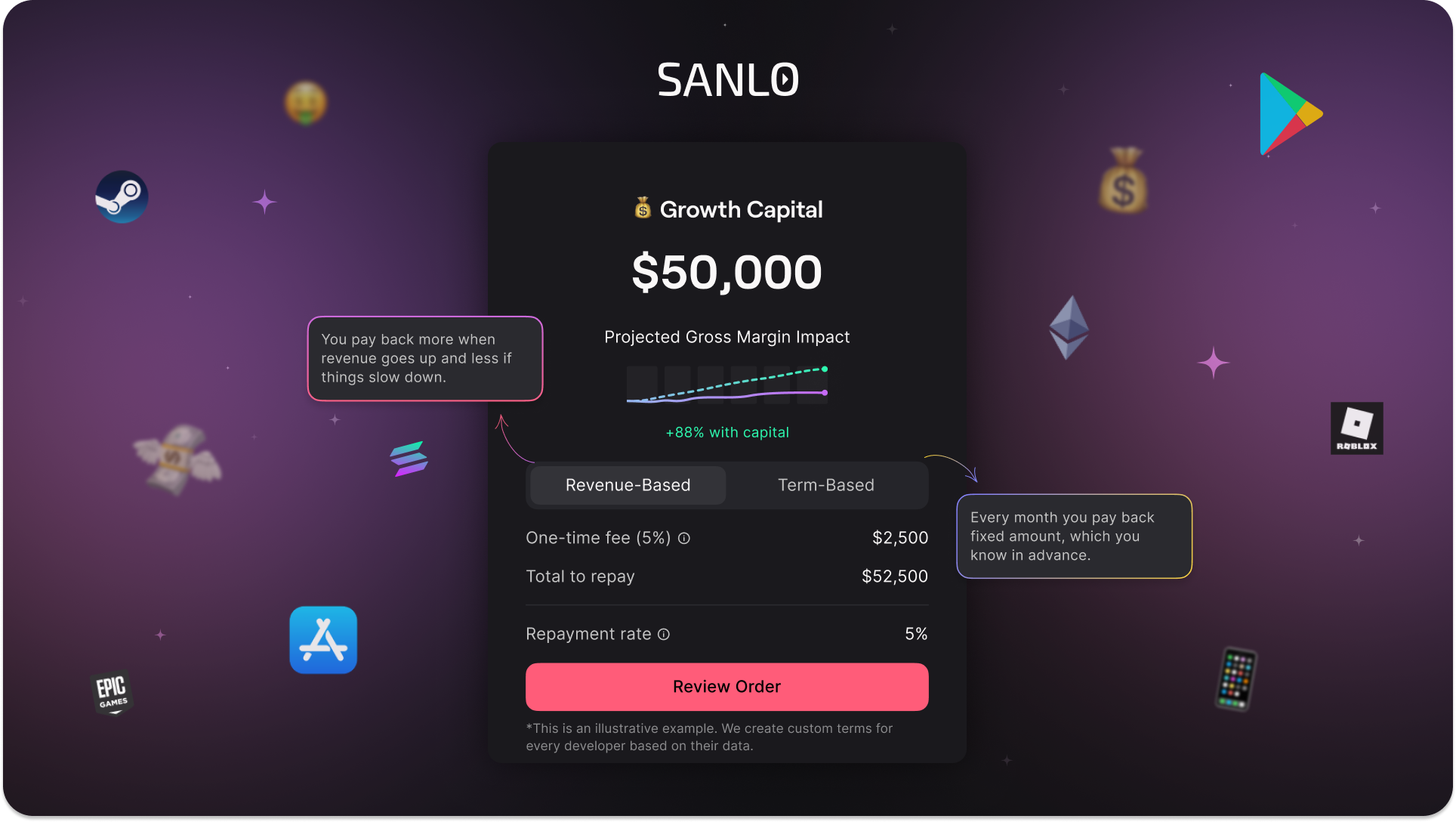
The startup was founded in 2020 by CEO Olya Caliujnaia and CTO William Liu, who both have backgrounds in fintech and gaming. Sanlo offers businesses access to technology, tools and insights that aim to help them achieve scalable growth. When Sanlo determines that the business could benefit from the deployment of capital, the startup assists by offering financing. Sanlo notes that it’s not a VC fund that takes equity in exchange for funding or a lender that charges compounding interest. The amount of financing provided varies, but it’s non-dilutive capital, which means that Sanlo takes no ownership stake in the companies it finances.

Caliujnaia told TechCrunch in an interview that one of the ways that Sanlo differs from other fintech companies is its focus on gaming and app developers. She noted that although there are other companies that are focusing on other verticals in ecommerce or SAAS, Sanlo is focused on gaming and consumer apps.

“We’re a technology company, not a fund,” Caliujnaia said. “That allows us to move quickly and be transparent about how we work and how we arrive at the products that we build and offer to customers. We’re also building a full stack of products, it’s not just about growth capital. Developers have other options via publishers, VCs and banks, but those usually involve complex and lengthy processes.”

To get started, Sanlo asks companies for certain types of data, including product data about how well the app or game monetizes. Sanlo also gets information about customer acquisition and retention, as well as marketing data and a subset of financial data. Its predictive algorithms then continually monitor the company’s growth trajectory to surface insights to identify where and how the business can grow. Sanlo then provide companies with access to capital.

sanlo

Image Credits: Sanlo

As for the new funding, Caliujnaia said Sanlo will use the money to create more products for developers and to bring on more people to grow its 15-person team.

“The plan is to build out more products and to build out the team,” Caliujnaia said. “We’re looking for passionate people to help us build better and faster. We’re working with people primary in North America at this point, but we’re open to talented people in other places around the world.”

The funding round included participation from existing investors, including Initial Capital, Portag3 Ventures, XYZ Venture Capital, London Venture Partners and Index Ventures. The funding round also included participation from new investors, including Fin Capital, GFR Fund and a number of angel investors. Sanlo’s Series A funding comes a year after it announced $3.5 million in seed funding co-led by Index Ventures and Initial Capital.

As part of the funding announcement, Sanlo also revealed that it has partnered with HCGFunds to expand its pool of capital to $200 million to provide funding to the developers it works with.

Sanlo has spent the past 12 months onboarding select developers and is current working with dozens of companies. Caliujnaia said the company carefully selects businesses to work with and regularly checks in with them to allow for close collaboration. In one instance, Sanlo says it helped a large game publisher that was looking to consolidate and gain visibility into cash flows from multiple platforms. The company has also helped a subscription consumer app developer that wanted additional financial bandwidth to bring economy designers on board to tighten monetization. In another case, Sanlo helped another game developer that was looking for predictable non-dilutive capital to finance the development of their expanding portfolio of games.


Nabla is now offering a health tech stack for patient engagement

Nabla is now offering a health tech stack for patient engagement

After setting out to examine digital healthcare from the inside by launching its own women’s health clinic as an app last year, French startup Nabla is executing the next step in a planned pivot to b2b — announcing today that it’s opened its machine learning tech stack to other digital health businesses and healthcare providers so they can offer what it bills as “personalized medicine”.

Nabla’s AI-powered patient communications and engagement/retention platform is designed to support clinicians to deliver a more continuous, data-driven service, whether the client is offering real-time telehealth consultations or delivering a service to patients via asynchronous, text-based messaging.

Nabla’s messaging and teleconsultation communication modules sit as a layer atop the customer healthcare service, ingesting and structuring patient data — with its machine learning software supporting clinicians with real-time prompts and visualizations, as well as offering ongoing patient outreach features to extend service provision.

The startup argues its approach can improve medical outcomes by supporting healthcare professionals to be able to ask relevant questions during a consultation, based on the AI’s ability to aggregate patient activity and surface contextually relevant data — and afterwards, with features like automated transcription and by suggesting updates a clinician could make to a patient’s medical file.

It likens the platform’s capabilities to having a really attentive family doctor who knows their patient’s full medical history and situation — and has a fault-less memory for all that detail. But the tech can go beyond what even a great doctor can offer as it enables healthcare providers to supplement in person consultations with ongoing, asynchronous outreach to provide a layer of continuous care — such as via follow on scheduled messaging (e.g to offer treatment reminders or ask patients about their progress etc). And, of course, even the best human doctor isn’t going to be able to provide patients with that level of check-in and attention in between visits.

Nabla’s premise is therefore that blending digitally delivered, synchronous (human) care with data-driven (AI-powered) support and asynchronous follow ups can offer a win-win: For patients, who get more ongoing (and potentially holistic) care than they could expect from traditional healthcare service delivery; and for digital health businesses which get to drive customer engagement and retention thanks to the smart, personalized assistance and outreach enabled by its platform.

Customer retention has become a pressing problem for digital healthcare providers, Nabla argues — pointing out that after the flood of interest in the space during the pandemic many of these businesses are likely coming back down to Earth with a bump as patient attention disperses, and as the wider global downturn complicates the task of scaling by raising funding.

“Health tech of course is affected a lot by the economic downturn,” says co-founder and CEO Alexandre Lebrun. “Around us we see lots of health tech startups that… owing to the COVID-19 crisis they automatically had lots of patients… It was very easy for them to get lots of patients and engagement. And now that COVID-19 is over — and plus cash is not free anymore — they discovered they have the same problems as ecommerce companies — I have to take care of my customers, I have to work on retention, I have to make them happy. It’s not just automatic.”

Nabla is not (currently) in the business of automating healthcare; rather its platform offers real-time clinician support and clinician-approved outreach to patients — which means that, crucially, a qualified human doctor remains in the loop and in charge of patient care decision-making at all times. So its product is not itself a medical device — although Lebrun can envisage taking further steps in that direction down the line.

“Our long term goal is to use this data not just for the benefit of one patient but learn and aggregate all this data and, for instance, try to predict what will happen next with the patient or to do faster diagnostics,” he tells TechCrunch. “Of course the data we have is super valuable for research because we have very, very detailed information about the patient and not just the typical hospital records… [We have data on] what they eat, how they live, their social environment, family environment — we know it’s very important for health but this information is nowhere to be found in existing medical records. But we have part of it. And so this is incredibly valuable for future academic research — and when we ask our users would you agree to share this data for medical research… most say yes of course, if they understand the scope of what we share.”

Lebrun cut his teeth in tech working on chatbots — and clearly has a strong appreciation of the limitations of the technology. After selling a prior AI startup (Wit.ai) to Facebook he stayed on at the tech giant to work on developing its hybrid general purpose AI concierge service (aka “M“) — which Facebook ultimately decided did not scale for its user base. But Lebrun had seen the potential of combining human-plus-AI for decision-making support, and decided to return to startup land to apply a similar hybrid approach in the narrower domain of healthcare where utility looked easier to hone.

Setting up and running a women’s health clinic was how Nabla’s founders subsequently decided to get to know the needs of the industry they wanted to supply and support with machine learning software — launching their clinic as an app in April 2021. The app, which Nabla says it will continue operating for the moment (although it’s no longer their main focus or product), has amassed some 25,000 patients to date.

This approach means Nabla’s tech is in the relatively novel position — certainly compared to general health products historically — of having been informed during development, primarily, by women’s experience. And its co-founders argue that’s resulted in a product which is both more attentive vs alternatives and more useful as a healthcare tool regardless of the sex of the user. So another win-win, as they tell it.

Having direct access to patients and doctors through the clinic provided Nabla with a link to core users, data and expertise it needed to develop the machine learning health stack product it’s now seeking to monetize. Although it emphasizes that patient data confidentiality requirements has meant always working with strict limits on data access — such as its engineers not being able to directly access users’ medical information (including during development of the AI-powered tech stack).

“I think the consequence of choosing women’s health is that we focused a lot on empathetic care. On the continuous and pluri-disciplinary aspect of the care — and that is completely forgotten in the existing healthcare systems,” suggests Lebrun. “It was a hard decision to make for me to say okay I’m opening a women’s health clinic. I started to spend all my day learning lots with gynecologists… If my co-founder was not a woman I wouldn’t have had the confidence to start a women’s health clinic. So it was great. We didn’t plan it when we started Nabla together — but it was good,” he adds.

“It enabled us to focus a lot on these things. Empathy, pluri-disciplinarity on the provider side, and trying to have a whole person view of the patient is more important for women than for men. I’m a man, I have a problem with my arm, I go to the doctor, ten minutes later I know what to do. That’s solved — but this is not what women need. And this is not what the existing system provides. So we learnt quickly to provide this kind of care with a mix of asynchronous and synchronous care. And what’s interesting is we realized that now, today, that this kind of care is actually better for everyone. Even for men.”

“What we really want to build is a patient engagement stack,” adds Delphine Groll, who is co-founder and COO. “And when we did some research we did a lot of beta version of the app and we found that women were the more engaged population regarding remote care. And as our focus was to drive engagement thanks to our ML models it was — I think — the best choice to have this kind of population so we could be in a position where we could understand a lot the insights from them and then put the best stack we could regarding engagement, retention… which is the main challenge healthcare companies have at the moment. So I think it was not the only reason — but one of the reasons we choose also to focus on women’s health.”

Nabla’s communication modules, which are connected to its machine learning-powered physician console, have been available to third parties, via APIs and SDKs, for about the past three months — and it says it’s signed up around 10 customers so far — but it’s announcing the formal opening today.

Early customers — which span a range of markets including the US, the UK and France in Europe, and Africa — include digital health startups such as Resilience, Cardiologs, Aura Fertility, Omena, Umana, Jeen, and Tchak; and established healthcare organizations such as AP-HP, which it notes is the largest hospital group in Europe. The idea is for the b2b business to be international from the get-go, per Groll.

Discussing the competitive landscape, Lebrun names as its closest rivals the US firms Canvas Medical, Seqster and Zus Health — and he confirms Nabla has strong designs on the US market, given how much digital healthcare action it accounts for.

“The closest companies are all in the US where, I think, they understood quite quickly that there will be a new tech stack of healthcare — like what happened in ecommerce 20 years ago — where every piece of ecommerce is managed by one of a few companies and then you assemble these bricks. The same thing is starting to happen in healthcare,” he argues, also likening Nabla’s approach to clinician support as akin to GitHub’s ‘AI pair programmer’ software, Copilot.  

“There is no question we’ll compete soon. Of course the needs are slightly different in the US. These competitors — I think we have the same philosophy of enabling healthcare providers to build the experience they want and make the life of the healthcare providers, of the doctors easier. But I think we have more focus on asynchronous care — how building asynchronous with synchronous care is interesting.

“Machine learning can of course help do that and with our 20 years and three companies before in the machine learning [space] I think we have great real world experience… We know what’s possible, what’s not possible and what’s desirable or not and we are trying to apply this.”

Groll suggests Nabla’s edge vs rivals is its focus on not just extracting what patients are telling their doctors but structuring that information so that it can be put to work in wider service of improving healthcare provision for them by surfacing suggestions for personalized follow-ups — and also, potentially, for research purposes, if patients agree. (Patient consent for their data to be processed is required for use of the AI-powered service; and, separately, for any wider sharing of aggregated and anonymized data for research purposes, the startup confirms.)

“When we are talking to potential clients what they really like at the end of the day is we are extracting the data from all the communication — especially messaging and teleconsultation — and we are not only extracting it… we are also structuring it and normalizing it so it can make a strong asset for them,” she says, adding: “So I believe our differentiation is… we are enabling them to have a communication module but also to have a way to leverage the data they have inside those communications.”

On the research side, Lebrun suggests the approach — as/if Nabla scales usage — will likely entail collaborations between its healthcare provider partners and public research institutions that would carry out studies in specific areas of interest, relying on aggregated, anonymized data from the service provider/s.

“Research is better conducted by public institutions or academia,” he argues. “So I think it would be a three parties collaboration where Nabla’s providers agree to contribute their data. They of course they ask the consent from their patients to agree to share their data. And then the academic partner or public institution does the actual research but you could see Nabla as a network of healthcare providers who can have an easy way — because it’s already structured — to contribute data for research.”




Wednesday, 1 June 2022

Indonesian hyperlocal social commerce app Super gets $70M led by NEA

Indonesian hyperlocal social commerce app Super gets $70M led by NEA

Super, the Indonesian social commerce startup focused on small towns and rural areas, announced today it has raised an oversubscribed $70 million Series C. The round was led by NEA with participation from Insignia Ventures Partners, SoftBank Ventures Asia, DST Global Partners, Amasia, B Capital, TNB Aura, Bain Capital chairman Stephen Pagliuca, Goldhouse, and Xendit CEO Moses Lo.

This brings Super’s total raised so far to $106 million since it was founded in 2018. TechCrunch last covered the startup at the time of its $28 million Series B in April 2021.

Steven Wongsoredjo, the co-founder and CEO of Super, says that Indonesia’s Tier 2, Tier 3 and rural area’s gross domestic product is three to five times lower than Jakarta, yet the cost of consumer goods there is higher by 20% to 200% thanks to supply chain issues. Not only that, but more than 30% of Indonesia’s GDP comes from East Java, Kalimantan and East Indonesia, making those places a valuable source of potential revenue for fast-moving consumer goods. By streamlining the supply chain and giving FMCG brands an easier way to reach consumers in rural areas, Super is also able to lower the costs of goods.

The startup plans to use its funding to expand into Kalimantan, Bali, West Nusa Tenggara, East Nusa Tenggara, Maluka and Papua over the next few years.

Super currently works with third-party logistics providers to create a hyperlocal logistics platform that it says can deliver consumer goods to thousands of agents within 24 hours of an order. The company’s agents, or resellers, can either be individuals or local shops called warungs.

Super says it currently has thousands of community agents, and aggregates and distributes millions of U.S. dollars worth of goods to communities each month. It now operates in 30 cities in East Java and South Sulawesi, primarily targeting areas that have a GDP per capital of $5,000 USD or lower.

Part of the funding will also be used to apply machine learning to the SKU’s in Super’s warehouse, to help the startup understand what sells best and where, so it can better determine the kind of inventory it holds. It is launching two private-label brands, including in cosmetics, and will create an app feature for agents that will let them track end-consumer transactions.


a16z-backed Loom lays off 14% of staff, one year after becoming a unicorn

a16z-backed Loom lays off 14% of staff, one year after becoming a unicorn

Loom, an enterprise collaboration video messaging service, has laid off 34 employees, or 14% of its total staff, sources say. Employees across product and people operations were impacted.

The venture-backed company confirmed the layoff and number of people impacted, and provided the following statement from founder and CEO Joe Thomas:

“We’ve had to make the extremely difficult decision to move forward with a reduction in force across our team. Each person impacted was not only a talented employee, but also a valued individual and teammate. We’re committed to supporting these employees through this transition both in their offered severance as well as career support. We’re confident in the path ahead for Loom. This decision was ultimately made to ensure we’re able to move forward sustainably, especially in light of increased economic uncertainty, and continue to deliver on our vision for years to come.”

The company was founded by Thomas and Vinay Hiremath in 2015, hitting 1.8 million users across 50,000 businesses just three years later. Per its website, Loom currently boasts 14 million users across 200,000 companies – including Netflix, Atlassian, Hubspot and Juniper Networks.

Similar to Hopin, Loom benefitted from a surge of people working from home in response to the COVID-19 pandemic; the product was positioned to help remote workers find better ways to connect with colleagues in a virtual-first world, and help hybrid workforces find a lightweight way to skip some meetings. Then, again similar to Hopin, the startup conducted layoffs to help it build in what it describes as a more sustainable way moving forward.

That growth has attracted $203 million in known venture capital funding, with the company most recently announcing a Series C led by Andreessen Horowitz. The same round, closed valued the company at $1.53 billion, making it hit unicorn status for the first time. Kleiner Perkins, Sequoia, Coatue, and General Catalyst are also investors in the company.

Over a year has gone by since the startup landed the new financing and valuation, and per today’s news, Loom joins the club of unicorns that have had to scale back workforces after landing the coveted milestone.

Less than a year ago, visual creator tools startup Picsart raised $130 million from SoftBank, landing a valuation of over $1 billion. The company laid off 8% of its staff last month, affecting 90 people. Cameo, which also became a unicorn last year, also recently conducted layoffs that impacted 87 people.


Tuesday, 31 May 2022

The death knell for SPACs?

The death knell for SPACs?

It’s a tough day for special purpose acquisition companies, or SPACs, which had already fallen out of favor after roughly 18 months in the limelight.

Senator Elizabeth Warren is planning a bill that targets the SPAC industry, her office announced today. Called the “SPAC Accountability Act of 2022,” the bill would expand the legal liability of parties involved in SPAC transactions, close loopholes that SPACs have “long exploited to make overblown projections,” and lock in longer the investors sponsoring a deal.

Even if the bill never passes, the SEC is today concluding a 60-day public comment period on a number of its own proposed guidelines for SPACs, specifically around disclosures, marketing practices and third-party oversight.

As TechCrunch noted in a weekend look at the astonishing number of electric vehicle SPACs to flounder, assuming the SEC’s rules are approved, the barrier of entry to going public via a SPAC will rise to the same level as companies choosing the more traditional IPO listing process, including to hold liable banks associated with SPACs for misstatements related to the merger. (To protect itself, Goldman Sachs has already said it’s no longer working with most SPACs that it took public and pausing work with new SPAC issuance.)

It’s not as if either initiative will abruptly stop SPACs in their tracks. They’d already begun losing momentum last year, when the SEC warned in March 2021 that SPACs weren’t accounting correctly for investor incentives called warrants. Indeed, while 247 SPACs were closed in 2020, most of the SPACs raised last year (613!) came together in the first half of the year, before the SEC made it quite so plain that it planned to do more on the regulatory front.

Now those many blank-check companies need to find suitable targets in a market turned bearish, and the clock is ticking. Given that blank-check companies are typically expected to find and merge with a target company within 24 months of investors funding the SPAC, if those hundreds of companies can’t complete mergers with candidate companies within the first half of next year, they’ll either have to wind down (which can means millions of lost dollars for SPAC sponsors) or else seek out shareholder approval for extensions.

It’s even worse than it sounds. With the time between when a deal is announced to when the SEC has time to review it taking up to five months, according to SPACInsider founder Kristi Marvin, even SPACs that strike a deal tomorrow couldn’t ask their shareholders to vote on it until roughly November.

In fact, while lawmakers and regulators seem late to the party, they will undoubtedly be watching for unnatural acts as SPAC sponsors do everything in their power to cross the finish line.

Already, a number of SPAC sponsors has already begun to ask their shareholders for more time to get a deal done, some of them apparently hoping investors might warm again to the once-obscure financial vehicles. Magnum Opus, the SPAC that planned to take Forbes to take it public, filed two deadline extensions this year after announcing the merger last August. It would have needed to obtain its shareholders’ approval for an extension yet again to keep the deal alive; instead, reports the New York Times, Forbes just scrubbed the deal.

Also bound to happen more: SPACs that announce target companies outside of their area of expertise, and more redemptions that leave SPACs with far less cash on hand for their mergers.

Surf Air Mobility is a perfect example of both. A nearly 11-year-old electric aviation and air travel company in Los Angeles that operates via a membership model, it recently announced it would be going public via a merger with the SPAC Tuscan Holdings Corporation II, which came together in 2019.

Given that Tuscan was a little long in the tooth as SPACs go, it had to ask shareholders to approve an extension. It received their approval, though many backers redeemed their shares, shrinking the size of the capital pool Tuscan had to work with. With less capital to work with, Surf Air essentially lined up additional financing for itself.

Tuscan was originally targeting — but not limited to — a company in the cannabis industry to acquire, not a travel company. There’s nothing legally wrong with that, underscores Marvin, who also observes that it isn’t the first SPAC to shop far outside its preferred sector of interest.

Still, it could be another reason to give investors pause when SPAC sponsors need them to believe.

Consider an earlier SPAC, Hunter Maritime, which came together in 2016 with the help of Morgan Stanley to acquire one or more operating businesses in the international maritime shipping industry, per its original prospectus. Three years later, it acquired a China-based wealth manager instead and rebranded.

Today that combined company, NCF Wealth Holdings, is no longer a company.

“A lot of SPACs will liquidate over the next two years,” says Matthew Kennedy, a senior IPO strategist at Renaissance Capital. “I think shareholders are just looking at [the performance of companies taken public via SPACs] and saying, ‘Why would I hold this if I have a four out of five chance of losing money?'”


This book made me fall in love with electronics all over again

This book made me fall in love with electronics all over again

It’s no secret that I’m a sucker for photography — I’ve been known to take a photo or two in my time — and I have a hell of a weak spot for electronics, to boot. In the upcoming Open Circuits from No Starch Press, authors Windell Oskay, co-founder of Evil Mad Scientist Laboratories, and Eric Schlaepfer, creator of the popular collection of vintage competing Twitter account Tube Time, talk about the creative beauty (and beautiful creativity) of electronics.

Part history book, part coffee-table photo book and part journey into the inner lives of the electronics, Open Circuits is a fascinating journey through the history of electronics. The authors explore the visual landscape of electronics, including tearing apart a bunch of the components to take a look at what’s inside, and adding a description of how it all works.

Thick film resistor arrays

In a spread about thick film resistor arrays, the authors explore the inner and outer beauty of the components, and call out details that I otherwise would never have noticed — such as the trimming laser scorch marks. Image Credits: Eric Schlaepfer and Windell H. Oskay.

Electronics nerds will have seen resistor arrays — these little colorful blocks on printed circuit boards (PCBs), but even though I must have soldered hundreds, if not thousands, of these in my time, I never stopped to think what’s happening on the inside. I found myself enraptured with intrigue to further explore the components. The authors took some of them apart to show off the simple, understated, elegant beauty of the components. For a brief moment, I was reminded that art is everywhere, even inside the electronics that surround us.

LED filament light bulb

LED filaments contain hundreds of little LEDs in microscopic strip lights. The phosphor is agitated into glowing, which gives the individual strands the look of “filaments”. Image Credits: Eric Schlaepfer and Windell H. Oskay.

I love how the authors explore the components visually (and they are beautiful), and take the time to explain why the components look the way they look. Take the humble LED filament light bulb, for example — I’ve never paused to think how they are made or why they look the way they look. Now, I’ll never be able to see them the same way again.

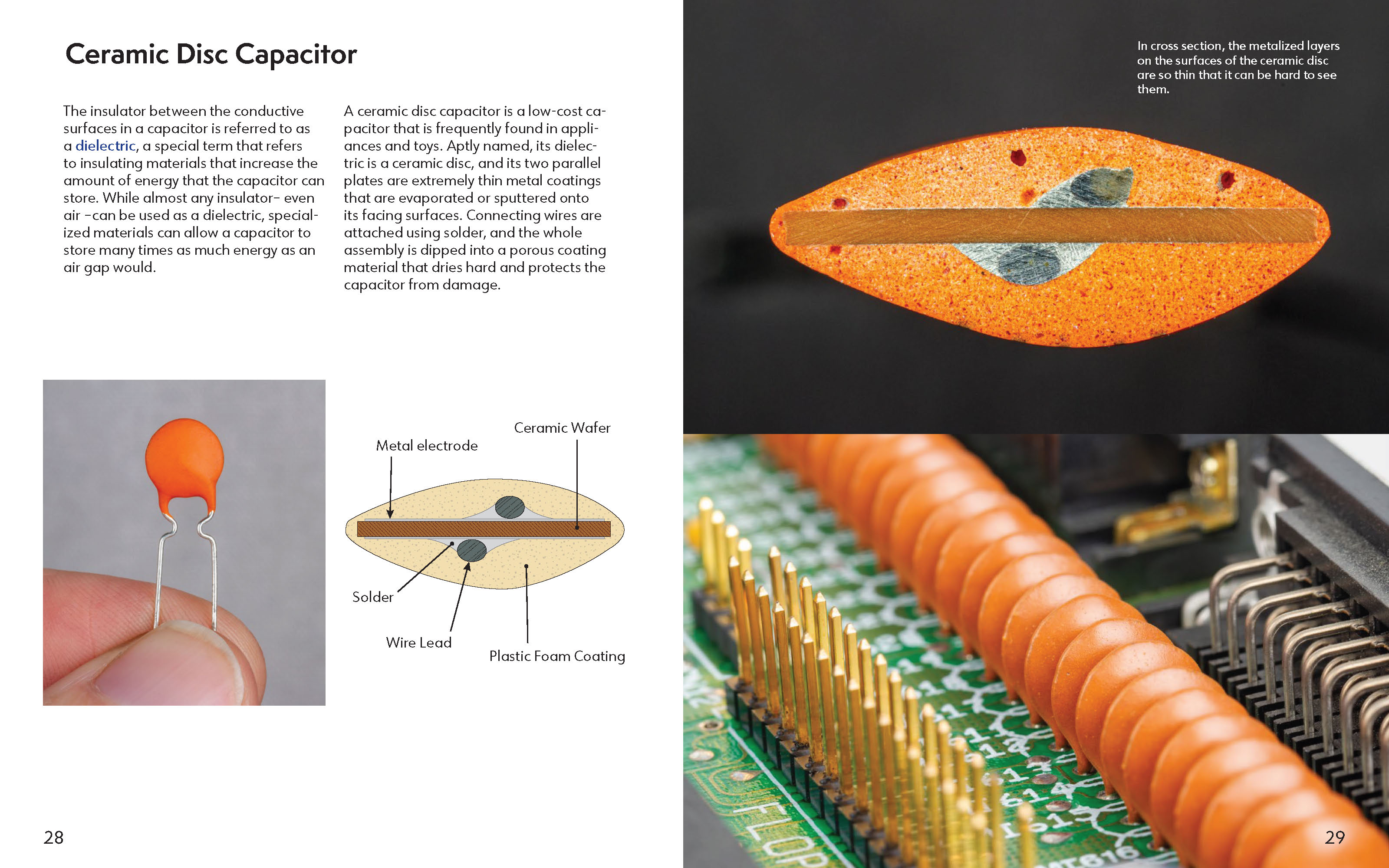
Ceramic Disc Capacitor

Cheramic caps are probably among the simplest components there are. I never paused to think that they might actually be pretty, too.Image Credits: Eric Schlaepfer and Windell H. Oskay.

Orange Ceramic Disc Capacitors are a dime a dozen — almost literally, if you order them in big enough quantities — and they are ubiquitous in electronics labs. So simple, and yet almost poetic in their beauty, this was the spread of the early access copy of the book the publisher sent me that made me decide to share its weird wonderment with you.

The book is available for preorder now for $40, and the final version is expected to be a 300-odd page hard-cover book shipping in September or so. Perhaps it’s a good holiday present for the visually oriented electronics nerds in your life.