Wednesday, 30 September 2020

Apple removes two RSS feed readers from China App Store

Apple removes two RSS feed readers from China App Store

It looks like Apple is scouring its Chinese App Store for any remaining services that may not sit well with Chinese censors. Two RSS reader apps, Reeder and Fiery Feeds, said this week that their iOS apps have been removed in China over content that is considered “illegal” in the country.

Apps get banned in China for all sorts of reasons. Feed readers of RSS, or Real Simple Syndication, are particularly troubling to the authority because they fetch content from third-party websites, allowing users to bypass China’s Great Firewall and reach otherwise forbidden information.

Those who use RSS readers in China are scarce, as the majority of China’s internet users — 940 million as of late — receive their dose of news through domestic services, from algorithmic news aggregators such as ByteDance’s Toutiao, WeChat’s built-in content subscription feature, to apps of mainstream local outlets.

Major political events and regulatory changes can trigger new waves of app removals, but it’s unclear why the two RSS feed readers were pulled this week. Inoreader, a similar service, was banned from Apple’s Chinese App Store back in 2017. Feedly is also unavailable through the local App Store.

The latest incidents could well be part of Apple’s business-as-usual in China: cleaning up foreign information services operating outside Beijing’s purview. The history of China’s crackdown on RSS dates back to 2007 when the authority launched a blanked ban on web-based RSS feed aggregators.

Before its ban, the Fiery Feeds iOS app was available in China without the use of a VPN, though some of the synced services it supported were blocked, the app told TechCrunch. Reeder and Apple cannot be immediately reached for comment.

“It seems [the ban] comes from the Chinese government, so I do see any use in appealing to Apple,” said a spokesperson at Fiery Feeds.


Apple to release new emojis with iOS 14.2

Apple to release new emojis with iOS 14.2

While the current version of iOS is iOS 14.0.1, Apple is already testing iOS 14.2. The company released an early beta version of the update yesterday, and it includes a new set of emojis, as Emojipedia spotted.

Apple already shared an early look of the new emojis back in July. Overall, there will be dozens of new emojis this year. Emojis will also be more diverse and inclusive than ever with new variations of existing emojis.

Earlier this year, the governing body in charge of approving new emojis, the Unicode Consortium, approved 117 new emojis as part of Unicode 13.0. Operating system developers and social network companies, such as Apple, Google, Microsoft, Twitter, Facebook and Mozilla, then draw their own versions of the new emojis and release them on their platforms.

In this release, you’ll find a transgender flag, a smiling face with tear, pinched fingers, two people hugging, some insects and animals, a disguised face and more.

My favorite is arguably disguised face:

Emojipedia compiled those new emojis on a single image:

When it comes to new variations, there will be a Mx Claus, a gender-inclusive alternative to Santa Claus and Mrs Claus. Tuxedos are no longer limited to men and veils are no longer limited to women. You’ll be able to send an emoji with a woman wearing a tuxedo and a man wearing a veil.

You can expect the full release of iOS 14.2, iPadOS 14.2 and macOS Big Sur in a month or two.


Lee Fixel’s Addition leads $35 million investment in India’s Inshorts

Lee Fixel’s Addition leads $35 million investment in India’s Inshorts

Inshorts, which operates a popular news aggregator app in India, has raised $35 million in a new financing round led by Lee Fixel’s Addition as the Indian startup looks to scale its adjacent, social network platform.

For Fixel, who wrote several high-profile checks to Indian firms while running Tiger Global, InShorts is the first Indian startup he is backing from his new VC firm. Fixel, who also invested in InShorts when he was at Tiger Global, has backed about six startups through Addition including New York Area-headquartered Odeko, which offers ordering and supply chain tools to cafes, Synk, which develops tools used to identify vulnerabilities, and dLocal, which operates a cross-border payment processor to connect global merchants to emerging markets.

SIG Global and Tanglin Venture Partners, also participated in Inshorts’ new round, which values the startup at about $125 million, a person familiar with the matter told TechCrunch.

Azhar Iqubal, founder and chief executive of Inshorts, told TechCrunch in an interview that the startup raised the capital to further scale Public, a social network it launched in April 2019.

Public is a location-based social network that connects individuals to people in their vicinity. Think about people living in the same society, or people in a mall or within a few miles from each other.

Public, which is available in several major Indian languages including Hindi, Bengali, Punjabi, Telugu, Tamil, Kannada, Malayalam, Odia, Assamese, Gujarati and Marathi, is allowing shop owners to drive e-commerce, serving as a classified platform and allowing recruiters to hire people from neighborhood, said Iqubal.

The app, which also provides entertainment and news services, has amassed over 50 million monthly active users, he said. More than 1 million videos are being created on the platform each month.

“There are more than 10,000 urban centres in India and existing social networking apps that are aimed at connecting friends leave room for a location-based play,” said Iqubal.

In the next few months, Iqubal said Public will attempt to deepen its penetration across India. In the future, he wants to expand Public outside of India as well, he said.

Inshorts, which is profitable, competes with a handful of players in the country including DailyHunt. Interestingly, both DailyHunt, co-run by Umang Bedi (former head of Facebook India) and Inshorts have expanded to explore opportunities in the space of social networks.


Emjoy picks up $3M to get more women tuned into sexual self-care

Emjoy picks up $3M to get more women tuned into sexual self-care

Barcelona-based Emjoy, an audio app for women that sells a narrative of sexual self-care and empowerment, has picked up $3 million in seed funding led by JME Ventures, with existing investor Nauta Capital participating.

The femtech startup believes it has lit on a major opportunity to target women with sex-positive subscription audio content that’s focused on sexual empowerment, intimate education and sensuous entertainment — all wrapped in unapologetically direct digital marketing.

Nor is it alone in seeking to build a brand around such ‘female first’ audio content. (Another startup that springs to mind in this ‘mindful sex’ space is Ferly, for example.) But Emjoy reckons there’s all to play for in this nascent space — which it says is benefitting not only from progress toward female empowerment in recent years but the rise in popularity of podcasting and audiobooks.

“My inspiration for founding Emjoy is based on my personal experience and the experiences of many girlfriends of mine. All of us had normalized not climaxing when having sexual encounters,” Andrea Oliver, CEO and co-founder tells TechCrunch.

“When I began researching this I came across the pleasure gap, with some studies showing that 40% of women have some type of sexual dysfunction. Having been in the VC world and having seen the tremendous success of startups in the mental health and fitness spaces, I was shocked when I could not find an app focusing on sexual wellbeing.”

“What sets us apart from competitors is offering a broad library of both wellbeing and entertainment audios, being extremely trustworthy and reliable because of our in-house sex therapist, partnering with sexual wellbeing experts, and finally being a product company that offers more than just content,” she goes on, discussing the competitive landscape. “An example of this is our ‘Daily Routines’ feature, which allows our users to take 30-day challenges to create new habits, such as accepting their bodies.”

Oliver moved from Nauta Capital, where she’d been working with startups, to founding her own business in January 2019, along with co-founder Daniel Tamas, CTO — taking in an initial €1M from her former VC employer to get the app to market.

Emjoy launched worldwide in early 2020 and went on to clock up 80,000 registered users in its first six months. It now has 150,000 active users globally, with the U.S. and the U.K. its main markets (NB: content is currently only available in English).

Almost 10% of “recently acquired” active users paying a subscription, per Oliver.

“The women who use Emjoy are typically in their 20s, and while most are cisgender we have also received tons of positive feedback from trans and non-binary folk. Really, Emjoy is about getting to know what you like and enjoying yourself, regardless of the gender of your partner(s),” she says.

“We are building a wellbeing brand for women because we see that sexual wellbeing is a major part of overall wellbeing. We want to normalize this,” Oliver adds, nothing that Emjoy’s “wellbeing positioning” includes “entertainment content with our erotic stories”.

The startup’s team has grown to 11 people at this point — including an in-house sex therapist. Most of Emjoy’s content is produced in house at this point.

Discussing its approach to content, which the app touts as “backed by science and supervised by our in-house intimacy therapist”, Oliver says: “For each theory or guided session we try to find a scientific study to back what we say, and we work with our in-house sex therapist who creates most of the content and supervises it. We also partner with external collaborators who are experts in different fields such as sexual trauma, body acceptance, relationships etc.”

“It is important to offer science-based content because most of the sexual content that is available today, in blogs or on YouTube, for example, is very untrustworthy. We want to be a trusted and safe environment for our users,” she adds.

The new seed funding will be ploughed into making more content — with plans for additional collaborations with “leading academics, experts and influencers within the sexual wellbeing and education space” — and the overarching aim of building the “category-defining” app in the female sexual wellness space.

Asked why he’s excited about women’s sexual wellbeing audio as a category, investor Samuel Gil, partner at JME Ventures, told us the space is interesting because it’s been so overlooked.

“It has been ignored or forgotten for a very long time but that’s now changing with women being more empowered than ever,” he said, adding: “Women with sexual wellbeing issues might be reluctant to search for help in a more traditional way due to shame or friction. A digital product is ideal to broaden access to sexual wellbeing solutions.”

He also lauded the “really immersive experiences” possible with audio content which he said “facilitates content production”. (Or, well, it’s a lot easier to get erotic sounds past ‘family-friendly’ App Store review rules than hardcore visuals.)

On investing in Emjoy specifically, Gil added: “It is a nascent category with no clear leaders yet. Emjoy’s vision, ambition, and above all, execution, so far makes us believe that they are really well-positioned to take the leading position very soon.”

Asked what she believes this new rush of female-pleasure-focused audio startups are tapping into, Olivier says: “It is very much an underserved need. We go hand-in-hand with our users to help them discover their bodies, gain confidence, and explore what turns them on, among many other things. We and our users see Emjoy as a journey, with our audio content helping users explore what they like and who they are.

“We are not telling users what they should do, or how they should feel because there is no normal, there’s no ‘should’ or ‘shouldn’t’. Each personal experience and body is unique and Emjoy adapts to each user’s unique journey.”

“Our users are also generating new habits with Emjoy and we are becoming an everyday tool for women who want to feel more confident or want a safe, female pleasure-centric and trusted place to get in the mood, as opposed to mainstream porn,” she adds.


October closes $300 million in new funds for its SME lending marketplace

October closes $300 million in new funds for its SME lending marketplace

French fintech startup October has raised some fresh capital to invest in small and medium companies on its lending platform. Overall, the company has gathered $300 million (€258 million) from various partners that will be deployed over the next few years.

This is not a traditional startup funding round as today’s new investment is specifically designed to finance new loans on its platform. October isn’t selling equity in exchange for capital.

October works with small companies in France, Spain, Italy, Netherlands and Germany that need a credit line. For small and medium companies, you can apply for a loan and get an answer just a few days later. October evaluates risk before handing out loans thanks to industry-specific data analysis and human analysts.

Loans range from €30,000 to €5 million. There’s no personal guarantee and interest rate varies depending on the risk associated with your application.

On the other side of the marketplace, individuals can contribute to SME financing. But the startup has been relying more and more on institutional investors looking for different types of assets to diversify their investment portfolios.

Hence today’s new influx of cash. Here’s the full breakdown:

  • $23 million (€20 million) will be used for traditional SME loans with monthly repayments.
  • $44 million (€38 million) will be deployed in the tourism industry specifically — hotels, restaurants and more. Six insurance companies and French public sector financial institution CDC are contributing to this fund. Companies applying for loans in this category can delay repayment.
  • $232 million (€200 million) will be injected in Italian SMEs in particular. Italian bank Intesa Sanpaolo Group is investing exclusively in this fund. Those government-backed loans will go live quite rapidly as everything will be deployed by the end of 2020.

As you can see, October is becoming an important technological partner for European support plans during the economic crisis. The startup can issue government-backed loans and some public institutions are choosing October to finance SMEs.

Over the past five years, October has handed out around 1,000 loans. It represents $521 million (€448 million) in capital. That number will go up rapidly following today’s announcement.


Baidu’s smart voice unit to raise independent round on $2.9B valuation

Baidu’s smart voice unit to raise independent round on $2.9B valuation

Baidu, China’s dominant search service and a leader in artificial intelligence research, is further diversifying into the smart voice space as its smart living group is poised to raise an independent round on a 20 billion yuan ($2.94 billion) post-money valuation.

The fundraising move signals a potential spinoff of the smart living group down the road. The unit is best known for its voice assistant DuerOS, the search giant’s Alexa equivalent, which was active on 200 million devices including both Baidu’s own branded speaker and a variety of third-party gadgets as of early 2019.

Baidu shipped around 15 million units of its Xiaodu speakers in 2019, making it the second-largest player in China following Alibaba and ahead of Xiaomi, according to market research firm IDC.

Investors including Citic Private Equity Funds Management (CPE), state conglomerate Citic’s asset management firm, as well as Baidu’s venture arm Baidu Capital and IDG Capital, have entered definitive agreements to invest an undisclosed amount into the smart living group’s Series A round.

China has in recent years seen increasing cooperation between its internet firms and industrial incumbents from sectors spanning real estate, healthcare, education to finance, which are eager to embrace digital solutions.

The transaction is expected to close in the fourth quarter of 2020, according to Baidu. Upon completion of the deal, Baidu will be the majority shareholder with super-voting rights in the smart living group and continue to consolidate the unit’s financial results.

The competition in voice intelligence is a race to secure partnerships with hardware makers, which could in turn contribute consumer usage and data. Besides selling speakers, Baidu has a leg up in putting its voice assistant in connected cars, thanks to its ecosystem of automakers using its open-source autonomous driving platform Apollo. Alibaba, needless to say, can leverage its dominance in retail to market its smart voice system and speakers. Xiaomi, on the other hand, commands an portolio of Internet of Things allies that may benefit from gaining voice capabilities.

Baidu’s endeavor in AI is marked by the lineup of famed scientists it has attracted (and lost) in recent years, including Andrew Ng and Lu Qi. The company vowed to stake its future on AI early on, though its nascent AI-related businesses have yet to deliver significant revenue. The 20-year-old firm continues to rely on search to drive ad revenue as it faces growing competition from advertisers’ new darling, TikTok parent ByteDance.


Papaya Global raises $40M for a payroll and HR platform aimed at global workforces

Papaya Global raises $40M for a payroll and HR platform aimed at global workforces

Workforces are getting more global, and people who work day in, day out for organizations don’t always sit day in, day out in a single office, in a single country, to get a job done. Today, one of the startups building HR to help companies provision services for and manage those global workers better is announcing a funding round to capitalise on a surge in business that it has seen in the last year — spurred in no small part by the global health pandemic, the impact it’s had on travel and the way it has focused the minds of companies to get their cloud services and workforce management in order.

Papaya Global, an Israeli startup that provides cloud-based payroll, as well as hiring, onboarding and compliance services for organizations that employ full-time, part-time, or contractors outside of their home country, has raised $40 million in a Series B round of funding led by Scale Venture Partners. Workday Ventures — the corporate investment arm of the HR company — Access Industries (via its Israeli vehicle Claltech), and previous investors Insight Partners, Bessemer Venture Partners, New Era Ventures, Group 11, and Dynamic Loop also participated

The money comes less than a year after its Series A of $45 million, following the company growing 300% year-over-year annually since 2016. It’s now raised $95 million and is not disclosing valuation. But Eynat Guez, the CEO who co-founded the company in that year with Ruben Drong and Ofer Herman, said in an interview that it’s 5x the valuation it had in its round last year.

Its customers include fast-growing startups (precisely the kind of customer that not only has global workforces, but is expanding its employee base quickly) like OneTrust, nCino and Hopin, as well as major corporates like Toyota, Microsoft, Wix, and General Dynamics.

Guez said Papaya Global was partly born out of the frustrations she herself had with HR solutions — she’s worked in the field for years. Different countries have different employment regulations, varied banking rules, completely different norms in terms of how people get paid, and so on. While there have been some really modern tools built for local workforces — Rippling, Gusto, Zenefits now going head to head with incumbents like ADP — they weren’t built to address these issues.

Other HR people who have dealt with international workers would understand her pain, those who control the purse strings might have been less aware of the fragmentation. All that changed in the last eight months (and for the foreseeable future), a period when companies have had to reassess everything about how they work to make sure that they can get through the current period without collapsing.

“The major impact of Covid-19 for us has been changing attitudes,” said Guez. “People usually think that payroll works by itself, but it’s one of the more complex parts of the organization, covering major areas like labor, accounting, tax. Eight months ago, a lot of clients thought, it just happens. But now they realize they didn’t have control of the data, some don’t even have a handle on who is being paid.”

As people moved into and out of jobs, and out of offices into working from home, as the pandemic kicked off, some operations fell apart as a result, she said. “Payroll continuity is like IT continuity, and so all of a sudden when Covid started its march, we had prospects calling us saying they didn’t have data on, for example, their Italian employees, and the office they were using wasn’t answering the phone.”

Guez herself is walking the walk on the remote working front. Papaya Global itself has offices around the world, and Guez herself is normally based in Tel Aviv. But our interview was conducted with her in the Maldives. She said she and her family decided to decamp elsewhere before Israel went into a second lockdown, which was very tough to handle in a small flat with small children. Working anywhere, as we have found out, can work.

The company is not the only one that has identified and is building to help organizations handle global workforces. In fact, just when you think the unemployment, furlough and layoff crunch is affecting an inordinate number of people and the job market is in a slump, a rush of them, along with other HR companies, have all been announcing significant funding rounds this year on the back of surges in business.

Others that have raised money during the pandemic include Deel, which like Papaya Global is also addressing the complexities of running global workforces; Turing, which helps with sourcing and then managing international teams; Factorial with its platform targeting specifically SMBs; Lattice focused on the bigger challenges of people management; and Rippling, the second act from Zenefits’ Parker Conrad.

“Papaya Global’s accelerating growth is a testament to their top-notch executive leadership as well as their ability to streamline international payroll management, a first for many enterprises that have learned to live with highly manual payroll processes,” said Rory O’Driscoll, a partner at Scale Venture Partners, in a statement. “The complexity and cost of managing multi-region workforces cannot be understated. Eynat and her team are uniquely serving their customers’ needs, bringing an advanced SaaS platform into a market long-starved for more effective software solutions.”


Salesforce creates for profit platform to help governments distribute COVID vaccine when it’s ready

Salesforce creates for profit platform to help governments distribute COVID vaccine when it’s ready

For more than 20 years, Salesforce has been selling cloud business software, but it has also used the same platform to build ways to track other elements besides sales, marketing and service information including Work.com, the platform it created earlier this year to help companies develop and organize a safe way to begin returning to work during the pandemic.

Today, the company announced it was putting that same platform to work to help distribute and track a vaccine whenever it becomes available along with related materials like syringes that will be needed to administer it. The plan is to use Salesforce tools to solve logistical problems around distributing the vaccine, as well as data to understand where it could be needed most and the efficacy of the drug, according to Bill Patterson, EVP and general manager for CRM applications at Salesforce.

“The next wave of the virus phasing, if you will, will be [when] a vaccine is on the horizon, and we begin planning the logistics. Can we plan the orchestration? Can we measure the inventory? Can we track the outcomes of the vaccine once it reaches the public’s hands,” Patterson asked.

Salesforce has put together a new product called Work.com for Vaccines to put its platform to work to help answer these questions, which Patterson says ultimately involves logistics and data, two areas that are strengths for Salesforce.

The platform includes the core Work.com command center along with additional components for inventory management, appointment management, clinical administration, outcome monitoring and public outreach.

While this all sounds good, what Salesforce lacks of course is expertise in drug distribution or public health administration, but the company believes that by creating a flexible platform with open data that government entities can share that data with other software products outside of the Salesforce family.

“That’s why it’s important to use an open data platform that allows for aggregate data to be quickly summarized and abstracted for public use,” he said. He points to the fact that some states are using Tableau, the company that Salesforce bought last year for a tidy $15.7 billion, to track other types of COVID data.

“Many states today are running all their COVID testing and positive case reporting through the Tableau platform. We want to do the same kind of exchange of data with things like inventory management [for a vaccine],” he said.

While this sounds like a public service kind of activity, Salesforce intends to sell this product to governments to manage vaccines. Patterson says that to run a system like this at what they envision will be enormous scale, it will be a service that governments have to pay for to access.

This isn’t the first time that Salesforce has created a product that falls somewhat outside of the standard kind of business realm, but which takes advantage of the Salesforce platform. Last year it developed a tool to help companies measure how sustainable they are being. While the end goal is positive, just like Work.com for Vaccines and the broader Work.com platform, it is a tool that they charge for to help companies implement and measure these kinds of initiatives.

The tool set is available starting today. Pricing will vary depending on the requirements and components of each government entity.

The real question here is should this kind of distribution platform be created by a private company like Salesforce for profit, or perhaps would be better suited to an open source project, where a community of developers could create the software and distribute it for free.


TravelPerk launches an open API platform to extend its work trip SaaS

TravelPerk launches an open API platform to extend its work trip SaaS

Business travel SaaS startup, TravelPerk, has launched an open API-based platform — letting its customers and partners build custom integration and apps.

The initial APIs covers HR and expense management use-cases but more are set to be added as usage and demand grows.

“Applications we’ve seen being built on the platform already include HR functionality (think BambooHR), expense management systems, company payment cards, financial reporting, and ERP,” says co-founder and CEO Avi Meir, discussing the launch.

Longer term he says the hope is the platform generates “a huge range” of additional functionality for customers to draw on.

“Many of our customers are tech companies full of developers, so we’re confident that if we give them the tools it will be boundless what they can create,” he adds. “In fact, we’re working with one customer already who is using our API to build a custom approvals process because they need a more complex system than the standard offering.”

TravelPerk has been running a private beta over the last few months with 20+ partners and customers but is now flipping the switch to open it to all users.

“We are providing a fully fledged toolkit for developers, from the most curated developer hub and API documentation, to a sandbox environment to test their solutions for quality assurance,” adds Ross McNairn, TravelPerk’s chief product officer, in a statement.

“We do not see TravelPerk as a silo tool, but rather one that needs to coexist with hundreds of other SaaS tools. Our ultimate goal is for partners and developers to consider TravelPerk as the platform to build and grow with us. Easy to understand, easy to build, and easy to grow.”

Business downtime resulting from the coronavirus pandemic slashing global travel has given TravelPerk a window of opportunity to focus on product dev.

“It’s no surprise that the [business travel]  market isn’t yet back to normal but we know that if we keep investing in creating the products businesses need to travel confidently we’ll emerge from this stronger,” says Meir, who notes that it’s been seeing signs of a recovery in some of its markets — with domestic segment usage in Germany and the US having returned to “pre-pandemic levels”.

Returning to the API, Meir says customer demand was a factor in the decision to augment its business travel SaaS with a free and fully open API platform: “Part of the reason we’ve brought this in was the huge demand for this kind of product from many of our customers, particularly SMEs. On the back of that demand, we’re expecting to see tens or hundreds of applications and customer integrations built in the coming months.”

The other driver is cultural, per Meir — who says the startup has a “philosophy of being open, collaborative and innovative” which he claims sets it apart from the “current, closed systems” offered by legacy travel industry players.

“Creating this marketplace means we can provide customers with a wide choice of expert-created functionality, rather than forcing a single proprietary solution on them,” he adds.


Tuesday, 29 September 2020

The joke is on consumers as Liquid Death raises $23 million more

The joke is on consumers as Liquid Death raises $23 million more

In what began as a kind of funny, savvy marketing stunt that has since gained traction, a nearly three-year-old, Santa Monica-based startup that sells water from the Austrian Alps under the brand Liquid Death, has raised $23 million in Series B funding. Backers in the round include an unnamed family office; ConvivialitĂ© Ventures, which is Pernod Ricard Group’s venture arm; the musician known as Fat Mike; and earlier backer Velvet Sea Ventures.

The company, originally incubated with the help of the L.A.-based startup studio Science, has now raised a little more than $34 million altogether.

We talked with Mike Cessario, the West Coast agency exec-turned-water entrepreneur, not long after he launched the company to the public, and he argued at the time that canned water could give sugary energy drinks like Rockstar, Monster and Red Bull a run for their money if it was also named like a heavy metal act.

Indeed, our favorite part of the product has long been its promise to “murder your thirst.” (It’s water, after all, so other differentiators are hard to come by.)

Clearly, plenty of other people are amused enough by the company’s inventive marketing that its products are selling, including at Whole Foods. It put the cans on its shelves back in February, around the same time that Velvet Sea led the company’s $9 million Series A round.

Liquid Death also sells at more than 1,000 7-Eleven stores in California, and it sells, as it always has, directly to customers, who can select either mountain water or sparkling water, and buy a T-shirt or hoodie from a growing merch store on their way out of its online store.

A 12-pack of tallboys costs $16. A “Hydrate or Die” T-shirt can be had for $26.


E-scooter startup Neuron Mobility adds $12M to its Series A for expansion in Australia and New Zealand

E-scooter startup Neuron Mobility adds $12M to its Series A for expansion in Australia and New Zealand

Neuron Mobility, a Singapore-based e-scooter rental startup, announced today that it has added $12 million to its Series A. Led by Square Peg, an Australian venture capital firm and GSR Ventures, this increases the round’s new total to $30.5 million. The company, which operates in Australia and New Zealand in addition to Southeast Asian markets, first announced its Series A in December 2019.

Part of Neuron Mobility’s growth plans hinges on the increased adoption of electric scooters and bikes during the COVID-19 pandemic. Many people are using their cars less frequently because they are working remotely or there are movement restrictions where they live. When they do go out, electric bikes and scooters offer an alternative to public transportation and ride-hailing services for short trips.

Neuron Mobility’s chief executive Zachary Wang said the company raised a Series A+ instead of moving onto a Series B because more cities are “opening up to the possibility of micromobility, particularly rental e-scooters as they present an individual transport option that takes pressure off public transport and allows people to continue social distancing.”

“We’ve been experiencing tremendous growth in ANZ and the pandemic has made us fast track our plans,” he added.

Though Neuron Mobility currently does not operate in other Southeast Asian countries besides Singapore, Wang said it is “constantly evaluating opportunities across APAC.”

The new funding will be used to speed up Neuron Mobility’s expansion plans in Australia and New Zealand, where it claims to be the leading electric scooter rental operator. The company is currently present in nine locations, including Auckland, New Zealand, and Australian cities Adelaide, Brisbane, Darwin, Canberra and Townsville. Neuron Mobility plans to expand into five new cities over the next two months and part of that involves hiring 400 more people in Australia, New Zealand and Singapore. In addition to the Asia-Pacific, Neuron Mobility will also launch in Slough, it’s first location in the United Kingdom, by the end of this year.

Neuron Mobility’s research found that before the COVID-19 lockdowns in Australia, one in five of its users had never used an e-scooter before. But now Australian and New Zealand users have increased their average e-scooter trip distances by 23% to 2.6 kilometers, with the average duration of rides rising by 10% to more than 14 minutes. Neuron Mobility’s pricing is meant to be affordable depending on different markets. For example, in Brisbane, users pay one Australian dollar (about 68 U.S. cents) to begin a trip and then 38 Australian cents for each minute of the ride. Its e-scooters can go up to speeds of about 25 kilometers (15.5 miles) per hour.

Other “micromobility” companies, including Ofo, Reddy Go, Obike and Lime, have also offered rental services in Australia and New Zealand, but ran into trouble. Bike-sharing startups Ofo, Reddy Go and Obike withdrew from Australia in part because city councils were frustrated by bikes were being abandoned on sidewalks and in parks. Lime still operates in Australian cities, but in June, the Australian Competition and Consumer Commission found that the company failed to disclose safety issues with its Generation 2 scooters (in response, Lime said it would implement new compliance procedures and upgrade to its new Generation 3 scooter).

Wang said Neuron Mobility avoids those issues by strategically planning which cities it will launch in, instead of focusing on rapid expansion, partnering with city councils and “continually shifting and adapting to meet their needs.” Several of Neuron Mobility’s features, including geofencing to control where and how fast e-scooters can be ridden, and a “Helmet Lock” to make helmets available for all scooters, were developed after discussions with city councils. Neuron Mobility’s scooters, designed by the company specifically for renting, also use swappable batteries to decrease pollution.

After launching in Singapore, Neuron Mobility decided to focus on Australia and New Zealand because “both countries have cities that are highly suitable for micromobility in terms of infrastructure and regulations,” Wang said. City councils have also “been keen to push the boundaries of what can be done with technology to make programs better and safer and that really suits our way of thinking.”


Facebook names VP of product growth Alex Schultz as new CMO

Facebook names VP of product growth Alex Schultz as new CMO

To fill its empty CMO position, Facebook just promoted to the C-suite a longtime Facebook executive focused on product growth.

Former VP of product growth and analytics Alex Schultz, who has been with the company since 2007, announced the move Tuesday in a Facebook post. Schultz will fill the position left open by Antonio Lucio, who joined the company from HP in 2018 and announced his departure last month. Lucio said he was leaving the company to “dedicate 100% of my time to diversity, inclusion and equity.”

In his Facebook post, Schultz said he planned to bring “experience in segmentation, targeting, and measurement” to the table to extend Facebook’s already massive reach. Schultz, who is the executive sponsor of Facebook’s LGBTQ resource group, added a personal note to the news, writing that Facebook is the first workplace where he has “truly safe to be gay and be open about it.”

Stepping into the role late in the U.S. election, an intensely consequential time for the company, Schultz acknowledged Facebook’s precarious position in the public eye. Touching on Facebook’s failures around platform enforcement, Schultz mentioned that he spent “most of my energy” over the last four years working on safety at the company. That work includes projects like Facebook’s community standards enforcement report, a new quarterly accounting of the company’s efforts to rid its platform of hate speech, harassment and other rule-breaking behavior.

“I believe deeply in the good Facebook’s products do,” Schultz said in his Facebook post. “We have all seen it through this pandemic as billions of people have connected with family and friends socially online while staying physically apart and slowing the spread of the virus. At the same time I think scrutiny of any new technology is appropriate and there are ways we can, and should, improve without losing all the good.”


Rally raises $17M to expand a platform that lets you invest in (but not buy) collectibles

Rally raises $17M to expand a platform that lets you invest in (but not buy) collectibles

When people ponder the investment opportunity around collectibles, they probably think about things like wine auctions, sales of very expensive, old cars or baseball cards, or maybe a pocket watch that made an unlikely appearance on an antiques TV show, hoping that their piece of treasured tat might one day also be worth millions. But a startup announcing some funding today is hoping that you might add another kind of more realistic kind of collectibles investment into the mix: taking equity in an objet that you might not own outright, but might still prove to give you good dividends.

New York-based Rally, which has built a platform for owners to list rare collectibles, and for others to take investments in them starting at $1, has raised $17 million in an investment of its own, on the back of reaching 200,000 users investing in some 120 “IPOs”, equivalent to more than $15 million worth of assets, according to the startup.

Along with the investment, Rally is also announcing a new leader. George Leimer, who has previously worked at Disney/ESPN, Apple & eBay, is taking on the role of CEO. Christopher Bruno, founding CEO, will take on a new role as president.

Rally got its start in 2017 with a focus on class cars — its full name is Rally Rd. (and, boo for us plus disclaimer, the person who first wrote about it here at TechCrunch, the lovely Fitz Tepper, eventually got poached to work there). Since then it has expanded beyond that to a wider set of categories including wine, sports memorabilia, comic books, watches and more, with the average investment per user hovering at around $300 per offering.

Co-founder and chief product officer Rob Petrozzo said in an interview that new funding round will be used in part to invest further in technology and growing the business, and in part to bring in a wider set of collectibles categories into the mix, in particular through partnerships with other companies.

Which, he would not disclose, but you could imagine how Rally might work as an interesting complement to those who specialize in sales of collectibles, using Rally as an alternative to outright big-ticket sales to meet customer interest in cases when those customers might not want to sink thousands or millions of dollars into a single item, but — as they would with other kinds of investments — spread their smaller amount of money across a wider number of assets.

Rally’s investment is coming from an interesting group of backers, both strategic and financial. They include Porsche Ventures, the Raptor Group (founded by Jim Pallotta, the investor who has owned a number of sports teams), Japanese firm Global Brain and Alexis Ohanian.

The round was actually closed this summer, Petrozzo said. Of the investors, Porsche has an obvious car connection, and was specifically interested in the company because of its connection to younger users, who are less likely to ever be able to buy classic cars, and might never, given changing tastes and consumer behavior.

“We want to have a front-row seat in the alternative investment space, and Rally is the perfect partner, as the average investor on Rally is just 27 years old, we will be able to increase our engagement with younger target groups. We will continue to learn about digital communities and explore business opportunities in FinTech,” said Stephan Baral, Head of Porsche Ventures US, in a statement.

But the other backers are also key, added Petrozzo. “It’s about bringing in a group of investors connected to sports teams and investing in them, and Alexis of course who knows how to build a community,” he said.

It brings the total raised by Rally to $27 million, and it’s not disclosing its valuation.

The company — which interfaces with customers by way of a handy mobile app, or via the web — has seen some significant growth in the last year, which is an interesting by product, I’m guessing, of a wave of people spending more time at home, and staring at screens, and looking for interesting alternatives for where to put their money.

The company said it now has some 200,000 users, with transaction growing some 195% in the last 12 months. Sports memorabilia, Petrozzo said that sports memorabilia has been the most successful and popular category in recent months.

Again, this is probably unsurprising: given how many professional and amateur sports have had to pause and only restart in very controlled circumstances, a platform like Rally provides an outlet for armchair sports fans to indulge in some activity to while away the time.

Typical items include things like a 1937 Heisman Trophy (valued: $460,000) and a Mike Trout Rookie Autograph Card ($225,000: a variant of it was the most expensive baseball card ever sold), but shareholders on the Rally platform can take stakes for under $50 per share.

It turns out that Ohanian’s interest isn’t based on “community building” but on collectibles, as a Rally customer.

“I’ve been investing in collectibles on Rally for nearly two years. It’s the first platform that has made investing in my passions as easy as buying/selling stock,” he said in a statement. “I’m excited to now also be an investor in the company, and am looking forward to watching Rally continue to grow.”

Under Rally’s model, Petrozzo said that the consigner keeps “ownership” of the collectible, the idea being that if the owner decides to sell it, it’s reached a new valuation by way of Rally’s trading platform. Investors can then cash out if the item is sold, or continue trading their shares with other investors, as you would on the stock market. Rally takes on custodianship of the item when it’s being traded on its platform.

“We manage the asset, which is insured and stored by us,” he said, adding that the company also has dabbled in showing off some of the collection at a store in Manhattan, although that project seems to be on pause for now.


Businesses reducing trash and plastic consumption are beginning to look like treasure to some VCs

Businesses reducing trash and plastic consumption are beginning to look like treasure to some VCs

Zuleyka Strasner didn’t set out to become an advocate for zero-waste consumption.

The former manager of partner operations at Felicis Ventures had initially pursued a career in politics in the UK before a move to San Francisco with her husband. It was on their honeymoon on a small island in the Caribbean that Strasner says she first saw the ways in which plastic use destroyed the environment.

That experience turned the onetime political operative into a zero-waste crusader — a transformation that culminated in the creation of Zero Grocery, a subscription-based grocery delivery service that sells all of its goods in zero-waste packaging.

Strasner returned from Corn Island with a purpose to reduce her plastic use and found inspiration in the social media posts and work of women like Anamarie Shreves, the founder of Fort NegritaLauren Singer, who became known for her TedX Teen talk on living waste free and launched Package Free; and Bea Johnson, who became a social media celebrity for her work reducing consumption and living waste-free.

Following in the zero-waste footsteps of others eventually led Strasner from her home in Redwood City, Calif. to San Francisco’s Rainbow Grocery, a food co-op dedicated to sustainable business practices. That 45 minute drive and hour spent in a store juggling jars, bottles, and shakers to perform basic shopping tasks convinced Strasner that there had to be a better way to shop zero-waste — especially for busy parents, professionals, and singles.

So she built one.

“I may have had no team and no money, but I had data. I spent 6 months alpha testing the early version of Zero. I was working from my apartment (cue clichĂ©) getting real sign-ups, servicing real customers and doing a lot of growth hacking,” Strasner wrote in a post on Medium about the company’s early fundraising efforts. “It was really janky, but going between research reports, market data and the data I was collecting from real-people, I had something tangible to put under investors noses to back up how Zero looks at scale.”

Living through COVID-19 is a literal trash heap 

Strasner’s push to create alternatives to single-use plastic in grocery delivery comes as the use of single use plastics skyrockets and grocery delivery services surge — putting her new company in the enviable position of solving an obvious problem that’s becoming more apparent to everyone.

An August study from the investment bank Jefferies on single-use plastic identified the surge in plastic use and laid the blame at the feet of the pandemic.

“Bans and taxes have been rolled back, physical and chemical recycling activity has decreased, and virus concerns may have reduced consumers’ desire to minimize consumption of single-use plastics,” said the report, entitled “Drowning in Plastics,” which was quoted in Fortune.

While much of the use in home delivery and consumer goods has been offset by reductions in the use of plastics in manufacturing as industries slowed down production, the reopening of international economies means that there’s the potential for renewed industrial use even as consumers renew their love affair with plastic.

Companies like Strasner’s present a way forward for consumers willing to pay a premium for the waste reduction — and she’s not alone.

Changing the supply chain for food and consumer packaged goods 

Lauren Singer was already two years into operating her (profitable and cash-flow positive since “day one”) Brooklyn-based and e-commerce stores when she raised $4.5 million for her plastic free and zero-waste wares last September.

The image of the years worth of waste she claimed to be able to fit into a single jar had made her a viral sensation on Instagram and she’d managed to turn that post, and her celebrity, into a business. She wasn’t alone. Bea Johnson, another star of the zero-waste movement wrote the book on going zero waste and has turned that into a business of her own.

At Package Free, products range from a line of plastic-free and zero-waste lifestyle products like bamboo toothbrushes and mason jars, to natural tooth powder alongside natural pacifiers, and a dog shampoo bar. The company’s packaging is composed of 100% up-cycled post-consumer box with paper wrapping and paper tape, according to the company.

Meanwhile, another New York-based startup, Fresh Bowl, raised $2.1 million in January to bring zero-waste packaging and circular economic principles to the bowl business. The company, founded by Zach Lawless, Chloe Vichot and Paul Christophe, uses vending machines around New York that could hold roughly 220 prepared meals with a five-day shelf-life. Those meals were distributed in reusable containers that customers could return for a refund of a deposit.

Before the pandemic hit in the early months of the company’s financing each of its machines were on track to bring in $75,000 in revenue — and roughly 85% of the company’s containers were being returned for re-use according to a January interview with chief executive officer Zach Lawless.

Roughly 40% of landfilled material is food or food packaging, Lawless said. “For consumers it’s hard to make that trade-off between convenience and sustainability,” he said. Companies like Fresh Bowl and Strasner’s Zero Grocery are each trying to make that tradeoff a little easier.

Designing a zero-waste delivery service

Zero Grocery currently counts around 850 unique items in stock and expects to be over 1,000 items at the end of the year — and all delivered in reusable or compostable packaging, according to Strasner.

“Our aim is to not create anything that would go into the landfill and really limit what would need to be recycled. For the products that are single use… they are banded toilet rolls and they’re wrapped in a single sheet of paper. It’s all compostable,” said Strasner. 

Zero Grocery’s current operations are confined to the Bay Area, but the company has seen its growth triple when the pandemic hit in March and then grow twenty times over the ensuing months, according to Strasner. And unlike companies like Singer’s and Lawless’, Strasner didn’t have the luxury of reaching out to a handful of investors for a small cap table.

“I have continuously raised throughout this period to get to this moment in time. Initially i believed that we would have a more typical round structure, maybe myself misunderstanding that I’m an atypical founder,” Strasner said. As a Black, trans, woman, the path to “yes” from investors involved over 250 pitches and an undue amount of “no’s”. 

An early champion was Charles Hudson, the founder of Precursor Ventures, who helped lead a seed round for the company back in 2019. Hudson’s investment allowed the company to launch its first service, an exclusive, á la carte, home delivery service. It was basically Strasner wheeling a cart brimming with produce, grains and compostable items into customers’ homes and filling their own jars.

Zero Grocery chief executive Zuleyka Strasner on an early delivery run for her company. Image Credit: Zero Grocery

Ultimately untenable, the first service gave Strasner a view into the ways in which grocery delivery worked, and allowed her to create the second version of the service.

That was more like a latter day milkman service, where the company would deliver next-day, door-to-door delivery of over 100 zero-waste products. These were pre-packaged goods that the company just dropped off and then had customers return (a similar thesis to Fresh Bowl’s retail strategy).

That was around November 2019, when the company launched publicly across the Bay Area with our new offering. The initial traction allowed Strasner to raise another $500,000 from existing investors and new firms like Chingona Ventures and Cleo Capital.

“At that point we had sixty members on the platform and had done four figures of revenue of that month,” Strasner said.

Then COVID-19 hit the Bay Area and sales started soaring. To meet the needs of a strained supply chain — since the company doesn’t use any third-party services for delivery and involves a heavy bit of sanitization of containers so they can be re-used — Zero Grocery raised another $700,00 from Incite.org, Gaingels, Arlan Hamilton and MaC Ventures.

As Strasner wrote in a Medium post:

When COVID-19 hit the US, our team was among the first companies to go into lockdown. By late February, only essential personnel were on the warehouse floor for order preparation and delivery in head-to-toe PPE. Soon after that, the Bay Area went into full shelter-in-place.

Much like other companies in the grocery delivery space, our demand skyrocketed. To keep up, we grew our team in half the time we anticipated and launched features that were half-baked. Customer experience is tantamount, and our underdog team fought tooth-and-nail to preserve that despite long hours, little sleep, and no time for planning. We abandoned our notions of roles and split up the responsibilities of customer service, order packing, feature development, and more.

Strasner’s experiences as an immigrant, Black, trans founder mean that she thinks about sustainability not just in environmental terms, but also social sustainability. That’s why she works with the staffing service R3 Score to provide opportunities for people who had criminal records. The service provides a risk analysis for employers of job applicants who have a criminal record, to give employers a better sense of their viability as an employee.,

As she told Fast Company, “This is a highly capable, untapped labor force who is ready to work and is actively looking for opportunities… This is not merely a COVID stopgap measure for us; it’s something we’re incorporating into our business for the long-term.”

More money, fewer problems? 

Zero Grocery now counts many thousands of customers on its service and has just raised another $3 million, led by the investment firm 1984, to grow the business. The company charges $25 for a membership that includes free deliveries and collects empty containers. Non-members pay a $7.99 delivery free for groceries priced competitively with Whole Foods and other higher end grocery options.

Right now, Zero Grocery occupies the as the only fully zero-waste online grocery store in the U.S., and its numbers are growing quickly.

But that kind of success can breed competition, and there are certainly no shortage of would-be competitors waiting in the wings.

Already some of the largest consumer packaged goods companies in the U.S. have rolled out a version of zero-waste delivery services for their products. These are companies like Procter & Gamble and Froneri, the owner of ice cream brand Haagen Dazs (and others). In April, their reusable, no-waste delivery service Loop launched nationwide to provide customers across the country with recyclable and reusable packaged containers.

The commercialization of new kinds of packaging technologies from companies like NotPla, Varden, and Vericool mean that compostable material packaging could become a wider solution to the waste dilemma.

Still, these solutions to packaging waste come with their own issues, like the sustainability of the supply chain used to make them and the carbon footprint of the manufacturing processes. In instances like these reducing the need to manufacture new material is likely the most sustainable option.

And, in many cases, companies like Zero Grocer help their vendors do a lot of the work to reduce the footprint of their own supply chains.

“A lot of work is to enable them to exist within a plastic free supply chain using our technology,” said Strasner of the work she’d done with vendors. 

“I started Zero to make zero-waste grocery shopping effortless and empower people to protect the planet while shopping conveniently,” she said. That’s a notion everyone can treasure. 



New program wants to be the Y Combinator for emerging fund managers

New program wants to be the Y Combinator for emerging fund managers

Rolling funds, the rise of solo capitalists, crowd syndicates, and team-based seed funds all scream one thing in unison: venture capital is growing and getting unbundled at the same time.

While the asset class remains largely exclusive and skewed white and male, innovation does have the potential to usher in a new, far more inclusive generation of investors. The question is how to ensure that these newer investors survive and thrive and are able to scale their operations in much the way that their predecessors in the industry have.

Oper8r hopes to fill in the gap between what it takes to be an occasional investor and become a full-time VC who is backed by institutional dollars. The program, which just completed its debut cohort, describes itself as Y Combinator for funds and emerging fund managers. The goal is to teach investors who want to build an institutional fund about the rules and oh-so-many regulations of the game.

Oper8r was started by Winter Mead, who worked as an institutional investor for years at Sapphire Ventures and Hall Capital Partners, and Welly Sculley, who operated at venture capital-backed fintech companies Ripple and Boku. The friends saw that there was no organization focused on next-gen fund managers. Instead of raising capital to create a program, the friends started a program, free of charge, to train investors.

“For VCs, barriers to entries were going down. Starting a VC fund was becoming easier. But it wasn’t easier to know various parts of building and scaling a VC firm,” Mead tells TechCrunch.

The program spans 10 weeks with 6 to 10 hours of instructional material per day. Oper8r’s curriculum covers the nuts and bolts of how to put together a scalable fund, but Mead says that they stay away from teaching investors how to invest since that information is already accessible. For example, VC University is a joint initiative between Berkeley Law, NVCA, and Venture Forward to teach venture finance.

“There’s a lot to firm building that isn’t just investing,” he said. “Having that knowledge can save you a lot of time, save you a lot of cost, save you a lot of headaches.”

Oper8r views its core benefit for aspiring fund managers as demystifying the world of limited partners.

“VCs come in here and think of the LP world as a monolith,” he said.” Oper8r helps VCs segment out the LP market, understand the difference between a family office and university, and understand “who will actually invest into a fund 1 or fund 2.”

To help navigate the LP world, Oper8r gives participants access to over 50 institutional investors, such as Hamilton College, Northern Trust, Legacy Ventures, and Investure, who will speak on their investment appetite and cadence. It doesn’t hurt that those same partners benefit from access to funds they find especially noble.

“[Limited partners] want to invest into these next generation of VCs, but they’re just having a hard time really understanding this market right now,” Mead said.

Unlike Y Combinator, Oper8r does not currently take a stake in the funds that participate in its program. However, Mead tells me that he and his co-founder are planning to capitalize the program and build an investment platform atop of Oper8r. In the future, they will function as LPs in graduated funds.

Oper8r’s first cohort was launched in June 2020. Out of 125 applications, only 18 VC fund teams were chosen. In terms of diversity, 11 of those teams were from underrepresented backgrounds including 6 women-led general partner teams and 5 black and person of color-led teams. Half of the teams also included immigrants.

Its first cohort included operator angels, investors who recently spun out of big firms, founders, and rolling fund managers, all looking to take a more institutional approach to investing.

Heather Harnett, the founder of NYC startup studio Human Ventures, was looking for a way to take advantage of the access she was getting from the platform she built. She turned to Oper8r to learn procedural and operational consistencies on how to create a fund, while also cross-referencing with other managers in the batch.

“What First Round Capital did to standardize the early financing rounds for startups and build community among founders, Oper8r is doing for emerging fund managers,” she said.

Oper8r isn’t entirely without competitors. Plexo Capital, which is both a venture firm and an outfit that backs other venture funds, is also spinning up a program to help educate young investors on the mechanics of back-office administration an other pieces of the venture fund puzzle.

Of course, an even bigger potential rival is AngelList, which takes care of the hassle, rules, and regulations that can up an up-and-coming fund manager and that charges a fee in return.

Mead doesn’t view Oper8r’s methodology as competitive with AngelList, saying that “there’s room for more than one organization that supports a merchant just because of the size of [venture capital] right now.” The firm is also focused on teaching new investors how to manage their businesses themselves. It’s a top-down versus ground-up approach.

Mead further adds that while AngelList’s rolling fund product has grown accessibility, some limited partners still only invest in venture capitalists who’ve raised capital from institutions previously. Thus, new fund managers might be comfortable raising a $10 million micro-fund via a rolling method, but when it comes time to get a $150 million early-stage investment vehicle with institutional LPs, it might not be as easy.

Ultimately, Oper8r and AngelList could co-exist as they both strive for similar goals: increase representation within venture capital, even if it’s through nontraditional routes.

“Most institutions see only one way to make money in VC, which is invest in the top brand-name VC firms,” Mead said. “We are trying to change that perception.”


Axis Security raises $32M to help companies stay secure while working from home

Axis Security raises $32M to help companies stay secure while working from home

Axis Security launched last year with the idea of helping customers to enable contractors and third parties to remotely access a company’s systems in a safe way, but when the pandemic hit, they saw another use case, one which had been on their road map: helping keep systems secure when employees were working from home.

Today, the company announced a $32 million Series B investment led by Canaan Partners with participation from existing investors Ten Eleven Ventures and Cyberstarts. Today’s round brings the total raised to $49 million, according to Axis.

Gil Azrielant, co-founder and CTO says that the company was able to make the shift to a work from home security scenario so quickly because it had built the product from the ground up to support this vision eventually. The pandemic just accelerated that approach.

“We decided to focus on third parties and contractors at first, but we saw where the puck was going and definitely [designed] the infrastructure to become a full-blown, secure access product. So the infrastructure was there, and we just had to add a few things that were planned for later,” Azrielant told TechCrunch.

He says that the company’s product uses the notion of Zero Trust, which as the name suggests assumes you can’t trust anyone on your system, and work from there. Using a rules-based engine, customers can create a secure environment based on your role.

“What you can see, or what you can do, or what you can download or get to is fully controlled by our Application Access Cloud. This is based on what device you’re using, where you are, who you are, what role you’re in, and what you usually do and don’t do to determine the level of access you are going to get,” he said.

As the startup emerged from stealth last March just three days after the pandemic shut down began in California, it had two main customers — a hotel chain and a pharmaceutical company — and CEO Dor Knafo says that as COVID took hold, “necessity became the mother of adoption.”

He added, “Both accounts came to us and asked us to start pursuing all these employee access use cases, and to us that was incredible because that gave them the push they needed to see the [remote access] vision just as vividly as we do,” he said. Today it has added to that initial pair and while it wouldn’t share it an exact number, it reports it has tens of customers.

Today, the startup has 38 employees almost evenly split between San Mateo, California and Tel Aviv in Israel with plans to accelerate hiring to reach 100 people next year. As the company scales, Knafo says that he is trying to build a more diverse group as it moves to hire more people in the coming year.

“Today, we have incentive internally to help us hire in a more diverse way. We invest heavily in that, and we continue to [keep that at top of mind] for everyone in the company,” Knafo said.

Azrielant added that the pandemic has shown employees don’t have to be located near the offices, which have been closed for much of this year, and that opens up more possibilities to build a more diverse workforce because they can hire from anywhere.

With a product that has much utility right now, the company will be using the new influx of cash to help build out its sales and marketing operations and expand sales outside of North America.

“With COVID accelerating and with a shift to work from anywhere, we’ll definitely focus on bringing our products to more enterprises, which are facing this urgent challenge of working from home,” Knafo said.


Disney+ adds a co-watching feature called GroupWatch

Disney+ adds a co-watching feature called GroupWatch

Disney+ is the latest streaming service to introduce a way for friends and family to watch movies and TV together while in different locations.

With the pandemic closing movie theaters and making any kind of indoor socializing pretty risky, the Netflix Party Chrome extension has become the main way I watch TV with friends. Netflix Party doesn’t have any official connection to Netflix, but other streaming services, like Amazon Prime Video and Disney-owned Hulu, have been adding similar features of their own.

Disney has already been testing the new GroupWatch feature in Canada, Australia and New Zealand, and today it’s launching for viewers in the United States.

Jerrell Jimerson, the chief product officer for Disney’s streaming services, told me that GroupWatch was already in development before the pandemic, but that the company “worked to accelerate it given the realities of COVID.”

The Disney+ experience has some key advantages over most other co-watching technology, because it doesn’t require users to install a browser extension and it will work on any device, not just laptop and desktop computers. Jimerson explained that the goal was to create something that was “super easy for consumers to use” and that “didn’t take away from the content and didn’t take away from the viewing experience.”

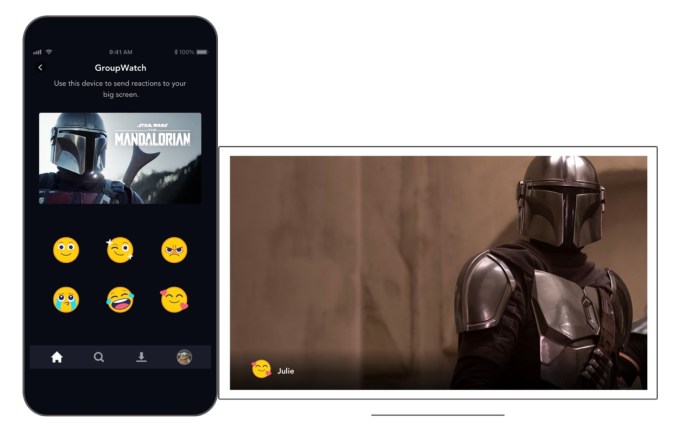
Disney+ GroupWatch

Image Credits: Disney

Once you’ve selected GroupWatch from the Details menu of a movie or TV show, you can invite up to six other people to participate — of course, they’ll need a Disney+ subscription of their own. And while the invitation has to be created via the Disney+ website or mobile app, people can also participate in a GroupWatch from their internet-connected TVs.

Besides synchronizing video playback (which any participant can control), GroupWatch allows viewers to respond to what’s happening on-screen by sharing emojis. But it lacks one of the hallmarks of co-watching, namely a chat that runs alongside the video.

Granted, a chat window could have been a bit distracting when blown up onto a big TV, but it’s arguably the centerpiece of social viewing. Jimerson said that if viewers want to chat, they can continue talking on whatever channel they used to send the invite (presumably a chat app on their phones).

“There are other opportunities to integrate communication capabilities, but we haven’t shared any timing on those things,” he added.