Wednesday, 30 December 2020

Fluence, the energy storage systems developer, is now worth over $1 billion after QIA investment

Fluence, the energy storage systems developer, is now worth over $1 billion after QIA investment

The Qatar Investment Authority is investing $125 million into energy storage systems integrator and power management tech developer, Fluence, in a deal that will value the company at over $1 billion.

The joint venture between the American independent power producer, AES Corp. and the German industrial conglomerate Siemens, was already worth $900 million prior to the transaction, according to Marek Wolek, the vice president of strategy and partnerships at Fluence.

With the new cash, Fluence will look to develop and acquire software and services that can expand the company’s offerings to its core clients among utilities and independent power project developers, Wolek said.

And it might not be too long before the company seeks additional liquidity from the public markets, Wolek said. He noted that the QIA is already backing the battery company QuantumScape, which was acquired by a special purpose acquisition company in late November and whose shares have been on a meteoric rise ever since.

After the QIA investment, AES and Siemens will remain majority shareholders. Each will hold a 44 percent stake in the company after the investment.

“We believe the global problem of climate change can only be tackled by  leveraging the combined capabilities of technologists and investors from around  the world,” said Manuel Perez Dubuc, Fluence’s Chief Executive Officer, in a statement. “We see  energy storage as the linchpin of a decarbonized grid and adding QIA to our  international shareholder base will allow Fluence to innovate even faster and  address the enormous global market for large-scale battery-based energy  storage.” 

One of six founding members of the One Planet Sovereign Wealth Fund Initiative, QIA is a multi-billion dollar investment vehicle that has significant stores of capital to continue its support of climate tech companies like Fluence.

Fluence has already deployed roughly 5 gigawatts of energy storage and management systems to a wide array of customers, according to Wolek.

And while Wolek said Fluence sees itself and its energy storage business as a key component of the global decarbonization which needs to occur to combat climate change, electric storage isn’t the only technology that’s needed.

It’s difficult looking at the energy market and looking at one technology and saying that one technology is going to solve everything,” said Wolek. 

Rather, the company’s role is to ensure that the battery technology Fluence is deploying can be integrated with the other technologies required to provide industry and society with the power it needs, he said. “We want to absolutely be the experts on battery-based storage,” Wolek said. “At the same time we do invest quite a bit on the digital side to expand our dispatch capabilities beyond storage.”

That could mean teaming up with other energy suppliers (like developers of hydrogen fuel proejcts) in the future, he said.

“We want to master the energy piece on the battery side,” Wolek said of the company’s ultimate goal.

That goal puts the company on something of a collision course with the energy business being built by Elon Musk’s Tesla.

The billion-dollar valuation that Fluence currently enjoys and the $36.6 billion market cap that QuantumScape has goes some way toward explaining why Tesla can be considered to be a company worth over $650 billion.


Imagine being blind and trying to attend a virtual event. Try that next time you stage one.

Imagine being blind and trying to attend a virtual event. Try that next time you stage one.

How do you make a virtual event accessible for people who are blind or visually impaired?

When I started work on Sight Tech Global back in June this year, I was confident that we would find the answer to that question pretty quickly. With so many virtual event platforms and online ticketing options available to virtual event organizers, we were sure at least one would meet a reasonable standard of accessibility for people who use screen readers or other devices to navigate the Web.

Sadly, I was wrong about that. As I did my due diligence and spoke to CEOs at a variety of platforms, I heard a lot of “we’re studying WCAG [Web Content Accessibility Guidelines] requirements” or “our developers are going to re-write our front-end code when we have time.” In other words, these operations, like many others on the Web, had not taken the trouble to code their sites for accessibility at the start, which is the least costly and fairest approach, not to mention the one compliant with the ADA.

This realization was a major red flag. We had announced our event dates – Dec 2-3, 2020 – and there was no turning back. Dmitry Paperny, our designer, and I did not have much time to figure out a solution. No less important than the dates was the imperative that the event’s virtual experience work well for blind attendees, given that our event was really centered on that community.

We decided to take Occam’s razor to the conventions surrounding virtual event experiences and answer a key question: What was essential? Virtual event platforms tend to be feature heavy, which compounds accessibility problems. We ranked what really mattered, and the list came down to three things:

  • live-stream video for the “main stage” events
  • a highly navigable, interactive agenda
  • interactive video for the breakout sessions.

We also debated adding a social or networking element as well, and decided that was optional unless there was an easy, compelling solution.

The next question was what third-party tools could we use? The very good news was that YouTube and Zoom get great marks for accessibility. People who are blind are familiar with both and many know the keyboard commands to navigate the players. We discovered this largely by word of mouth at first and then discovered ample supporting documentation at YouTube and Zoom. So we chose YouTube for our main stage programming and Zoom for our breakouts. It’s helpful, of course, that it’s very easy to incorporate both YouTube and Zoom in a website, which became our plan.

Where to host the overall experience, was the next question. We wanted to be able to direct attendees to a single URL in order to join the event. Luckily, we had already built an accessible website to market the event. Dmitry had learned a lot in the course of designing and coding that site, including the importance of thinking about both blind and low-vision users. So we decided to add the event experience to our site itself – instead of using a third-party event platform – by adding two elements to the site navigation – Event (no longer live on the site) and Agenda.

The first amounted to a “page” (in WordPress parlance) that contained the YouTube live player embed, and beneath that text descriptions of the current session and the upcoming session, along with prominent links to the full Agenda. Some folks might ask, why place the agenda on a separate page? Doesn’t that make it more complicated? Good question, and the answer was one of many revelations that came from our partner Fable, which specializes in usability testing for people with disabilities. The answer, as we found time and again, was to imagine navigating with a screen reader, not your eyes. If the agenda were beneath the YouTube Player, it would create a cacophonous experience – imagine trying to listen to the programming and at the same time “read” (as in “listen to”) the agenda below. A separate page for the agenda was the right idea.

The Agenda page was our biggest challenge because it contained a lot of information, required filters and also, during the show, had different “states” – as in which agenda items were “playing now” versus upcoming versus already concluded. Dmitry learned a lot about the best approach to drop downs for filters and other details to make the agenda page navigable, and we reviewed it several times with Fable’s experts. We decided nonetheless to take the fairly unprecedented step of inviting our registered, blind event attendees to join us for a “practice event” a few days before the show in order to get more feedback. Nearly 200 people showed up for two sessions. We also invited blind screen reader experts, including Fable’s Sam Proulx and Facebook’s Matt King, to join us to answer questions and sort out the feedback.

It’s worth noting that there are three major screen readers: JAWS, which is used mostly by Windows’ users; VoiceOver, which is on all Apple products; and NVDA, which is open source and works on PCs running Microsoft Windows 7 SP1 and later. They don’t all work in the same way, and the people who use them range from experts who know hundreds of keyboard commands to occasional users who have more basic skills. For that reason, it’s really important to have expert interlocutors who can help separate good suggestions from simple frustrations.

The format for our open house (session one and session two) was a Zoom meeting, where we provided a briefing about the event and how the experience worked. Then we provided links to a working Event page (with a YouTube player active) and the Agenda page and asked people to give it a try and return to the Zoom session with feedback. Like so much else in this effort, the result was humbling. We had the basics down well, but we had missed some nuances, such as the best way to order information in an agenda item for someone who can only “hear” it versus “see” it. Fortunately, we had time to tune the agenda page a bit more before the show.

The practice session also reinforced that we had made a good move to offer live customer support during the show as a buffer for attendees who were less sophisticated in the use of screen readers. We partnered with Be My Eyes, a mobile app that connects blind users to sighted helpers who use the blind person’s phone camera to help troubleshoot issues. It’s like having a friend look over your shoulder. We recruited 10 volunteers and trained them to be ready to answer questions about the event, and Be My Eyes put them at the top of the list for any calls related to Sight Tech Global, which was listed under the Be My Eyes “event’ section.  Our event host, the incomparable Will Butler, who happens to be a vice-president at Be My Eyes, regularly reminded attendees to use Be My Eyes if they needed help with the virtual experience.

A month out from the event, we were feeling confident enough that we decided to add a social interaction feature to the show. Word on the street was that Slido’s basic Q&A features worked well with screen readers, and in fact Fable used the service for its projects. So we added Slido to the program. We did not embed a Slido widget beneath the YouTube player, which might have been a good solution for sighted participants, but instead added a link to each agenda session to a standalone Slido page, where attendees could add comments and ask questions without getting tangled in the agenda or the livestream.  The solution ended up working well, and we had more than 750 comments and questions on Slido during the show.

When Dec. 2 finally arrived, we were ready. But the best-laid plans often go awry, we were only minutes into the event when suddenly our live, closed-captioning broke. We decided to halt the show until we could bring that back up live, for the benefit of deaf and hard-of-hearing attendees. After much scrambling, captioning came back. (See more on captioning below).

Otherwise, the production worked well from a programming standpoint as well as accessibility. How did we do? Of the 2400+ registered attendees at the event, 45% said they planned to use screen readers. When we did a survey of those attendees immediately after the show, 95 replied and they gave the experience a 4.6/5 score. As far as the programming, our attendees (this time asked everyone – 157 replies) gave us a score of 4.7/5. Needless to say, we were delighted by those outcomes.

One other note concerned registration. At the outset, we also “heard” that one of the event registration platforms was “as good as it gets” for accessibility. We took that at face value, which was a mistake. We should have tested because comments for people trying to register as well as a low turnout of registration from blind people revealed after a few weeks that the registration site may have been better than the rest but was still really disappointing. It was painful, for example, to learn from one of our speakers that alt tags were missing from images (and there was no way to add them) and that the screen reader users had to tab through mountains of information in order to get to actionable links, such as “register.”

As we did with our approach to the website, we decided that the best course was to simplify. We added a Google Form as an alternative registration option. These are highly accessible. We instantly saw our registrations increase strongly, particularly among blind people. We were chagrined to realize that our first choice for registration had been excluding the very people our event intended to include.

We were able to use the Google Forms option because the event was free. Had we been trying to collect payment of registration fees, Google Form would not have been an option. Why did we make the event free to all attendees? There are several reasons. First, given our ambitions to make the event global and easily available to anyone interested in blindness, it was difficult to arrive at a universally acceptable price point. Second, adding payment as well as a “log-in” feature to access the event itself would create another accessibility headache. With our approach, anyone with the link to the Agenda or Event page could attend without any log-in demand or registration. We knew this would create some leakage in terms of knowing who attended the event – quite a lot in fact because we had 30% more attendees than registrants – but given the nature of the event we thought that losing out on names and emails was an acceptable price to pay considering the accessibility benefit.

If there is an overarching lesson from this exercise, it’s simply this: Event organizers have to roll up their sleeves and really get to the bottom of whether the experience is accessible or not. It’s not enough to trust platform or technology vendors, unless they have standout reputations in the community, as YouTube and Zoom do. It’s as important to ensure that the site or platform is coded appropriately (to WCAG standards, and using a tool like Google’s LightHouse) as it is to do real-world testing to ensure that the actual, observable experience of blind and low-vision users is a good one. At the end of the day, that’s what counts the most.

A final footnote. Although our event focused on accessibility issues for people who are blind or have low vision, we were committed from the start to include captions for people who would benefit. We opted for the best quality outcome, which is still human (versus AI) captioners, and we worked with VITAC to provide captions for the live Zoom and YouTube sessions and 3Play Media for the on-demand versions and the transcripts, which are now part of the permanent record. We also heard requests for “plain text” (no mark-up) versions of the transcripts in an easily downloadable version for people who use Braille-readers. We supplied those, as well. You can see how all those resources came together on pages  like this one, which contain all the information on a given session and are linked from the relevant section of the agenda.


Amazon acquires podcast network Wondery

Amazon acquires podcast network Wondery

Amazon just announced that it’s acquiring Wondery, the network behind podcasts including “Dirty John” and “Dr. Death.”

Wondery will become part of Amazon Music, which added support for podcasts (including its own original shows) in September. At the same time, the announcement claims that “nothing will change for listeners” and that the network’s podcasts will continue to be available from “a variety of providers.”

Media companies and streaming audio platforms are all making big bets on podcasting, with Spotify making a series of acquisitions including podcast network Gimlet, SiriusXM acquiring Stitcher and The New York Times acquiring Serial Productions. Amazon is coming relatively late to this market, but it will now have the support of a popular podcast maker as it works to catch up.

“With Amazon Music, Wondery will be able to provide even more high-quality, innovative content and continue their mission of bringing a world of entertainment and knowledge to their audiences, wherever they listen,” Amazon wrote.

Financial terms were not disclosed. The Wall Street Journal previously reported that acquisition talks were in the works, and that those talks valued Wondery at around $300 million.

The startup was founded in 2016 by former Fox executive Hernan Lopez (who’s currently fighting federal corruption charges tied to his time at Fox). Numbers from Podtrac rank it as the fourth largest podcast publisher in November, with an audience in the U.S. of more than 9 million unique listeners.

Wondery has raised a total of $15 million in funding from Advancit Capital, BDMI, Greycroft, Lerer Hippeau and others, according to Crunchbase.


Dear Sophie: Tips for getting a National Interest green card by myself?

Dear Sophie: Tips for getting a National Interest green card by myself?

Here’s another edition of “Dear Sophie,” the advice column that answers immigration-related questions about working at technology companies.

“Your questions are vital to the spread of knowledge that allows people all over the world to rise above borders and pursue their dreams,” says Sophie Alcorn, a Silicon Valley immigration attorney. “Whether you’re in people ops, a founder or seeking a job in Silicon Valley, I would love to answer your questions in my next column.”

Extra Crunch members receive access to weekly “Dear Sophie” columns; use promo code ALCORN to purchase a one- or two-year subscription for 50% off.


Dear Sophie:

I’m working in the Bay Area on an H-1B visa and my employer won’t sponsor my green card.

I really want permanent residence, but I never won a Nobel prize; I’m single; and I don’t have a million dollars yet. However, I think I might qualify for an EB-2 NIW green card.

What can you share?

— National in Napa

Dear National:

Wonderful that you’re taking matters into your own hands! This is a complicated process, so the most important advice I can give you is to retain an experienced business immigration attorney to represent you and prepare and file your green card case.

For additional do’s and don’ts in U.S. immigration, please check out the recent podcast that my law firm partner, Anita Koumriqian, and I posted on the commandments of immigration (and especially what to not do when it comes to visas and green cards).

This particular episode focuses on family-based green cards, but these recommendations are timeless and apply to individuals who are self-petitioning for employment-based green cards, such as the EB-2 NIW (National Interest Waiver) for exceptional ability and the EB-1A for extraordinary ability. Our top recommendation in that podcast episode is to avoid DIY immigration, so definitely retain legal counsel!

Filing for an EB-2 NIW or any green card requires more than just filling out the appropriate forms. The process needs to be understood, as the law and legal requirements, and the analysis of whether and how you can best qualify is complicated.

With any immigration matter, one needs to have the resources to fully understand the process, the steps for applying, and the timing and deadlines. We want to always make sure that you always maintain legal status (never falling out of status) so that you can remain in the U.S. (and don’t have to leave).


Student-founded Develop for Good surpasses 25,000 volunteer hours connecting students with nonprofits

Student-founded Develop for Good surpasses 25,000 volunteer hours connecting students with nonprofits

This has been the year of the social organization. As the COVID-19 pandemic swept across the world and the United States, governments and a patchwork of nonprofits and volunteer organizations sprang into action, offering everything from food and medical supplies to children’s books and clothing to individuals and families struggling in the virus’s wake.

Perhaps the biggest divide though to getting people help has been digital — non-profits need to connect with their beneficiaries over the internet just as much as any retailer today. Unfortunately, tech talent is expensive and hard to find, particularly for often cash-strapped nonprofits.

That was part of the impetus for two Stanford seniors, Mary Zhu and Amay Aggarwal, to co-found Develop for Good, a matching service designed to connect motivated and ambitious undergrads in computer science, design and economics to nonprofits with specific projects that require expertise. They launched the network in March as the pandemic started spreading rapidly, and since then, the organization has itself started growing exponentially as well.

Develop for Good “was in response to [the pandemic], but at the same time, a lot of our peers were having their internships canceled, [and] a lot of companies were having hiring freezes,” Zhu explained. “People were also seeking opportunities to be able to develop their professional skills and develop their project experience.” This coincidence of needs among both students and nonprofits helped accelerate the matching that Develop for Good offers.

So far, the 501(c)(3) non-profit has coordinated more than 25,000 volunteer hours across groups like the Ronald McDonald House, UNICEF, the Native American Rights Fund (NARF), Easterseals, The Nature Conservancy, Save the Children, AARP and more. The program, which in its first batch focused on Zhu and Aggarwal’s network at Stanford, has since expanded to more than a dozen schools across the United States. The two first reached out to nonprofits through Stanford’s alumni network, although as the program’s reputation has grown, they have started getting inbound interest as well.

Volunteers take on a project for 5-10 hours per week for 10 weeks, typically in teams. Each team meets their nonprofit client at least weekly to ensure the project matches expectations. Typical projects include application development, data visualization, and web design. Most projects conclude at the end of the batch, although the founders note that some in-depth projects like product development can cross over into future batches. As the program has expanded, Zhu and Aggarwal have added a more formal mentorship component to the program to help guide students through their work.

Applications for the next batch starting in January are currently open for students (they’re due January 2nd, so get them in quick!). The founders told me that they are expecting 800 applications, and are likely going to be able to match about 200 volunteers to 32 projects. Applications are mostly about matching interests with potential programs for the best fit, rather than a purely competitive exercise. So far, the program has worked on 50 projects to date.

For this next batch, Amazon Web Services will sponsor a stipend for first-generation and low-income students to help defray the financial impact of volunteer work for some students. “Over the past cycle, a few people had to drop out because they said, ‘they’re unable to work for free because they’re having a lot of financial stress for their families’,” Aggrawal said. The new stipend is meant to help these students continue to volunteer while alleviating some of that financial burden.

Aggrawal said that two-thirds of the program’s volunteer developers and designers are female, and one-third are first-generation or low-income.


Section 230 is threatened in new bill tying liability shield repeal to $2,000 checks

Section 230 is threatened in new bill tying liability shield repeal to $2,000 checks

Tech got dragged into yet another irrelevant Congressional scuffle this week after President Trump agreed to sign a bipartisan pandemic relief package but continued to press for additional $2,000 checks that his party opposed during negotiations.

In tweets and other comments, Trump tied a push for the boosted relief payments to his entirely unrelated demand to repeal Section 230 of the Communications Decency Act, a critical but previously obscure law that protects internet companies from legal liability for user-generated content.

The political situation was complicated further after Republicans in Georgia’s two extremely high stakes runoff races sided with Trump over the additional checks rather than the majority of Republicans in Congress.

In a move that’s more a political maneuver than a real stab at tech regulation,  Senate Majority Leader Mitch McConnell introduced a new bill late Tuesday linking the $2,000 payments Republicans previously blocked to an outright repeal of Section 230 — a proposal that’s sure to be doomed in Congress.

McConnell’s bill humors the president’s eclectic cluster of demands while creating an opportunity for his party to look unified, sort of, in the face of the Georgia situation. The proposal also tosses in a study on voter fraud, not because it’s relevant but because it’s another pet issue that Trump dragged into the whole mess.

Over the course of 2020, Trump has repeatedly returned to the ideal of revoking Section 230 protections as a cudgel he can wield against tech companies, particularly Twitter when the platform’s rules result in his own tweets being downranked or paired with misinformation warnings.


If the latest development sounds confusing that’s because it is. Section 230 and the stimulus legislation have nothing at all to do with one another. And we were just talking about Section 230 in relation to another completely unrelated bit of legislation, a huge annual defense spending bill called the NDAA.

Last week Trump decided to veto that bill, which enjoyed broad bipartisan support because it funds the military and does other mostly uncontroversial stuff, on the grounds that it didn’t include his totally unrelated demand to strip tech companies of their Section 230 protections. Trump’s move was pretty much out of left field, but it opened the door for Democrats to leverage their cooperation in a two-thirds majority to override Trump’s veto for other stuff they want right now, namely those $2,000 stimulus checks for Americans. Sen. Bernie Sanders is attempting to do just that.

Unfortunately, McConnell’s move here is mostly a cynical one, to the detriment of Americans in financial turmoil. An outright repeal of Section 230 is a position without much if any support among Democrats. And while closely Trump-aligned Republicans have flirted with the idea of stripping online platforms of the legal shield altogether, some flavor of reform is what’s been on the table and what’s likely to get hashed out in 2021.

For lawmakers who understand the far-reaching implications of the law, reform rather than a straight up repeal was always a more likely outcome. In the extraordinarily unlikely event that Section 230 gets repealed through this week’s strange series of events, many of the websites, apps and online services that people rely on would be thrown into chaos. Without Section 230’s liability protections, websites from Yelp to Fox News would be legally responsible for any user-generated reviews and comments they host. If an end to comments sections doesn’t sound so bad, imagine an internet without Amazon reviews, tweets and many other byproducts of the social internet.

The thing is, it’s not going to happen. McConnell doesn’t want Americans to receive the additional $2,000 checks and Democrats aren’t going to be willing to secure the funds by agreeing to a totally unrelated last-minute proposal to throw out the rules of the internet, particularly with regulatory pressure on tech mounting and more serious 230 reform efforts still underway. The proposed bill is also not even guaranteed to come up for a vote in the waning days of this Congressional session.

The end result will be that McConnell humors the president by offering him what he wanted, kind of, Democrats look bad for suddenly opposing much-needed additional stimulus money and Americans in the midst of a deadly and financially devastating crisis probably don’t end up with more money in their pockets. Not great.


One CMO’s journey with risk management and compliance

One CMO’s journey with risk management and compliance

Marketers don’t grow up daydreaming about risk management and compliance. Personally, I never gave governance, risk or compliance (GRC) a second thought outside of making sure my team completed required compliance or phishing training from time to time.

So, when I was tasked with leading the General Data Protection Regulation (GDPR) compliance initiative at a previous employer, I was far from my comfort zone.

What I thought were going to be a few, small requirements regarding how and when we sent emails to contacts based in Europe quickly turned into a complete overhaul of how the organization collected, processed and protected personally identifiable information (PII).

It is a risk leader’s job to facilitate conversations around risk and help guide business unit leaders to finding their own risk appetites.

As it turned out, I had completely underestimated the scope and importance of the project. My first mistake? Assuming compliance was “someone else’s issue.”

Risk management is a team sport

No single risk leader can alone assess, manage and resolve an organization’s risk cap. Without active involvement from business unit leaders across the company in marketing, human resources, sales and more, a company can never have a healthy risk-aware culture.

Leaders successful at developing that culture instill a company-wide team mentality with well-defined objectives, a clear scope and an agreed-upon allocation of responsibility. Ultimately, you need buy-in similar to the way a football coach needs players to buy into the team’s culture and plays for peak performance. While the company’s risk managers may be the quarterbacks when it comes to GRC, the team won’t win without key plays by linemen (sales), running backs (marketing) and receivers (procurement).

It is a risk leader’s job to facilitate conversations around risk and help guide business unit leaders to finding their own risk appetites. It’s not their job to define acceptable levels of risk for us, which is why CMOs, HR and sales leaders have no choice but to take an active role in defining risk for their departments.

Shifting my view on risk management

If I am being honest, I only used to think about risk management in terms of asset protection and cost reduction. My crash course in risk responsibility opened my eyes to the many ways GRC can actually speed deals and furthermore, drive revenue.


NSO used real people’s location data to pitch its contact-tracing tech, researchers say

NSO used real people’s location data to pitch its contact-tracing tech, researchers say

Spyware maker NSO Group used real phone location data on thousands of unsuspecting people when it demonstrated its new COVID-19 contact-tracing system to governments and journalists, researchers have concluded.

NSO, a private intelligence company best known for developing and selling governments access to its Pegasus spyware, went on the charm offensive earlier this year to pitch its contact-tracing system, dubbed Fleming, aimed at helping governments track the spread of COVID-19. Fleming is designed to allow governments to feed location data from cell phone companies to visualize and track the spread of the virus. NSO gave several news outlets each a demo of Fleming, which NSO says helps governments make public health decisions “without compromising individual privacy.”

But in May, a security researcher told TechCrunch that he found an exposed database storing thousands of location data points used by NSO to demonstrate how Fleming works — the same demo seen by reporters weeks earlier.

TechCrunch reported the apparent security lapse to NSO, which quickly secured the database, but said that the location data was “not based on real and genuine data.”

NSO’s claim that the location data wasn’t real differed from reports in Israeli media, which said NSO had used phone location data obtained from advertising platforms, known as data brokers, to “train” the system. Academic and privacy expert Tehilla Shwartz Altshuler, who was also given a demo of Fleming, said NSO told her that the data was obtained from data brokers, which sell access to vast troves of aggregate location data collected from the apps installed on millions of phones.

TechCrunch asked researchers at Forensic Architecture, an academic unit at Goldsmiths, University of London that studies and examines human rights abuses, to investigate. The researchers published their findings on Wednesday, concluding that the exposed data was likely based on real phone location data.

The researchers said if the data is real, then NSO “violated the privacy” of 32,000 individuals across Rwanda, Israel, Bahrain, Saudi Arabia and the United Arab Emirates — countries that are reportedly customers of NSO’s spyware.

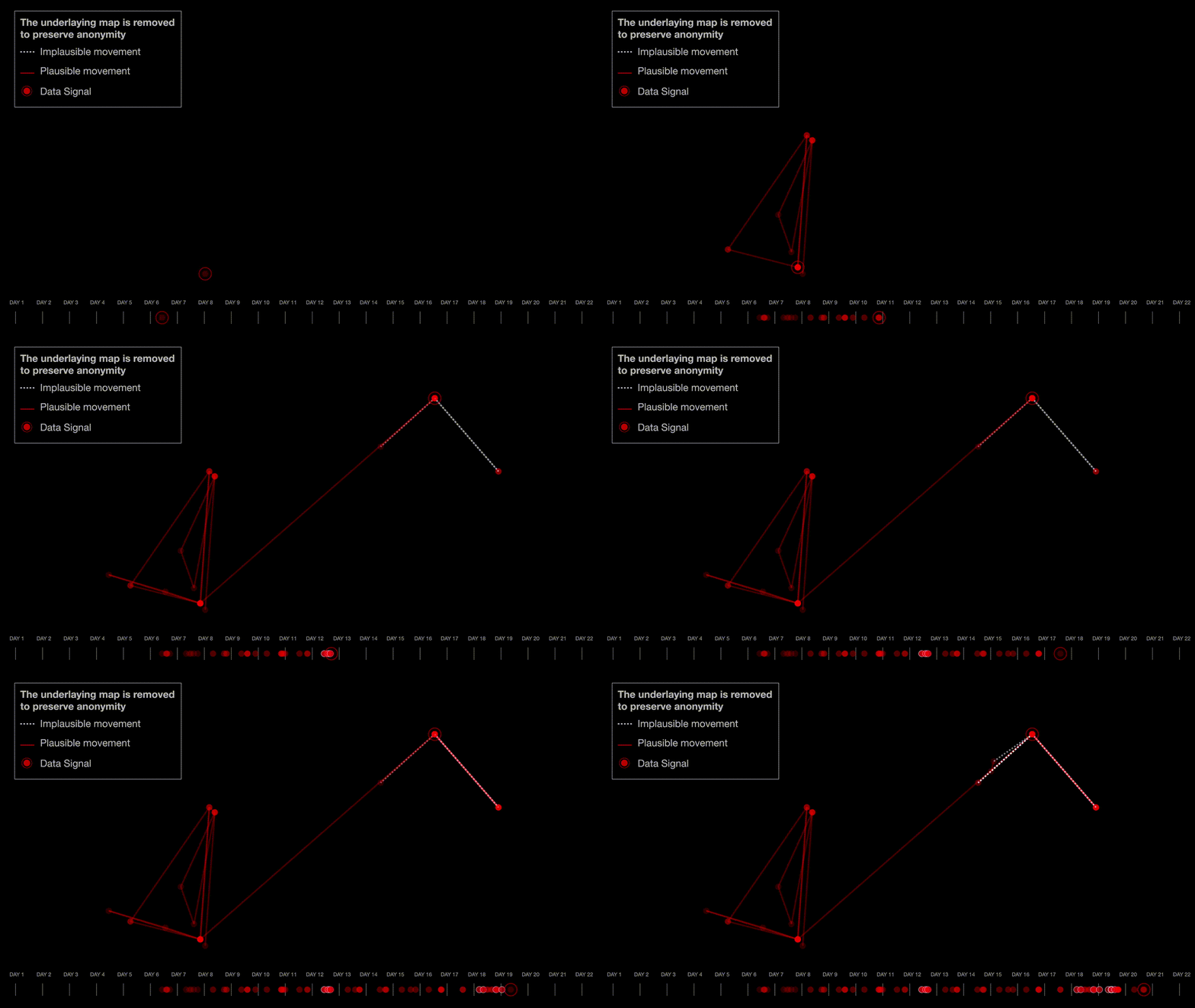
The researchers analyzed a sample of the exposed phone location data by looking for patterns they expected to see with real people’s location data, such as a concentration of people in major cities and by measuring the time it took for individuals to travel from one place to another. The researchers also found spatial irregularities that would be associated with real data, such as star-like patterns that are caused by a phone trying to accurately pinpoint its location when the line of sight to the satellite is obstructed by tall buildings.

“The spatial ‘irregularities’ in our sample — a common signature of real mobile location tracks — further support our assessment that this is real data. Therefore, the dataset is most likely not ‘dummy’ nor computer generated data, but rather reflects the movement of actual individuals, possibly acquired from telecommunications carriers or a third-party source,” the researchers said.

The researchers built maps, graphs, and visualizations to explain their findings, while preserving the anonymity of the individuals whose location data was fed into NSO’s Fleming demo.

Gary Miller, a mobile network security expert and founder of cyber intelligence firm Exigent Media, reviewed some of the datasets and graphs, and concluded it was real phone location data.

Miller said the number of data points increased around population hubs. “If you take a scatter plot of cell phone locations at a given point in time, there will be consistency in the number of points in suburban versus urban locations,” he said. Miller also found evidence of people traveling together, which he said “looked consistent with real phone data.”

He also said that even “anonymized” location data sets can be used to tell a lot about a person, such as where they live and work, and who they visit. “One can learn a lot of details about individuals simply by looking at location movement patterns,” he said.

“If you add up all of the similarities it would be very difficult to conclude that this was not actual mobile network data,” he said.

A timeline of one person’s location data in Bahrain over a three-week period. Researchers say these red lines represent travel that seems plausible within the indicated time. (Image: Forensic Architecture/supplied)

John Scott-Railton, a senior researcher at Citizen Lab, said the data likely originated from phone apps that use a blend of direct GPS data, nearby Wi-Fi networks, and the phone’s in-built sensors to try to improve the quality of the location data. “But it’s never really perfect,” he said. “If you’re looking at advertising data — like the kind that you buy from a data broker — it would look a lot like this.”

Scott-Railton also said that using simulated data for a contact-tracing system would be “counterproductive,” as NSO would “want to train [Fleming] on data that is as real and representative as possible.”

“Based on what I saw, the analysis provided by Forensic Architecture is consistent with the previous statements by Tehilla Shwartz Altshuler,” said Scott-Railton, referring to the academic who said NSO told her that was based on real data.

“The whole situation paints a picture of a spyware company once more being cavalier with sensitive and potentially personal information,” he said.

NSO rejected the researchers’ findings.

“We have not seen the supposed examination and have to question how these conclusions were reached. Nevertheless, we stand by our previous response of May 6, 2020. The demo material was not based on real and genuine data related to infected COVID-19 individuals,” said an unnamed spokesperson. (NSO’s earlier statement made no reference to individuals with COVID-19.)

“As our last statement details, the data used for the demonstrations did not contain any personally identifiable information (PII). And, also as previously stated, this demo was a simulation based on obfuscated data. The Fleming system is a tool that analyzes data provided by end users to help healthcare decision-makers during this global pandemic. NSO does not collect any data for the system, nor does NSO have any access to collected data.”

NSO did not answer our specific questions, including where the data came from and how it was obtained. The company claims on its website that Fleming is “already being operated by countries around the world,” but declined to confirm or deny its government customers when asked.

Contact Us

Got a tip? Contact us securely using SecureDrop. Find out more here.

The Israeli spyware maker’s push into contact tracing has been seen as a way to repair its image, as the company battles a lawsuit in the United States that could see it reveal more about the governments that buy access to its Pegasus spyware.

NSO is currently embroiled in a lawsuit with Facebook-owned WhatsApp, which last year blamed NSO for exploiting an undisclosed vulnerability in WhatsApp to infect some 1,400 phones with Pegasus, including journalists and human rights defenders. NSO says it should be afforded legal immunity because it acts on behalf of governments. But Microsoft, Google, Cisco, and VMware filed an amicus brief this week in support of WhatsApp, and calling on the court to reject NSO’s claim to immunity.

The amicus brief came shortly after Citizen Lab found evidence that dozens of journalists were also targeted with Pegasus spyware by NSO customers, including Saudi Arabia and the United Arab Emirates. NSO disputed the findings.


Activist hedge fund manager Daniel Loeb takes on Intel, plans launch of new VC fund

Activist hedge fund manager Daniel Loeb takes on Intel, plans launch of new VC fund

Third Point, the activist hedge fund run by Daniel Loeb, is busy in the waning days of 2020. It’s had great returns despite huge turbulence early in the pandemic — Reuters says that it is up 12.3% for the year as of earlier this month — and the firm clearly sees more and more potential for growth in the tech sector.

First, we learned via Asa Fitch at the Wall Street Journal yesterday that the hedge fund sent a vituperative shareholder letter to Intel chair Omar Ishrak, demanding wide-scale changes in its management after the American chipmaker fell dramatically behind rivals in recent years. As I noted in TechCrunch’s 2020 wrapup of the semiconductor industry, Intel has a make-or-break moment coming next year, and now with even further activist pressure from hedge funds, the push to fix Intel’s underlying problems is intensifying.

Third Point, according to the Journal, has acquired a $1 billion stake in the company. Intel’s stock jumped 5% immediately following the news as investors hope the added pressure improves the company’s prospects going forward.

But apparently, you won’t have to be a public company to get activist hedge funds on your cap table.

According to Miles Kruppa in the Financial Times this morning, the hedge fund is looking to raise up to $300 million for a new venture fund, with a presumed close by February. The hedge fund has made numerous venture investments in the past through its Third Point Ventures wing, although that line of its business has never garnered quite the business press headlines like its huge activist bets.

In the past, the firm’s venture investments targeted the tech, healthcare, and fintech spaces, with checks written to such companies as SentinelOne and Yellowbrick Data according to Crunchbase. No word on whether the stage or industry will remain the same for the new fund, assuming it closes.


China’s adaptive robot maker Flexiv raises over $100 million

China’s adaptive robot maker Flexiv raises over $100 million

As businesses around the world look to automate production lines and supply chains, companies making the robots are attracting great investor interest. The latest to get funded is Flexiv, which closed a Series B round north of $100 million from investors including China’s on-demand services giant Meituan, TechCrunch learned.

Other major investors in the strategic round are Chinese venture capital firm Meta Capital (元知资本), major Chinese agricultural company New Hope Group, private equity firm Longwood, Jack Ma’s YF Capital, prominent Chinese venture capital firms Gaorong Capital and GSR Ventures, as well as Plug and Play’s China and U.S. ventures. The new round boosted the startup’s capital raised so far to over $120 million.

The company operates out of several major Chinese cities and California with two-thirds of its staff stationed in China, a common strategy for AI startups helmed by Chinese founders who have worked or studied in the U.S.

In 2016, Wang Shiquan, an alumus of Stanford’s Biomimetics and Dexterous Manipulation Lab, founded Flexiv with a focus on building adaptive robots for the manufacturing industry. With the new capital, the startup plans to implement its AI-driven, general-purpose robots in other areas such as services, agriculture, logistics and medical care.

Through Meituan’s strategic investment, for instance, Flexiv could deploy its solutions to the investor’s core food delivery business, one that involves repetitive, high-volume tasks and is primed for automation.

Curved surface processing by Flexiv’s robot Rizon / Photo: Flexiv

In the meantime, there is still ample room for automation in traditional manufacturing, Wang said in an interview with TechCrunch. Consumer electronics especially require high-precision, delicate manufacturing processes, which means the production line often needs to be revamped for a new product. Flexiv’s robots, equipped with force feedback and computer vision systems, can adjust to new circumstances and potentially save factory bosses some time and money in setting up new machinery, Wang claimed.

The company’s flexible robots are what distinguishes it from many existing players, the founder added.

“Conventional robotic arms can safely perform tasks when there are no barriers around, but they are less capable of operating in complicated environments… Many seemingly simple tasks such as washing dishes actually require a lot of AI-based recognition and decision-making power.”

The company began mass production in the second half of this year and has so far produced around 100 robots. It plans to monetize by selling robots, licensing software, and providing after-sale services. The challenge then lies in finding partners and customers across a wide range of industries to trust its nascent technologies.

China remains Flexiv’s largest market while North America is a key market in its expansion plan. “Each country has its own competitive edge in robotics,” Wang suggested. “China’s advantage is in manufacturing, supply chains, and labor costs.”

“In the area of traditional and adaptive robotics, the gap between different countries is certainly narrowing,” the founder said.


Biteable raises $7 million Series A for its template-based online video builder

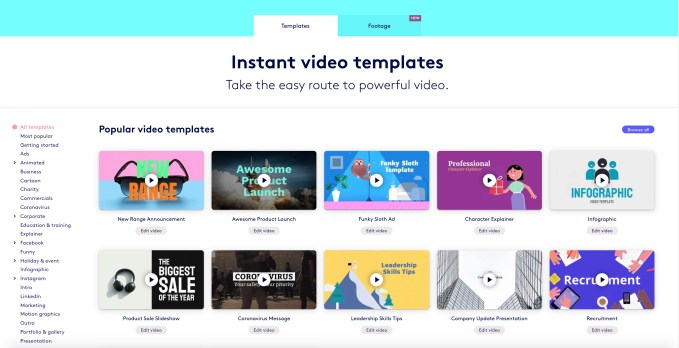
Online video platform Biteable, a startup that makes it easier to create polished and professional videos using templates and a library of images and animations, has raised $7 million in Series A funding led by Cloud Apps Capital Partners. The service today competes with products from Vimeo, Canva, Adobe and others, but focuses on creating video assets that have more staying power than temporary social videos.

These sort of videos are in more demand than ever, as the pandemic has prompted increased use of video communications — particularly among smaller businesses — which has also helped Biteable to grow, the company says. 

“[The pandemic] accelerated the move toward video that was already happening,” notes Biteable CEO Brent Chudoba, who joined the company at the end of last year. “It helped, obviously, things like Zoom and products like Loom. We saw a benefit, as well. I think, actually, we’ll see an even bigger benefit over time as companies are now used to working and sharing messages remotely, and having to get more creative in how they distribute information,” he says.

The startup itself was originally co-founded in 2015 in Hobart, Australia by CTO Tommy Fotak, Simon Westlake, and James MacGregor. Fotak’s background was in software development, while Westlake had experience in animation and studio production. MacGregor, who has a software, product and marketing background and previously worked at BigCommerce, is Biteable’s Chief Product Officer.

The team had initially been working on freelance projects for people who needed advertising and explainer videos, which led them to realize the opportunity in the video creation market. They believed there was demand for a video builder product that simplified a lot of the decisions that needed to be made when making a video. That is, they wanted to do for video creation what Squarespace, Wix and others have done for website creation.

Chudoba more recently joined the company as a result of Biteable wanting to bring in a CEO with more experience growing freemium software productivity businesses. Prior to Biteable, Chudoba worked in private equity, was an early SurveyMonkey employee (CRO), and also spent time at PicMonkey (COO), Thrive Global (COO and CFO) and Calendly (Head of Business Operations).

While Chudoba admits Biteable is not without its competition, he views that as a positive thing. It means there’s opportunity in the market and it gives Biteable a chance to differentiate itself from others.

On that front, Biteable’s customers tell him the product offers a good balance between the amount of time and skill set they have and the quality of the results.

“They can produce results that they are very proud of and that exceed what they thought they could do with — not necessarily low effort — but without having the training, skills and design background,” says Chudoba.

Above: A Biteable explainer video built with Biteable

The customers also appreciate the sizable content library, which includes a combination of stock photography, stock video footage, and hundreds of animations and scenes. Biteable licenses content from Unsplash and Storyblocks, while its animation library and templates are built in-house by its own professional design team. This allows the company to release hundreds of scenes per month, to keep the library content refreshed and current.

Unlike some of the other products on the market, Biteable’s sweet spot isn’t on “quick hit” social videos, like Instagram Stories, for example. Instead, it focuses on assets that companies use and reuse — like video explainers for a business, online marketing and ads, videos that appear on product pages, and more. Its videos also tend to be between 30 seconds and 3 and half minutes.

Already, Biteable has found individuals from companies like Amazon, Microsoft, Google, Disney, Salesforce, BBC, Shopify and Samsung have used its service, though it doesn’t have any official contracts with these larger businesses.

Above: A Biteable recruiting video template

Today, the startup generates revenue via a freemium business model that includes multiple subscription plans.

A free plan for individual users offers access to the suite of tools for video creation, including the 1.8 million pictures, clips, and animations within the Biteable library. However, free videos are watermarked with Biteable’s branding. A $19 per month plan for single users removes the watermark and allows you to add your own, and offers HD 1080p resolution and other features, like commercial usage rights. Professionals pay $49 per month for shared editing and projects and use by unlimited team members, and more. Custom pricing plans are also available.

Combined, Biteable’s free and paid users total over 6 million. They create around 100,000 unique videos per month, and that number had roughly doubled over the course of 2020.

Image Credits: Biteable

The new $7 million round, announced today, was led by new investor Cloud Apps Capital Partners. Existing investor Tank Stream Ventures also returned for the round and was joined by both new and existing angel investors. In total, Biteable has raised over $9 million (USD) to date.

With the additional funds, Biteable aims to hire and continue to develop the product.

Another shift attributed to the pandemic is that people have warmed up to remote work. Biteable had already been a remote-first operation whose team of 46 is geographically distributed across Australia, the U.S., Canada, and Western Europe. Now, Biteable no longer has to convince people that remote work is the future — and this helps with recruiting talent, too.

Chudoba believes Biteable can grow to become a larger company over time.

“Video is a platform concept and so I think you can build a really big standalone company,” Chudoba says. “We’re a freemium model so that’s a low customer acquisition cost. It’s a high value service and it can be very sticky when you get teams involved,” he notes.

“The power of online video has been incredible, and the events of 2020 have accelerated adoption trends that would have otherwise taken five or more years to evolve,” notes Matt Holleran, General Partner at Cloud Apps Capital Partners, in a statement about his firm’s investment. “As a firm, we look for great businesses in high growth industries with excellent teams that we can help reach the next level. In Biteable, we see all three of those elements and are incredibly excited to partner with Brent and the Biteable team on this next chapter of growth,” he says.


For Tony Fadell, the future of startups is connected and sustainable

For Tony Fadell, the future of startups is connected and sustainable

Tony Fadell can’t stop thinking about what’s next in tech.

The man credited with creating the iPod, building the iPhone and founding the smart-home company, Nest, had tried to retire before he started his latest venture, Future Shape, but found that retirement didn’t really take.

So the 51-year-old designer, engineer and investor, together with a core group of collaborators, has spent the last three years staking out the shape of the future of tech with a slew of public and undisclosed investments. Fadell’s bets track to personal obsessions (he’s an investor in the website for the watch-obsessed, Hodinkee) and what he sees as the next waves in technological innovation.

“We call ourselves mentors with money,” Fadell said of his latest endeavor. The idea, he said, was to “help all of these companies that are doing really difficult things.”

Fadell and his crew have identified a few really difficult things that he sees as big investment areas going forward. They include the electrification of everything; the digital connection of everything; the rise of biomanufacturing; and the eradication of waste.

Those themes drive some, but not all, of the company’s work with the over 200 companies it has in its portfolio, according to a spokesperson for the firm.

One of the areas where Fadell has been most public about his commitments is around the notion of the programmable electrification of everything. There, Fadell has made some big bets with companies like Rohinni, which makes micro-light emitting diodes; Turntide, which makes digital motors; Menlo Micro, which is making micro-electronic miniaturized switches; and Phononic, which makes a solid state chipset for cooling.

Each of these technologies takes mechanical technology that, with the exception of the lightbulb, hasn’t seen much in the way of digital advancements for decades and makes those technologies programmable.

Fadell argues that Future Shape is in a unique position to take these technologies to commercialization thanks to his history with the manufacturing industry from his days at Apple and Google.

“We span these gaps from the atoms to the electrons (software) and we try to fit those systems together,” Fadell said.

That thesis applies to the development of technologies that will leverage the growing connectivity and digitization of nearly everything.

“There’s going to be this expansion of 4G/5G connectivity through all of these regions of the world… [So] we can put cheap sensors that collect information on smart phones and integrate it with software and cloud services… From that we get data that allows for [new industry] to happen.”

The proliferation of low cost sensors batteries, and power will create opportunities for data collection that can be applied in a vast array of new markets, from farming to construction, and engender better services in industries that are already data-heavy — like finance and insurance, Fadell said.

Image Credit: Getty Images/Rost-9D

It’s one of the reasons that the company invested in Understory Weather,  which Fadell calls a climate-change driven, next-generation insurance company that started with smart weather stations and data. 

Other companies in the Future Shape portfolio represent Fadell’s belief in biomanufacturing and the eradication of waste. An early investor in Impossible Foods, Fadell thinks that the kinds of synthetic biological processes that could lead to the replacement of meat with alternative proteins could extend to the fabrication of a leather replacement and the development of new, bioplastics to replace chemicals currently used today.

That’s why Future Shape has invested in MycoWorks, joining a slew of celebrity and institutional backers in the $40 million financing that the company closed in November.

“Biomanufacturing is happening, and it’s happening at a staggering rate because we’re embracing the powerful thing on the planet — life,” Fadell said. “You want to drive the market to where it needs to go. And everybody follows — just like what Impossible is doing.”

Finally, Fadell sees a huge opportunity in rethinking the supply chains associated with waste streams and the opportunities in the creation of circular economies. That applies to companies in the restaurant industry — like Sweetgreen — and to packaging and products like novel bioplastics.

“Another thing we look at is waste — how do we reduce the waste and how do we recycle the waste. We go after the problems and waste is a big one,” Fadell said. 

That opportunity set extends from companies that are examining the economics and providing a life cycle analysis on company’s carbon waste streams and material, physical byproducts. “Mine the waste, don’t mine the earth,” Fadell said of the potential for replacing a multi-billion dollar extractive industry.

While many of the companies in the portfolio are still very early stage, Fadell said that there have been some exits in the Future Shape portfolio, although he expects many more are on the way.

“We’re not in this for the money we’re in this for the change,” Fadell said. “If we do this right the money comes. I’m not in the job of convincing LPs… we do it based on conviction.” 


Understanding Europe’s big push to rewrite the digital rulebook

Understanding Europe’s big push to rewrite the digital rulebook

European Union lawmakers have set out the biggest update of digital regulations for around two decades — likening it to the introduction of traffic lights to highways to bring order to the chaos wrought by increased mobility. Just switch cars for packets of data.

The proposals for a Digital Services Act (DSA) to standardize safety rules for online business, and a Digital Markets Act (DMA), which will put limits on tech giants aimed at boosting competition in the digital markets they dominate, are intended to shape the future of online business for the next two decades — both in Europe and beyond.

The bloc is far ahead of the U.S. on internet regulation. So while the tech giants of today are (mostly) made in the USA, rules that determine how they can and can’t operate in the future are being shaped in Brussels.

What will come faster, a U.S. breakup of a tech empire or effective enforcement of EU rules on internet gatekeepers is an interesting question to ponder.

The latter part of this year has seen Ursula von der Leyen’s European Commission, which took up its five-mandate last December, unleash a flotilla of digital proposals — and tease more coming in 2021. The Commission has proposed a Data Governance Act to encourage reuse of industrial (and other) data, with another data regulation and rules on political ads transparency proposal slated as coming next year. European-flavored guardrails for use of AI will also be presented next year.

But it’s the DSA and DMA that are core to understanding how the EU executive body hopes to reshape internet business practices to increase accountability and fairness — and in so doing promote the region’s interests for years to come.

These are themes being seen elsewhere in the world at a national level. The U.K., for example, is coming with an “Online Safety Bill” next year in response to public concern about the societal impacts of big tech. While rising interest in tech antitrust has led to Google and Facebook facing charges of abusive business practices on home turf.

What will come faster, a U.S. breakup of a tech empire or effective enforcement of EU rules on internet gatekeepers is an interesting question to ponder. Both are now live possibilities — so entrepreneurs can dare to dream of a different, freer and fairer digital playground. One that’s not ruled over by a handful of abusive giants. Though we’re certainly not there yet.

With the DSA and DMA the EU is proposing an e-commerce and digital markets framework that, once adopted, will apply for its 27 Member States — and the ~445 million people who live there — exerting both a sizable regional pull and seeking to punch up and out at global internet giants.

While there are many challenges ahead to turn the planned framework into pan-EU law, it looks a savvy move by the Commission to separate the DSA and DMA — making it harder for big tech to co-opt the wider industry to lobby against measures that will only affect them in the 160+ pages of proposed legislation now on the table.

It’s also notable that the DSA contains a sliding scale of requirements, with audits, risk assessments and the deepest algorithmic accountability provisions reserved for larger players.

Tech sovereignty — by scaling up Europe’s tech capacity and businesses — is a strategic priority for the Commission. And rule-setting is a key part of how it intends to get there — building on data protection rules that have already been updated, with the GDPR being applied from 2018.

Though what the two new major policy packages will mean for tech companies, startup-sized or market-dominating, won’t be clear for months — or even years. The DSA and DMA have to go through the EU’s typically bruising co-legislative process, looping in representatives of Member States’ governments and directly elected MEPs in the European parliament (which often are coming at the process with different policy priorities and agendas).

The draft presented this month is thus a starting point. Plenty could shift — or even change radically — through the coming debates and amendments. Which means the lobbying starts in earnest now. The coming months will be crucial to determining who will be the future winners and losers under the new regime so startups will need to work hard to make their voices heard.

While tech giants have been pouring increasing amounts of money into Brussels “whispering” for years, the EU is keen to champion homegrown tech — and most of big tech isn’t that.

A fight is almost certainly brewing to influence the world’s most ambitious digital rulebook — including in key areas like the surveillance-based adtech business models that currently dominate the web (to the detriment of individual rights and pro-privacy innovation). So for those dreaming of a better web there’s plenty to play for.

Early responses to the DSA and DMA show the two warring sides, with U.S.-based tech lobbies blasting the plan to expand internet regulation as “anti-innovation” (and anti-U.S.), while EU rights groups are making positive noises over the draft — albeit, with an ambition to go further and ensure stronger protections for web users.

On the startup side, there’s early relief that key tenets of the EU’s existing e-commerce framework look set to remain untouched, mingled with concern that plans to rein in tech giants may have knock-on impacts — such as on startup exits (and valuations). European founders, whose ability to scale is being directly throttled by big tech’s market muscle, have other reasons to be cheerful about the direction of policy travel.

In short, major shifts are coming and businesses and entrepreneurs would do well to prepare for changing requirements — and to seize new opportunities.

Read on for a breakdown of the key aims and requirements of the DSA and the DMA, and additional discussion on how the policy plan could shape the future of the startup business.

Digital Services Act

The DSA aims to standardize rules for digital services that act as intermediaries by connecting consumers to goods, services and content. It will apply to various types of digital services, including network infrastructure providers (like ISPs); hosting services (like cloud storage providers); and online platforms (like social media and marketplaces) — applying to all that offer services in the EU, regardless of where they’re based.

The existing EU e-Commerce Directive was adopted in the year 2000 so revisiting it to see if core principles are still fit for purpose is important. And the Commission has essentially decided that they are. But it also wants to improve consumer protections and dial up transparency and accountability on services businesses by setting new due diligence obligations — responding to a smorgasbord of concerns around the impact of what’s now being hawked and monetized online (whether hateful content or dangerous/illegal products).

Some EU Member States have also been drafting their own laws (in areas like hate speech) that threatens regulatory fragmentation of the bloc’s single market, giving lawmakers added impetus to come with harmonized pan-EU rules (hence the DSA being a regulation, not a directive).

The package will introduce obligations aimed at setting rules for how internet businesses respond to illegal stuff (content, services, goods and so on) — including standardized notice and response procedures for swiftly tackling illegal content (an areas that’s been managed by a voluntary EU code of conduct on illegal hate speech up til now); and a “Know Your Customer” principle for online marketplaces (already a familiar feature in more heavily regulated sectors like fintech) that’s aimed at making it harder for sellers of illegal products to simply respawn within a marketplace under a new name.

There’s also a big push around transparency obligations — with requirements in the proposal for platforms to provide “meaningful” criteria used to target ads (Article 24); and explain the “main parameters” of recommender algorithms (Article 29), as well as requirements to foreground user controls (including at least one “nonprofiling” option).

Here the overarching aim is to increase accountability by ensuring European users can get the information needed to be able to exercise their rights.


On the diversity front, 2020 may prove a tipping point

On the diversity front, 2020 may prove a tipping point

Since Minneapolis police officers killed George Floyd in May and kicked off months of nationwide protests, the corporate world — including venture capitalists — have attempted to respond to the Black Lives Matter movement.

Indeed, many quickly took to social media to voice their support, broadcast their new diversity-focused networking groups and pledge to do better, particularly when it comes to finding and funding more Black founders and other underrepresented entrepreneurs.

As of 2018, 81% of venture firms still lacked a single Black investor.

It was tempting to dismiss it as so much hot air, given that VCs have talked about diversity for eons without doing much about it.

As of February 2020, according to a report by All Raise, an organization that promotes female founders, 65% of VC firms still had no female partners. As of 2018, 81% of venture firms still lacked a single Black investor, per an analysis by Equal Ventures partner Richard Kerby.

Those numbers are comparatively rosy when considering the percentage of women and Black investors in senior decision-making roles. According to recent PitchBook data, at the start of this year, just 12.4% of decision-makers at U.S. venture firms were women (up slightly from the 9.65% at the start of 2019). As for for the number of Black investors in senior positions, it has long hovered around just 2%.

But here’s the good news: While it remains an ongoing challenge to get these numbers in sync with other industries, there were two developments specifically in 2020 that may beget more action in 2021.

We’d first point to the decision this fall by Yale’s endowment to require its asset managers to do better when it comes to diversity. Specifically, the school’s $32 billion endowment — led since 1985 by investor David Swensen — told its 70 U.S. money managers that from here on out, they will be measured annually on their progress in increasing the diversity of their investment staff, from hiring to training to mentoring to their retention of women and minorities.


EarlyBird’s new app lets families and friends ‘gift’ investments to children

EarlyBird’s new app lets families and friends ‘gift’ investments to children

A new fintech startup called EarlyBird wants to help families invest in their children’s financial futures. Through the EarlyBird mobile app, parents in just a few minutes can create a custodial account, also known as a UGMA (Uniform Gifts to Minors Act) account. These accounts typically allow a parent, aka the “custodian,” to invest in stocks, bonds, mutual funds, and other securities on behalf of the minor child. When the child comes of legal adult age, the investments become theirs.

Through the app, parents can set up an account for their child, then invite other family members and close friends to contribute.

The idea is not so different, in spirit at least, from something like HoneyFund, where newlyweds ask loved ones for cash donations instead of physical gifts. Similarly, EarlyBird offers an alternative to giving a child toys and more “stuff,” by inviting family and friends to donate money. Except in EarlyBird’s case, it’s not asking for straight cash donations — this is not some glorified crowdfunding platform, after all — it’s enabling investments.

Specifically, EarlyBird aims to make it easier and less confusing for parents to establish custodial accounts. It’s not the first fintech to do so — Stash and Acorns, for example, also offer this.

EarlyBird, however, aims to combine the investment account itself with a platform that allows for social features and a gifting experience. The idea is to make the act of donating to the account feel more like a real gift — unlike the gift of a check or some cash tucked into a greeting card.

Image Credits: EarlyBird

With the EarlyBird app, the giver can record a short video “memory” alongside their donation to the investment account. This makes for a more social and personal experience as the child can later look back on these videos. In addition, other family members and friends may also see the videos and be prompted to donate to the child’s investment account, too.

The idea for EarlyBird comes from former AgilityIO COO Jordan Wexler, now EarlyBird CEO, and early Yello.co employee and VP Caleb Frankel, now EarlyBird COO.

Wexler explains that he began thinking about investments as an alternative to physical gifts when a new baby arrived in his own extended family.

“This all started with a problem I experienced years ago when my beautiful baby niece was born. I found myself head over heels and spending hundreds and hundreds of dollars on just the most ridiculous stuff — pretty much just junk gifts,” he says.

A few years ago, he got the idea to start investing his cash into an index fund on the child’s behalf.

“I wanted to have a larger impact in her life and something that she could really use when she grew up,” Wexler says.

His father had once done the same for him, in fact. When he was 12 years old, his dad gave him some money in a TD Ameritrade account which he withdrew later in life to help fund his first startup — SucceedOverseas in Qingdao, China — a strategic consulting firm that aided companies with employee relocation. (It was acquired in 2015 by Chiway Education Group.) 

Wexler met EarlyBird co-founder Caleb Frankel in Qingdao and reconnected with him again when he returned the U.S. Last year, they teamed up on EarlyBird, with the goal of simplifying the process for parents who want to launch custodial investment accounts for their kids.

Image Credits: EarlyBird

Custodial accounts, to be fair, are perhaps not a well-known investment vehicle to those who aren’t parents — or even to those who are, in some cases. That’s because their alternative, the 529 plan, has generally been more popular because of its tax advantages.  

While both accounts allow families to invest on behalf of minor children, investments in 529 plans grow tax-free. Any withdrawals made for educational expenses — like tuition, room and board, books, and more — are also not taxed. That’s a big perk.

UGMA accounts, meanwhile, are taxed at certain levels. The first $1,100 of unearned annual income is tax-free, but the next $1,100 is taxed at the child’s tax rate. Unearned income above $2,200 is then taxed at the rates for trusts and estates, which can be higher than the child’s tax rate.

Donations to UGMA accounts don’t receive an income tax reduction, but they aren’t taxed themselves up to $15K for an individual or $30K for a married couple.

Because most families are investing with college expenses and tax advantages in mind, 529 plans have been better known. But Wexler says things are changing.

“A lot of parents actually have no idea what education and college will look like in 15 years and want something a little bit more flexible,” he explains.

Plus, UGMA accounts can be used for college, if need be. But if college, say, becomes free in the U.S. one day (!!!), the UGMA account’s investments can be used for anything else. That flexibility is why the account is more attractive to some parents these days — and why other fintechs, like Acorns, are entering this market.

However, EarlyBird will expand into 529 plans within a year, it says. It just didn’t start there.

Image Credits: EarlyBird

Another differentiator between EarlyBird and Acorns or Stash’s custodian plans is how EarlyBird incorporates financial literacy into its product.

From birth to 5 years old, the parent manages the child’s account entirely. But when the child is age 6 to 13, parents can show the app to the child in a special “view only” mode where the child can learn about their investments and watch them grow. At 13 to 18, the child can download the app and, alongside their parents, can begin to interact with it. At age 18 (or 21 in some states), the child takes full custody of the account.

EarlyBird also simplifies the act of investing by offering a range of portfolios from conservative to aggressive. On the conservative side, the portfolio is 100% ETF bond-based while the aggressive portfolio is 100% ETF equity-based. Like Acorns, it offers a fixed portfolio model, but it also offers customized portfolios so you can match your investing to your values — like investing in socially responsible businesses. Users can also automate their investments — small or large — on a recurring basis, if they choose.

Image Credits: EarlyBird

The portfolios were designed and built with a team of expert financial advisors led by EarlyBird advisor Evan List, a 12-year VP at Bernstein Private Wealth Management. The company says the portfolios are integrated with a rebalancing engine on the backend that ensures that each equity position stays within a 10% drift of the target allocation that EarlyBird has set within the selected portfolio. It also reviews all portfolios quarterly and rebalances them, if necessary, similar to other robo-investors.

The startup’s investment accounts are currently held with its partner Apex Clearing Corporation, a third-party SEC registered broker-dealer and member of FINRA and Securities Investor Protection Corporation (SIPC). This arrangement protects the investments up to $500,000 total. In time, EarlyBird aims to transition to a broker-dealer itself.

Currently, EarlyBird generates revenue by way of its $3 per month management fee (and $1 per month for each additional child.)

Over time, it will make money much as many fintechs do. It plans to leverage the trades and transactions with Apex Clearing. And as it transitions to a broker-dealer (when a sizable user base and assets under management are achieved), it may pursue a fully-paid lending program, similar to other brokerages.

These programs aren’t live at this time, to be clear, as the startup is only weeks old.

EarlyBird is backed by $2.4 million in funding, led by Network Ventures, in a round closed in November 2020. Other investors include Chingona Ventures, Bridge Investments, Kairos Angels, Takoma Ventures, Subconscious Ventures and various angels.

The app is a free download on iOS.