Sunday, 12 March 2023

FDIC auction for SVB assets said to be underway

FDIC auction for SVB assets said to be underway

An auction for the remaining assets of the failed Silicon Valley Bank is reportedly underway, with final bids due this afternoon and a result potentially arriving late Sunday, according to Bloomberg.

Bloomberg says that the U.S. Federal Deposit Insurance Corp. (FDIC), which stepped in and shut down SVB on Friday as it was experiencing an unprecedented run on funds by its clients, is hoping to conclude the auction before markets open on Monday morning.

A fast sale could help the FDIC make at least some of the uninsured deposits of SVB customers available to them by Monday. Already, the U.S. agency has said it’ll make the insured amounts available in full in time for next week to kick off.

When contacted, a spokesperson for the FDIC said that they are not providing comment on these reports.

As a potential resolution looms in the background, others in the startup ecosystem are jumping up to find liquidity options for entrepreneurs trying to make payroll next week. Most recently, Brex CEO Henrique Dubugras said he is working to raise over a billion dollars in a weekend to help fund an emergency bridge credit line.


Read more about SVB's 2023 collapse on TechCrunch

FDIC auction for SVB assets said to be underway by Darrell Etherington originally published on TechCrunch


Online education platform Kajabi helps creators earn money for sharing their expertise

Online education platform Kajabi helps creators earn money for sharing their expertise

Kajabi, the video education and web hosting platform for content creators to sell, manage and market online courses, announced today that its 60,000 creators earned a combined $5 billion in lifetime gross merchandising value (GMV).

The company claims that its GMV has increased by 528% since 2019 and more than doubled since the end of 2021. The $5 billion figure is a significant jump from March 2020, when Kajabi had over $1 billion in creator revenue, former chief marketing officer Orlando Baeza previously told TechCrunch.

Founded in 2010 by Kenny Rueter and Travis Rosser, Kajabi gives “How to,” Do-it-Yourself (DIY) and other knowledgeable content creators the ability to monetize their online courses and other digital products like virtual meetups, coaching programs, membership websites and podcasts.

Kajabi is now valued at over $2 billion, according to the company.

The GMV milestone comes on the heels of Kajabi launching its AI Creator Hub product, which gives users access to six AI-powered tools that help generate content such as course outlines, landing pages, sales emails, course lessons, social media content and sales video script. The tools, which are free for everyone to use, rely on GPT-3, OpenAI’s language model.

Another AI-powered feature, Creator Studio, launched in beta recently and transcribes a video, reads through the script and identifies key sentences to create a summary of the video.

“What [AI] does for people who want to build businesses is give them a nudge in the right direction to actually get going,” Ahad Khan, CEO of Kajabi, told TechCrunch. “[The tools] actually help you get going which is, a lot of the time, the thing that slows people down.”

Kajabi found that it takes an average of over 80 hours to create an online course. By entering a prompt into the new AI Creator Hub, the company hopes content creators will be able to brainstorm ideas easier and minimize time typing email campaigns and other content.

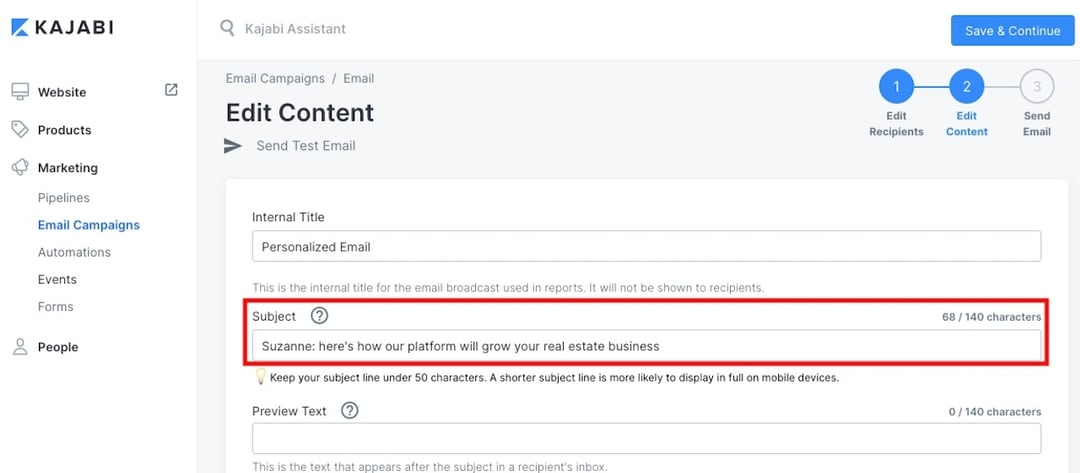
In addition to helping users “sell their knowledge,” so to speak, Kajabi’s toolkit includes a website builder, email marketing software, sales funnel software, a payment gateway, as well as analytical tools to help creators determine the best sales strategy. Essentially, Kajabi aims to be an all-in-one platform for users by consolidating the necessary tools to run a video education business.

“That [software] toolset, historically, has been really fragmented,” Khan added. “You use X for your website, use Y for your [products] and use Z for your checkout. What Kajabi does is consolidate all that stuff into one easy-to-use platform…it’s a lot simpler to have it under one roof, and also a lot cheaper to have it under one roof.”

In 2022, Kajabi launched a built-in live video feature with a recording capability, so creators can virtually meet face-to-face with their clients and have the recorded sessions automatically emailed to them. The company also acquired the community platform Vibely last year to roll out Kajabi Communities, where creators can chat with their followers (or students) in real-time as well as have live calls, challenges, leaderboards and more.

The company plans to venture into the mobile world and eventually launch creator-branded apps, Khan told us.

The most enticing part about Kajabi is that users keep 100% of their earnings. That being said, Kajabi charges a pretty penny for its subscription plan, which has three pricing tiers: Basic ($149/month), Growth ($199/month), and Pro ($399/month). There’s also a 14-day free trial.

For comparison, the online course platform Thinkific also has a 0% transaction fee yet offers plans that range from $49, $99 and $199 per month. However, Kajabi claims to have more in-house marketing tools than Thinkific, such as the ability to build out sales funnels, create blogs and use email marketing that includes built-in features like autoresponder, Customer Relationship Management (CRM), templates for email campaigns and more. Kajabi also offers a mobile app whereas Thinkific has yet to launch one.
While some creators continue to rely on ads or brand deals to make money, other creators are turning to additional sources of income like online education, a market that was valued at $30 billion in 2021. According to Custom Market Insights’ recent market research study, the online education market size and share value are expected to reach about $200 billion by 2030.

Notable content creators that have signed up for Kajabi include YouTubers Matt Steffanina, a dance choreographer, and Cassey Ho (Blogilates), a fitness instructor that specializes in Pilates workout videos. Steffanina and Ho have approximately 30 million and 10 million followers, respectively, across social platforms.

“[Kajabi] allowed us a place to put content where the rules will never change… ideally, you want to have an element of social platforms that’s also providing an income because, at the end of the day, you never know when the algorithm or the rules are going to change. And that’s something that I’ve learned over the years, as there were times when I was making most of my income from YouTube…and now, it’s Kajabi,” Steffanina shared in a statement.

Lesser-known creators have also found success with Kajabi. For instance, Wendy Conklin joined in 2019 with a DIY chair upholstery course. At the start, she had 114 students and earned $34,000 in one week, Conklin told TechCrunch. “I got close to $100,000 in the first year of opening and closing that first course,” she added.

Since then, Conklin has launched various other courses and founded her business, Chair Whimsy. Currently, she teaches more than 7,000 students and has made a total of over $1.5 million on Kajabi.

Kenny Keller, a certified helicopter flight instructor, launched his company in Kajabi in 2012. Helicopter Online Ground School (HOGS) provides training videos to people that want to become helicopter pilots. Keller has earned over $2 million in revenue with Kajabi and has more than 5,000 customers. HOGS has 37,000 YouTube subscribers.

The average Kajabi creator makes about $40,000 in annual income, according to the company, with one in three full-time content creators earning over six figures a year. Kajabi claims that most users who have reached $100,000 in revenue have a minimum of 400 customers on average.

Online education platform Kajabi helps creators earn money for sharing their expertise by Lauren Forristal originally published on TechCrunch




Is generative AI really ready for the enterprise?

Is generative AI really ready for the enterprise?

OpenAI released ChatGPT just a few short months ago, and it’s fair to say that it took the world by storm: It has over 100 million active users already. No wonder, when it can generate human-like, grammatically correct responses. Related technologies can also produce artwork and code by entering a description of what you want, and the tech produces it.

You can even interact with the AI after your initial question, so if you don’t like the output you got or need clarification, you can ask additional questions or make adjustments to your picture or code, so it more closely matches your vision. All of this happens instantly without the help of a subject expert, an artist or a coder.

But none of this comes without issues, which include the sourcing of the data used to train the underlying AI model, the currency of that training data, a lack of permissions to use the source data, bias in the model and, perhaps most importantly, the accuracy of the responses, which are sometimes laughably wrong.

None of this has stopped enterprise software companies from taking the generative AI plunge. These companies see massive commercial potential and a lot of enthusiasm from users and they clearly don’t want to get left behind.

Salesforce, Forethought and Thoughtspot all recently announced betas of their own flavors of generative AI. Salesforce is adding generative AI across the platform. Forethought is aiming at chatbots and Thoughtspot wants to use AI for data querying. Each company took the base technology and added some algorithmic boosters to tune the tech for their platform’s unique requirements.

Microsoft also announced that its OpenAI service aimed at enterprise users on Azure is generally available as a managed service.

Throughout this year you can expect to see many more companies joining in, but the limitations are real, which makes us wonder: Is the technology — as early and raw as it is, no matter how cool it looks on its face — really enterprise ready?

Is generative AI really ready for the enterprise? by Ron Miller originally published on TechCrunch



Web of lies: Web3 isn’t the security fix-all you think it is

Web of lies: Web3 isn’t the security fix-all you think it is

Advocates of web3 will tell you that the decentralized web brings greater resilience and security compared to Web 2.0 thanks to its underlying blockchain-based technology.

Web 2.0, which first debuted in the early 2000s with a focus on user-generated content, rich user interfaces and cooperative services, also brought with it a new wave of security threats, including malware, phishing, social engineering, spoofing, cross-site scripting, SQL injection and data breaches, to name just a few.

Web3, a term encompassing several technologies such as cryptocurrencies, NFTs and DAOs, certainly gives the impression that it will make such threats a thing of the past: Not only does web3 give people more control over their data, but it relies on distributed technologies, such as blockchain, to smooth out the many flaws of its predecessor.

In reality, however, web3 is no more secure than Web 2.0, and it’s already creating a new playground for opportunistic cybercriminals. That’s because although it represents a shift in what the internet can do and will be used for, it doesn’t change how the internet fundamentally works.

New and unimproved

While it promises to be fully decentralized, web3’s user-facing components mainly operate on Web 2.0 technology, such as APIs and endpoints, despite being built on blockchain technology. This means that users of web3 services and decentralized apps, or “dApps,” continue to rely on legacy technologies for making transactions and ultimately means that web3 is vulnerable to all of the classic security issues that plagued its predecessor, from DNS hijacking to cross-site scripting. Web3 companies also have to communicate with their users, mostly through Web 2.0 technologies such as email or online messaging that are also prone to legacy security issues.

Web of lies: Web3 isn’t the security fix-all you think it is by Carly Page originally published on TechCrunch



Synthesis Institute collapse is a major setback for US psychedelic therapy

Synthesis Institute collapse is a major setback for US psychedelic therapy

The Amsterdam-based psychedelic retreat and practitioner training provider Synthesis Institute has filed for bankruptcy in the Netherlands, Willamette Week reported this week, leaving almost 300 students enrolled in its psilocybin facilitator training course in Oregon with an uncertain future.

Founded in the Netherlands in 2018 by Myles Katz and Martijn Schirp, Synthesis Institute sought to bridge the gap between clinical and more wellness-oriented psychedelic therapies, which are used to help tackle depression and anxiety and has shown promise to help treat other mental health ailments. Its flagship center just outside of Amsterdam offered three- or five-day retreats at roughly $1,000 per day. The company started expanding to the North American market in 2021, and Synthesis planned to establish a psilocybin service center and facilitator training program. It secured $7.25 million in Series A funding in September 2021, with an unusual company structure in the form of a Steward-Ownership organization.

However, the expansion project did not come together as expected. In June 2021, a company owned by Katz bought Buckhorn Springs, a 124-acre property in Jackson County, Oregon, for $3.6 million. The intention was to use Buckhorn Springs as a psilocybin service center, but it fell foul of Jackson County’s zoning regulations. As Buckhorn Springs sits in a resource zone, not a commercial zone, the county’s Land Development Ordinance deemed that it couldn’t be used as a psilocybin service center. This came after a 2022 vote in Jackson County that could have prevented companies from establishing psilocybin centers in the jurisdiction.

While the retreat might have met with bureaucratic roadblocks, Synthesis’ psychedelic practitioner training program was one of the first approved by the state of Oregon. The first students to embark on the Psychedelic Practitioner Core Training program did so in November 2022. The course was due to take 13 months and had an upfront cost of just under $10,000.

Companies fail every day, for myriad reasons. Whether it’s a centuries-old and well-respected department store, a tech startup or a psilocybin facilitator training and retreat organization, bad management, bad trading conditions, bad decisions or just bad luck can take a business under. But in the case of Synthesis, the ramifications of its collapse could have a destabilizing impact on the nascent commercial psychedelics community as a whole.

Synthesis Institute collapse is a major setback for US psychedelic therapy by Haje Jan Kamps originally published on TechCrunch


Saturday, 11 March 2023

A 10-step playbook for founders with Silicon Valley Bank accounts

A 10-step playbook for founders with Silicon Valley Bank accounts

Yesterday, the U.S. experienced its second-largest bank failure in history. In the technology world, Silicon Valley Bank (SVB) was one of the largest banks supporting small businesses, but today, tens of thousands of depositors are unable to access capital.

This is not the first time I’ve witnessed a funding crunch. I’ve been building technology businesses for more than 20 years: 15 years in software/internet and five in advanced hardware. Previously, I founded Archer Aviation, which went public in 2021 for $2.7 billion. Prior to that, I founded Vettery, which was acquired for $110M.

While I hope for the best, it’s important for founders and CEOs to plan for the worst. This will be the weekend that differentiates a good entrepreneur from a bad one.

In 2020, when COVID-19 hit, I was raising my Series A for Archer and the venture funding environment completely ground to a halt. Within 48 hours, every single meeting I had was canceled.

While I hope for the best for companies banking with SVB, it’s important for founders and CEOs to plan for the worst. This will be the weekend that differentiates a good entrepreneur from a bad one.

Here is a 10-step playbook for founders and CEOs that can increase your company’s odds of success:

1. Get to the office

This weekend, you are in the war room. Spend the time building a thoughtful plan based on the many scenarios that could play out. It’s best to prepare for the worst, stay calm, and execute with precision.

The goal of this session is to thoughtfully document a plan that will extend the cash runway, establish talking points for employee communication, and identify any levers you can pull immediately to conserve cash.

2. Build an internal three-person tiger team

This team should consist of the CEO, financial leadership, and folks who lead overall product and people operations. Small teams make it easier to communicate and move quickly but a mentor who has experience navigating business cycles like this one could also be helpful.

The goal of this team is to extend remaining cash on hand for at least 30 days with the hope that uninsured depositors will see high recovery rates quickly. The longer your runway, the higher your odds of success.

3. Start communicating with investors now

In case you need more capital than the Federal Deposit Insurance Corporation (FDIC) insures, get in touch with current investors and be transparent about your SVB exposure. Be direct: ask if they are in a position to wire cash to cover your capital needs, even if it means with no terms in place.

I would also start building a list of every non-current investor in my network and be prepared to make contact with them on Monday morning. Work to track all of this so you can stay organized in case deposit settlements take several weeks.

You will find that good investors will step in to help because they understand that this situation will not last forever. Your ask is to get them to lend new money or buy deposit claims outright. If things go south, you don’t want to be one of 40,000 companies calling investors on Monday.

A 10-step playbook for founders with Silicon Valley Bank accounts by Walter Thompson originally published on TechCrunch


Brex CEO is trying to raise over $1 billion in a weekend for SVB-related bridge loans

Brex CEO is trying to raise over $1 billion in a weekend for SVB-related bridge loans

Brex CEO Henrique Dubugras is currently working to raise over a billion dollars in a weekend to help fund an emergency bridge credit line that he believes will help startup customers impacted by Silicon Valley Bank’s collapse be able to make payroll next week. Dubugras declined to comment on how much capital has been committed for the credit line thus far, but said he’s on back to back calls trying to get funds locked down.

“We’re working with a lot of lenders this weekend, to basically raise as much money as we can afford,” Dubugras said. So far, over $1.3 billion of payroll loan requests has been made from over 500 applicants. “The same people who are requesting the $1 billion have around 10 billion in aggregate deposits [at SVB].

The founder says demand is increasing every five minutes. And while Dubugras said that the final close is “TBD” he said it’s “very likely” they will close some capital.

One question is if the terms of the deal will be favorable to founders, or, as one entrepreneur ominously suggested to me today, will the sharks come out?

Brex is not disclosing the terms of the deal but said that they are not making money on these loans. “That’s where we’re working through to kind of get what the right rate is, but think about it this way: there’s not a lot of information right now and coming up with over a billion dollars in a weekend, it’s no easy feat,” Dubugras said. “So you know, I think that we’re just trying to see if we can figure something out that works for everyone and create an option.”

Another question is on the quality of applicants. As one founder told TechCrunch yesterday, onboarding an influx of people “is the easiest way to invite fraud and get kicked out of the banking ecosystems.” Dubugras said that the quality of SVB’s customer base is “pretty good.”

“Most of the customers that we’re getting are real startups that had real businesses with real deposits – and they’re connecting the data to their SVB account that had real money in it,” he said. “We’re verifying that these customers are real customers for sure – that is not what I’m worried about.”

“I hope that the lesson for the industry is not, hey, if it’s a bank that is not JP Morgan, it’s unsafe. I think that will be terrible for our ecosystem and for America,” he added. The lesson instead, Dubugras thinks, is for founders to distribute their risk. “I think the safest place in my view for your money is not a bank account, it’s in a money market fund, and a cash management account, so that’s why do we do this at Brex.”

While Dubugras focuses on raising and asserts that Brex is operationally ready for this and isn’t trying to make money off desperate founders, the company will have to prove they can pull this off. 

As SVB fell, Brex was looked at as a formidable competitor seeking to benefit from the shifting of funds. Sure enough, sources tell TechCrunch that fintech was getting billions of dollars in deposits. Then SVB closed the wires, and hours later, was seized by the FDIC.

“The reason we’re doing it is obviously we want to support a community, that’s very important,” Dubugras said. “The business reason we’re doing this is because we’ll fund these loans and our business accounts, and we hope people stay our customers right after that.”

Dubugras isn’t the only tech executive rallying others to help extend loans to founders. Another CEO is working to raise money for an emergency fund for climate specific startups, while others are looking at ways to create funding sources for historically overlooked and marginalized groups of founders.

If you have a juicy tip or lead about happenings in the SVB fall out, you can reach Natasha Mascarenhas on Twitter @nmasc_ or on Signal at +1 925 271 0912. Anonymity requests will be respected.  

Brex CEO is trying to raise over $1 billion in a weekend for SVB-related bridge loans by Natasha Mascarenhas originally published on TechCrunch


For fintechs in 2022, the bigger the exit, the larger the decline in value

For fintechs in 2022, the bigger the exit, the larger the decline in value

While the public market correction has been widespread, tech and fintech stocks have seen the largest declines, according to a recent report.

Specifically, the Fintech Index — which tracks the performance of emerging, publicly traded financial technology companies — was down a staggering 72% in 2022, according to F-Prime Capital’s State of Fintech 2022 report. After hitting a peak of $1.3 trillion in late 2021, the F-Prime Fintech Index slid to $397 billion by the end of 2022.

Currently, the Fintech Index comprises 55 companies across B2B SAAS, payments, banking, wealth and asset management, lending, insurance and proptech.

“The biggest shift in 2022 was that public investors for the first time got to weigh in on fintech stocks,” said David Jegen, managing partner of F-Prime Capital. “That was probably not super great timing considering the broad macroeconomic impact on tech.”

The fact that so many fintech companies even went public was a big deal in and of itself, Jegen said. “We had 10 years of exciting fintech disruption, all of it led by private investors,” he said. “So 2021 was huge because the IPO window was open when we had a really mature cohort of fintech companies.”

Indeed, 75 fintech companies went public in 2021, meaning 2022 was the first year that F-Prime could even put together a Fintech Index.

Notably, the decline was especially pronounced for the 10 largest exits during the peak years of 2020-2021. In other words, the bigger the exit, the larger the decline. The cumulative market cap decline for the top 10 recent exits totaled over $220 billion; Coinbase, NuBank, Robinhood, SoFi, Affirm and Wise all saw their valuations tumble.

For fintechs in 2022, the bigger the exit, the larger the decline in value by Mary Ann Azevedo originally published on TechCrunch


Bitcoin and the Lightning Network are moving payments globally

Bitcoin and the Lightning Network are moving payments globally

Welcome back to Chain Reaction, a podcast diving deep into the stories, backgrounds and latest news with the biggest names in crypto.

For this week’s episode, Jacquelyn interviewed Jack Mallers, the founder and CEO of Strike, a bitcoin-based payment network and financial app that is trying to expand the reach of cross-border payments and remittance markets.

Last year, Mallers’ company raised $80 million in a Series B round to grow into that space, and today counts major companies like Visa, Clover and Fiserv among its partners.

“I think it’s about meeting consumers where they are and solving a problem for them,” Mallers said.

Mallers is also the CEO of Zap, a bitcoin investment and payments company that transacts on the Lightning Network, which is a second layer on Bitcoin’s blockchain that allows for off-chain transactions between parties.

“We’re a business involved with Bitcoin but we don’t care about its price,” Mallers said. “We use Bitcoin and the Lightning Network for payments, so we’re actually using Bitcoin, the instrument, to move value around the world. But our customers spend and receive dollars, or spend and receive euros, or spend and receive stablecoins.”

The service works if Bitcoin is $1 or $1 million, Mallers said. The business isn’t reliant on the price but is “using it as a technological innovation in the world of payments.”

We discussed Mallers’ backstory, how he got into the Bitcoin scene as a young adult, whether the Lightning Network could be better than the payment networks that exist today and how big players can enter the space. This episode was heavily focused on Bitcoin, so buckle up.

We also dove into:

  • Lightning Network’s global potential
  • El Salvador’s adoption of Bitcoin
  • Creating new infrastructure to make Bitcoin more accessible
  • The future of the Strike and Bitcoin ecosystems

“I do think Lightning will serve as the single value transfer protocol for the earth,” Mallers said. “But, I think, as we evolve in the early innings of this journey, the lowest-hanging fruit is: how do you get fiscal value across planet earth? That’s why we start there and focus there.”

Chain Reaction comes out every other Thursday at 12:00 p.m. PT, so be sure to subscribe to us on Apple Podcasts, Spotify or your favorite pod platform to keep up with the latest in web3 and crypto.

Bitcoin and the Lightning Network are moving payments globally by Jacquelyn Melinek originally published on TechCrunch


Silicon Valley Bank collapse is impacting many Indian startups

Silicon Valley Bank collapse is impacting many Indian startups

The sudden collapse of Silicon Valley Bank, which served as lifeblood for startups, is also impacting firms 8,000 miles away.

Dozens of young Indian startups backed by the likes of YC, Accel, Sequoia India, Lightspeed, SoftBank and Bessemer Venture Partners banked with Silicon Valley Bank, sometimes as their only banking partner, and couldn’t take out the money on time, multiple people familiar with the situation said.

VCs are cautious divulging the names of the impacted startups out of fear that it would impact the young firms’ prospects of raising capital in the future. Regulators stepped in Friday to shut down Silicon Valley Bank, the 16th largest in the U.S. and the bank for most startups.

Some Indian firms couldn’t timely move their funds from Silicon Valley Bank because they didn’t have another US banking account readily available, many venture capitalists recounted.

Many Indian startups are incorporated in Delaware to make it easier for them to raise capital from U.S. venture firms such as Y Combinator. Some SaaS firms are registered in the U.S. because even as they operate from India, they want to serve the international markets and want to be seen as a US-firm.

And for many firms that “flipped” their home base from to the U.S. from India, Silicon Valley Bank was the preferred choice, another person familiar with the matter said, pointing to many events sponsored by SVB.

Nearly all Indian SaaS startups with large presence in the U.S. banked with Silicon Valley Bank, a partner at one of the top venture funds said. Over a dozen Indian SaaS unicorns and many more “soonicorns” are headquartered in the U.S.

Many of these young firms did not diversify their funds into multiple banks because in the early days it’s usually not feasible to increase admin and operating costs.

A U.S.-based investor, who requested anonymity speaking candidly, said he knew for a fact that many Indian firms had about $4-10 million parked in their SVB accounts. A group of Indian YC founders polled members about their exposure to SVB and reported that more than 60 firms had over $250,000 parked in SVB, according to results seen by TechCrunch.

Indian SaaS startups and otherwise those backed by YC who set up their companies in the U.S. and raised their maiden round there often had SVB as their default bank, Ashish Dave, India head of Mirae Asset, tweeted. “Uncertainty is killing them. Growth ones are relatively safer as they diversified.”

Garry Tan, the president of Y Combinator, said more than a 1,000 YC-backed startups are impacted by the collapse of Silicon Valley Bank. “30% of YC companies exposed through SVB can’t make payroll in the next 30 days,” he tweeted.

The story will be updated as we learn more.

Silicon Valley Bank collapse is impacting many Indian startups by Manish Singh originally published on TechCrunch


Flutterwave’s troubles in Kenya yet to end as second case proceeds

Flutterwave’s troubles in Kenya yet to end as second case proceeds

Africa’s most valuable unicorn Flutterwave is still not off the hook in Kenya. About $3 million of its money that was confiscated in the second government seizure over money laundering and fraud claims remains frozen, in two banks, and 19 mobile money accounts (M-pesa paybill numbers), as the matter is before Kenya’s high court.

The $3 million funds seizure happened late August last year, less than two months after Kenyan court froze $52.5 million from Flutterwave and other entities including Elivalat Fintech, Boxtrip travel and tours, Bagtrip travels, Hupesi Solutions, Cruz Ride Auto Ltd, and Adguru.

With each seizure, the country’s Assets Recovery Agency (ARA), a state agency tasked with tracing proceeds of crime, filed a suit.

The initial case was closed last week and $52.5 million released, after the ARA formally withdrew the case. The second case, where Flutterwave, Adguru and Hupesi solutions are the respondents, however, continues. High court judge Esther Maina yesterday set the next mention for March 23.

While some parties predict that the case is unlikely to proceed to full hearing, Flutterwave’s remains uncleared by the courts, delaying its prospects of getting a license to operate in Kenya.

What has happened so far

Funds released after first case closes but Flutterwave’s still frozen

The court released the funds belonging to Flutterwave and its co-accused after the ARA formally withdrew a forfeiture application against all of them on February 27 this year, bringing the first case to an end.

TechCrunch is, however, privy to information that although the Kenyan court released the funds after the close of the initial case, the fintech had yet to access the funds by Friday — yet some parties in the case had accessed their funds. It was not immediately clear why the fintech could not access its funds, and efforts to get a comment from Flutterwave on this were unsuccessful.

The releasing of the funds came after the Kenyan court, earlier in February, threw out an application by 2,468 Nigerians who sought to have part of the frozen funds separated in the event that the money was forfeited to the government. The individuals sought to recover funds they had ‘invested’ and lost through a sports betting platform, which they claim was a false investment and trading scheme that used Flutterwave to process its payments.

The court threw out the application on February 9 on grounds that the ARA had filed to withdraw the forfeiture application in December last year, nearly a month after it applied to have Boxtrip Travel and Tours, and Bagtrip travels expunged from the proceedings.

The genesis

Flutterwave’s woes in Kenya started in July last year when it was accused by the ARA of fraud and money laundering ARA, leading to the freezing of millions of dollars in accounts linked to the fintech and its co-accused.

The agency said that Flutterwave’s bank accounts were used as conduits for money laundering under the guise of providing merchant services, and that the fintech had no evidence to corroborate retail transactions from customers paying for goods and services. It added that there was no evidence of settlements to the alleged merchants. The agency has petitioned the court to have the money forfeited to the government.

However, a turnaround has been noted after a new government took office late last year, dropping some high-profile cases including the one against the Flutterwave.

Founded in 2016 by Iyinoluwa Aboyeji, Olugbenga “GB” Agboola (CEO), and Adeleke Adekoya, Flutterwave facilitates cross-border payments in Africa, has a remittance service that allows users to send money to recipients to and from the continent. Its services also includes Flutterwavestore service, a shopify-like e-commerce platform, for small businesses.

The fintech, which raised $350 million last year at a $3 billion valuation, making it one of the most valuable startups in Africa, has faced a string of controversies over the last year including claims of harassment, funds misappropriation, and mismanagement.

Flutterwave’s troubles in Kenya yet to end as second case proceeds by Annie Njanja originally published on TechCrunch


Friday, 10 March 2023

Daily Crunch: Silicon Valley Bank goes bust — regulators take control of $175B+ in deposits

Daily Crunch: Silicon Valley Bank goes bust — regulators take control of $175B+ in deposits

To get a roundup of TechCrunch’s biggest and most important stories delivered to your inbox every day at 3 p.m. PST, subscribe here.

Hi, Crunchers,

Today, there’s only one story on everyone’s lips: The sudden and dramatic collapse of Silicon Valley Bank (SVB), the 40-year-old Silicon Valley institution. With $209 billion of assets under management at the time of its failure, it’s the second-largest bank failure in U.S. history.

A huge number of startups suddenly found themselves in a pickle as the bank went through a Swift-Velocity Breakdown. In this special edition of the Daily Crunch, we summarize what the Sudden Value Bust means across the industry.

Haje

The TechCrunch Top Story

  • Regulators stepping in: Natasha M reports that the bank and its 17 branches were closed by the California Department of Financial Protection and Innovation. The agency appointed the Federal Deposit Insurance Corporation (FDIC) as receiver.
  • So, er, what happened?: (TC+): Alex can be trusted to provide the context, and concludes that it seems like the rumor of SVB being in trouble caused a run on the bank, which put it in actual trouble soon after.
  • What the founders think: Several of my colleagues took to the (virtual) streets and got the lowdown on how founders are reacting to the bank’s collapse.

The demise of Silicon Valley Bank

Before the bank got shut down by regulators, a lot of things happened very quickly:

Building a lean B2B startup growth stack

Hand of a scientist with a syringe injecting liquid to a plant, in an experiment.

Image Credits: Jose Bernat Bacete (opens in a new window) / Getty Images (Image has been modified)

Selecting the right tool for the job is easy when you already know exactly how to proceed.

Most B2B growth marketers don’t have a blueprint to work from, however, which is why Primer CEO Keith Putnam-Delaney shared a guest post with TC+ that identifies which tools are most appropriate for early-stage, midstage and late-stage startups.

“The current budget-constrained environment should be seen as a net positive by marketers,” he writes. “It will force teams to think deeply about what’s absolutely necessary, which tools will add efficiency (or subtract from it).”

TechCrunch+ is our membership program that helps founders and startup teams get ahead of the pack. You can sign up here. Use code “DC” for a 15% discount on an annual subscription!

And some other news too

Okay, fine, there were other things happening besides SVB going straight to hell without passing “go” today as well. Here’s a smattering of things worth reading across the rest of the site…

A lot of news in cybersecurity today, as Carly reports that the SEC charges Blackbaud for failing to disclose the ‘full impact’ of a ransomware attackZack writes that Telehealth startup Cerebral shared millions of patients’ data with advertisers; and Zack also reports that PeopleGrove security lapse exposed users’ personal information. Meanwhile, Lorenzo dove in to explore how the FBI proved a remote admin tool was actually malware.

And here are some non-SVB, non-cybercrime headlines for you as well. Aren’t we generous today:

Daily Crunch: Silicon Valley Bank goes bust — regulators take control of $175B+ in deposits by Haje Jan Kamps originally published on TechCrunch


What does the collapse of SVB mean for venture debt?

What does the collapse of SVB mean for venture debt?

Earlier this week, venture investors and startups ran from Silicon Valley Bank, a financial institution that started the week solvent and closed it being shut down by regulators. While its failure affects the accounts of startups and venture investors that banked with it, SVB’s demise also has an impact on another service startups frequently used the bank for: venture debt.

SVB has long been thought of as a venture debt leader, and for many the bank’s name is synonymous with venture lending itself. So how could its collapse affect the increasingly hot venture debt market? It depends on who you ask.

What does the collapse of SVB mean for venture debt? by Rebecca Szkutak originally published on TechCrunch


Meta will stop offering Reels bonuses to creators on Facebook and Instagram

Meta will stop offering Reels bonuses to creators on Facebook and Instagram

Meta is pausing its program to pay bonuses to creators for making Reels and hitting specific benchmarks. The program, originally introduced in 2021, incentivized content makers to generate more short video content. The shutdown will impact all Reels creators on Facebook and U.S.-based creators on Instagram — the Instagram program was only available for creators based in the U.S.

The program’s discontinuation, first reported by Business Insider, indicates that platforms are looking to pull back from paying creators based on the popularity of their short videos. Meta will still respect any commitment for bonuses for 30 days, according to the report.

Meta told the publication that it might reintroduce the program in “targeted” ways if Reels enter a new market. This is a bit strange to hear, given that the short video product is already available in more than 150 countries.

As TechCrunch has reported previously, creators got healthy bonuses under this program. Multiple creators got more than $10,000 in bonuses with some claiming to get even $35,000 in a month. But these creators had to garner millions of views on their Reels, and Meta was happy to distribute money to make the format more popular.

Given that short video is one of the most popular formats on social media today, Meta is probably trying to bank ad money. Last year, it expanded its overlay ads experiment to creators in more than 50 countries in addition to displaying in-stream ads. For both these ad formats, the company shares 55% of the revenue with the creators.

Last year, Mark Zuckerberg said that Reels have reached a $1 billion annual revenue rate. But the company would hope that the format brings more money while it burns cash on the metaverse efforts.

On the investor call for Meta’s Q4 2022 result, Zuckerberg expressed that Reels is not making enough money yet.

“The next bottleneck that we are focused on to continue growing Reels is improving monetization efficiency or the revenue that’s generated per minute of Reels watched. Currently, the monetization efficiency of Reels is much less than Feed. So the more that Reels grows, even though it adds engagement to the system overall, it takes some time away from Feed and we actually lose money,” he said.

As the company is stopping bonuses, creators would need incentives to post short videos on Meta’s platforms instead of TikTok or YouTube Shorts. Facebook has promised to give more monetization tools to creators to earn money on Reels.

“This year, we’re focused on adapting and enhancing these [monetization] tools for short-form video. We’ll continue expanding our ads on Facebook Reels tests to help more creators earn ad revenue for their Reels and grow virtual gifting via Stars on Reels,” Facebook head Tom Alison said in a blog post earlier this week.

But Meta is not an anomaly when it comes to stopping creator bonuses for short videos. Both Snapchat and YouTube Shorts have moved to ad revenue-sharing models instead of splashing the cash on creator funds.

Meta will stop offering Reels bonuses to creators on Facebook and Instagram by Ivan Mehta originally published on TechCrunch


PeopleGrove security lapse exposed users’ personal information

PeopleGrove security lapse exposed users’ personal information

PeopleGrove confirmed Thursday that it’s investigating after a security lapse exposed users’ personal information online.

The company, formerly CampusKudos, which provides and hosts a social platform for higher education institutions and alumni networks, left the server hosting an internal database exposed to the internet without a password, allowing anyone to access the data using only a web browser and knowing its IP address.

The database contained gigabytes of personal information, including email addresses, phone numbers, addresses, details of university achievements and scores, and resumes containing detailed work histories and employment details. The records also contained links to the user’s profile photo.

None of the exposed data was encrypted.

CloudDefense cloud security researcher Anurag Sen discovered the database on Thursday and contacted TechCrunch so we could notify PeopleGrove. The server became inaccessible a short time later.

“The database identified is a database for our development servers,” said PeopleGrove chief technology officer Reilly Davis, when reached by email. “I do know that most of the data in those databases is non-production test data, so we are investigating exactly what data is contained in there, and how any production data was included.”

Davis said an investigation was underway but did not say why the internal database became accessible from the internet. It’s also unclear why the apparent test database contained real people’s information.

TechCrunch verified a portion of the exposed data by matching contact information using public records, social media profiles, and other career social networks like LinkedIn. One user, whose profile said they served as a U.S. intelligence officer, had details of their former top secret security clearance exposed in their user record, along with their home address, personal email address and phone number. Another user, whose information was found in the data but asked not to be named for this story, confirmed to TechCrunch that their exposed information was accurate but could not explain how it had been collected, or by whom.

At the time it was discovered, the database had more than 25 million logs. PeopleGrove’s website says it has more than 20 million users.

PeopleGrove CTO Davis said the company would notify users who “if we do find their sensitive data was exposed.” Davis said the company has logging in place within its Google Cloud environment to determine what data may have been accessed or exfiltrated.

PeopleGrove chief executive Adam Saven, who was copied on the email, did not comment.

PeopleGrove security lapse exposed users’ personal information by Zack Whittaker originally published on TechCrunch


Bird still has a long way to go to reach profitability

Bird still has a long way to go to reach profitability

Shared micromobility company Bird reported a somewhat head-scratching fourth quarter and full year 2022 earnings Friday morning. At first glance, Bird’s earnings show a company that beat Wall Street revenue expectations and is promising free cash flow positivity by the end of this year. But at second glance, that revenue beat isn’t as simple as it seems.

Bird reported revenue of $69.7 million for the fourth quarter of 2022, a big improvement from the $49.5 million reported in the same quarter of 2021. However, that Q4 revenue included $28.8 million of unredeemed preloaded wallet balances collected over the past two years. That means revenue for Q4 is more like $40.9 million — a dip from prior periods.

You might recall that in the third quarter of 2022, Bird reported to the SEC that it had overstated its revenue for the past two years. At the time, the company said it had recorded revenue on certain trips even when customers had lacked sufficient preloaded wallet balances. Bird has also underreported breakage in the past two years, which is the amount of money a customer leaves behind in their preloaded wallet balance. The $28.8 million is Bird’s attempt at playing catch up from those uncounted remainders, and while Bird says it will continue to report breakage as part of revenue in the future, this is pretty much a one-time sweetener to Bird’s top line.

For the sake of keeping things tidy, let’s just deal with the $40.9 million in revenue, which is Bird’s Q4 revenue minus the one-time sweetener. The total cost of revenue for the quarter is reported as $40.25 million, which means Bird barely broke even on a gross profit basis. Additionally, the company’s adjusted operating expenses were $42.3 million, which is a decrease of 29% year-over-year.

Shane Torchiana, Bird’s CEO as of September, told TechCrunch that the merger with Bird Canada in December may have driven up operating expenses slightly. That merger brought Bird around $32 million in new financing, money that Torchiana had previously told TechCrunch Bird needed to raise as part of its overhaul strategy to become profitable.

Another part of that strategy was exiting unprofitable markets. Last October, Bird left dozens of unprofitable markets across the U.S., as well as Norway, Sweden and Germany. Its smaller footprint is one reason the company says its ride revenue is much lighter than last year’s. The company also said the winter months mean fewer riders, and therefore, less revenue.

Revenue isn’t the only thing that’s down from the decreased footprint. Ride volume and rides per scooter fell in Q4 as compared to the same period last year. Bird recorded 8.2 million rides in Q4, which is down from 9.4 million in Q4 2021. For the full year, however, Bird reported a 16% increase in total rides.

However, looking at rides per deployed vehicle per day, Bird is getting less bang for its buck. In Q4 2021, Bird’s scooters got an average of 1.3 rides per day. That number fell to one ride per scooter per day in Q4 of 2022. For the full year, Bird’s scooters got 1.3 rides per day, down from 1.6 rides per day in 2021.

At first blush, the gross transaction value appears to have increased YoY — from $59.5 million in Q4 2021 to $74.8 million in Q4 2022. The company includes that $28.8 million in one-time revenue in its “Reconciliation of Gross Transaction Value to Revenue,”  as part of its gross transaction value. So really, that’s down YoY, as well.

Finally, as of December 31, 2022, Bird has $33.47 million in unrestricted cash and cash equivalents. At the end of 2021, the company had $128.56 million in cash. That money may not be enough to see Bird through to the end of 2023, and indeed the going concern warning the company issued last quarter is still very much in effect.

What Bird says about all this

Bird says despite all of this it is still focusing on profitability. The company aims to reach adjusted EBITDA this year in the range of $15 to $20 million, get to positive cash flow of $5 to $10 million, and bring its adjusted operating expenses down below $100 million. (Keep in mind in Q2 2022 alone, Bird’s operating expenses hit $225 million.)

“Obviously we’re in the midst of a transformation, and those numbers don’t fully flow through in Q4,” said Torchiana, who took over as CEO in September and has since implemented a new strategy of cutting costs and increasing asset efficiency. “You’ll see a lot more of the cost reductions [from the past few months] in Q1 [2023].”

Bird also said it hopes to see a 10% to 20% improvement in asset utilization, starting in Q2, as a result of rolling out a new drop engine that has a more data driven approach to where the company places its vehicles and when it rebalances vehicles it’s used in the past. Torchiana says this new system is being trialed in certain markets.

Bird’s stock was trading at $0.18 at market close on Thursday. The company received a warning from the New York Stock Exchange last year that its stock was trading too low, and the company has until September to bring the price up to above $1.

“Our expectation is if the markets are rational, we should see our stock price come up as we deliver against that guidance,” said Torchiana. 

Bird still has a long way to go to reach profitability by Rebecca Bellan originally published on TechCrunch


Prosus in talks to sell Olx Autos business in India, other markets

Prosus in talks to sell Olx Autos business in India, other markets

Prosus is actively engaging with multiple players to explore sale of classified business Olx’s Autos unit in several markets including India and Indonesia, according to a source familiar with the matter.

In a statement, the technology investor said pursuit of a global growth strategy for Olx’s automotive business “is no longer the right approach for our shareholders” and that it was exploring “all options for the Olx Autos business.” The firm blamed the ongoing macroeconomic and market challenges for the move.

In India, Prosus has held talks with some of unicorn startup Cars24’s investors to explore the sale of the Autos’ local unit, according to the source. Cars24 counts DST Global and SoftBank among its backers. Those investors have passed on the deal as they shift focus on conserving cash, the source said, requesting anonymity discussing private matters.

Prosus has been scrambling for Olx Autos’ play for years. In early 2021, the firm shut down Frontier Car Group’s Berlin office and shifted focus on Latin America and Asia markets.

Olx Autos increased its revenue by 84% to $1 billion in the first half of its 2022 financial year, Prosus said in November. But Autos is not profitable. Olx said earlier this year that it would cut 1,500 jobs internationally.

“Beyond Olx Autos, the core classifies business in OLX is profitable, cash flow positive, and fast-growing. The exit of OLX Autos will lead to a significant improvement in the profitability profile of the classifies segment as a whole,” Prosus said.

Prosus in talks to sell Olx Autos business in India, other markets by Manish Singh originally published on TechCrunch


Meta is working on a decentralized social app

Meta is working on a decentralized social app

If there is a social media phenomenon getting some kind of popularity, Meta will try and jump in. We have seen the company copy different kinds of formats ranging from Stories to short videos after seeing the success of other platforms. Now, the Mark Zuckerberg-led company is working on a decentralized text-based app.

Meta confirmed this development in a statement but didn’t give out details about when it plans to release the app.

“We’re exploring a standalone decentralized social network for sharing text updates. We believe there’s an opportunity for a separate space where creators and public figures can share timely updates about their interests,” a Meta spokesperson said.

This new decentralized app, codenamed P92, is still under development — as first reported by MoneyControl. According to the documents seen by the publication, the app will let users log-in through their Instagram credentials. This could irk people who might not want to share that data with another Meta app.

A report by Platformer said that the project will be overseen by Instagram head Adam Mosseri. The company is already involving the legal department to sniff out early privacy concerns before the app is public, the report added.

Meta’s move is seen as its attempt to build a Twitter alternative or a Mastodon competitor. The latter gained popularity after Elon Musk took over Twitter. The decentralized network is part of the Fediverse — a network of decentralized servers — that supports the ActivityPub protocol. Meta’s new app also plans to support ActivityPub making it easier to connect with other instances like Mastodon, according to MoneyControl.

There are plenty of other tools that have implemented (or planning to implement) ActivityPub support including Tumblr, Flipboard, and Flickr.

But decentralization is not limited to this protocol. Jack Dorsey-backed Bluesky launched its iOS app in beta last week. And messaging apps like Rocket.chat have embraced the Matrix protocol.

However, former Twitter engineer Blaine Cook told TechCrunch last year that the existence of competing protocols is a good thing.

“I think the diversity of protocol is important, as is the diversity of the applications built on top of the protocols. That said, I strongly believe that interoperability between ActivityPub and Bluesky won’t be difficult. The only thing preventing, for example, interoperability between Twitter and Facebook’s timeline has been protectionist policies by those companies,” he noted.

It’s important to remember that Meta has tried making new apps and experiences that haven’t always taken off. In the past few years, it has killed experiments like the anonymous teen app tbh, Cameo-like app Super, Nextdoor clone Neighborhoods, couples app Tuned, student-focused social network Campus, video speed dating service Sparked, and TikTok clone Lasso just to name a few. So it won’t be surprising if the new decentralized experience shuts down in a couple of years after the launch.

Meta is working on a decentralized social app by Ivan Mehta originally published on TechCrunch


Thursday, 9 March 2023

Some SVB customers are struggling to wire funds out of the bank

Some SVB customers are struggling to wire funds out of the bank

Some of Silicon Valley Bank’s customers are struggling to transfer funds out of their bank accounts, numerous sources tell TechCrunch.

The seeming wave of attempted withdrawals comes after SVB announced yesterday that it lost $1.8 billion in the sale of U.S. treasuries and mortgage-backed securities that it had invested in, owing to rising interest rates. The bank also said that it was raising more capital, and investing into higher-yield products. Concern ensued, leading the share price to tank more than 50% at time of publication.

Dozens of VCs are advising their portfolio companies to pull their assets from the bank, sources say, while others are pushing for founders to at least diversify where they hold their capital. Others, meanwhile, warn that the panic is coming too early — perhaps from earlier news this week that Silvergate, another bank, is shutting down. SVB as a result is clearly experiencing deposit volatility from a subset of its users.

One source tells TechCrunch that parts of the SVB site is down, as well as one of its client support phones, despite using different browsers and apps to try to move their capital. Another says that account access controls are now view only, meaning that users cannot conduct withdrawals or wires. Others on Twitter say that they’re unable to log into the online banking portal at large.

One VC tells me that, because the website is down, portfolio founders are at SVB bank branches currently asking for cash to be released.

In a call earlier today, CEO Greg Becker told clients that said the bank has “ample liquidity” to support its clients “with one exception: If everybody is telling each other that SVB is in trouble, that will be a challenge.” The executive asked VC clients to “stay calm. That’s my ask. We’ve been there for 40 years, supporting you, supporting the portfolio companies, supporting venture capitalists.”

If you have a juicy tip or lead about happenings in the venture world, you can reach Natasha Mascarenhas on Twitter @nmasc_ or on Signal at +1 925 271 0912. Anonymity requests will be respected. 

Some SVB customers are struggling to wire funds out of the bank by Natasha Mascarenhas originally published on TechCrunch


Crypto-friendly bank Silvergate to wind down after FTX blow-up

Crypto-friendly bank Silvergate to wind down after FTX blow-up

Silvergate Capital Corporation, the holding company of crypto-focused Silvergate Bank, announced Wednesday its intent to wind down operations and voluntarily liquidate the banking unit.

The move came days after Silvergate shocked the industry with news that it was facing a financial crisis. The institution, which was one of the few banks that acted as an intermediary in the space of institutional crypto, is yet another victim of the “crypto winter” following the implosion of FTX, which used the bank to transfer customer funds.

The bank was founded three decades ago in California as a small local lender, but in recent years, it had soared to become a key player in the crypto industry. Its fortune also rose and fell with market volatility. As token prices boomed, deposits at Silvergate surged from around $2 billion in 2020 to over $10 billion in 2021. But by the end of 2022, its deposits slumped to $6.3 billion, a decrease of over 50% from just three months earlier.

At the time of FTX’s collapse last fall, Silvergate tried to reassure investors and regulators that its exposure to the digital assets exchange was limited.

“As of September 30, 2022, Silvergate’s total deposits from all digital asset customers totaled $11.9 billion, of which FTX represented less than 10%. Silvergate has no outstanding loans to nor investments in FTX, and FTX is not a custodian for Silvergate’s bitcoin-collateralized SEN Leverage loans. To be clear, our relationship with FTX is limited to deposits,”  Alan Lane, Silvergate’s CEO, wrote in a statement in November.

But the government looked elsewhere. U.S. prosecutors in the Justice Department’s fraud unit were investigating Silvergate’s dealings with FTX and Alameda Research, Bloomberg reported in February.

The shutdown of Silvergate will deal a big blow to how money moves in and out of the crypto world. On March 3, the bank announced it would discontinue the Silvergate Exchange Network (SEN), its crypto payments network that enabled dollar transfers between investors and crypto exchanges 24/7. The volatile nature of cryptocurrencies means very few financial institutions want to touch crypto.

It looks like Silvergate’s customers are at least getting their deposits back. As the company said in its latest statement:

“In light of recent industry and regulatory developments, Silvergate believes that an orderly wind down of Bank operations and a voluntary liquidation of the Bank is the best path forward. The Bank’s wind down and liquidation plan includes full repayment of all deposits. The Company is also considering how best to resolve claims and preserve the residual value of its assets, including its proprietary technology and tax assets.”

Crypto-friendly bank Silvergate to wind down after FTX blow-up by Rita Liao originally published on TechCrunch


Wednesday, 8 March 2023

Envisics raises $50M at a $500M valuation for its in-car holographic tech

Envisics raises $50M at a $500M valuation for its in-car holographic tech

The automotive industry is starting to show some signs of recovery after a big contraction during the Covid-19 pandemic, and carmakers planning for the next five years are looking at what new features might help them eek out more sales. Envisics — a U.K. startup that designs holographic in-car technology that projects navigation, safety alerts and other data on the inside of the windscreen (commonly described as heads-up display, or HUD) — is today announcing $50 million in funding, as it vies to be a part of that conversation.

The funds will be used both to carry out work with current customers on Envisics’ existing holographic technology, with customers including GM; and to continue developing the next generation of the platform, which Dr. Jamieson Christmas, the founder and CEO, says come in a smaller form factor that will make it possible to build into cars of all sizes (and price points), and with more enhanced video capabilities.

“Our next-generation technology unlocks much more of the holographic potential,” he said in an interview. “We really are on the path to delivering that Star Wars vision of the world, with [in-car] 3-D volumetric experiences.”

This latest funding, which more specifically is being described as “over” $50 million, is coming from a raft of strategic backers that include Hyundai Mobis, InMotion Ventures (the investment arm of Jaguar Land Rover, and Stellantis. Envisics says it is “part of” a Series C. Even with the current clouds hanging over the market, Milton Keynes-based Envisics confirmed to us that it is still in talks with other investors to raise more.

Yet the $50 million being announced today has already driven up the valuation of Envisics to $500 million — double the $250 million valuation Envisics had in 2020, when it raised $50 million in a Series B. (That round that also included Hyundai Mobis, alongside General Motors Ventures, SAIC Motors and Van Tuyl Companies — the family office of the Van Tuyl Group, which specializes in automotive dealerships and related services. All of these remain shareholders, Envisics said.)

Envisics has been carving out a solid place for itself among auto manufacturers. Christmas told us in an interview that Envisics is “working with just about everybody” at the moment, although he declined to give names beyond Jaguar Land Rover, which was the first OEM customer for Envisics’ technology; and GM, which has confirmed that its Lyriq electric Cadillacs will integrate Envisics’ second generation displays.

But all the same, the startup is facing market challenges on two fronts. We are in an era where we have seen many automotive technology plays stall or run out of gas altogether. Be it shut downs of high profile efforts like Argo AI, or small but promising startups like Broadmann17; or more scrutiny for those still standing like Cruise, it feels like nothing has been spared. Equally we have yet to see any great businesses built around augmented reality technology, which includes the HUD market.

Hanging over both industries is the wider economy and the impact that will have not just on more automotive sales, but consumers willing to pay a premium to load in extras like augmented reality displays into new vehicles.

Despite these hurdles, there are some promising signs, too.

The GM deal, for example, is seemingly all coming in on time. Back in 2020, Christmas said that Envisics’ first commercial products would come out in 2023, and Christmas confirmed this week that this is still the plan. The first HUDs are “remarkably, absolutely on track to be released this year,” he said.

While the Lyric will most certainly be a high-end, premium vehicle, it’s a start. The startup has also inked deals with the likes of Panasonic Automotive Systems, the major automotive supplier that is a division of the consumer electronics giant Panasonic, which points to future rollouts across a wider range of models and price points.

As for what is appearing on these HUDs, for the moment, Christmas said that the initial focus — no pun intended — is on need-to-know, rather than nice-to-know, information for the driver: safety, vehicle status and navigation alerts are priorities; alerts for new albums or podcasts dropping on Spotify are not. Overall, it’s still optimizing what the best, and safest, experience might be for drivers.

Although car makers originally thought that drivers would want screens in vehicles that were as big an pervasive as their computers, phones and TVs are today, in fact large displays have started to fall out of favor because they can become too distracting, and often not even necessary, Christmas pointed out. The same goes for HUDs and the real estate that their data would occupy on the windscreen.

Christmas described the question of how much real estate is too much “the single biggest pain point that car companies are facing” when it comes to questions of how to build out interactive, connected experiences for drivers.

“We’re working hard, obviously, to qualify the tech,” he said. The company notes that while AR HUD is still a very small part of the overall OEM market, accounting for just 1.6 million units in 2022, it will grow to 19.1 million by 2032.

In the meantime, strategic backers see investing in Envisics now as a good way to get early access to its technology for when they are ready to deploy it.

“Hyundai Mobis is very pleased to continue our strategic partnership with Envisics to jointly develop AR-HUDs and to improve the in-car experience.” said Younghoon Han, VP and head of electronic control and convenience, Hyundai Mobis, in a statement. “Hyundai Mobis expects to provide next-generation AR-HUDs with cutting-edge holographic technology, and to deliver an intuitive, safe, and convenient HMI to global automakers by strengthening our partnership with Envisics.”

Envisics raises $50M at a $500M valuation for its in-car holographic tech by Ingrid Lunden originally published on TechCrunch